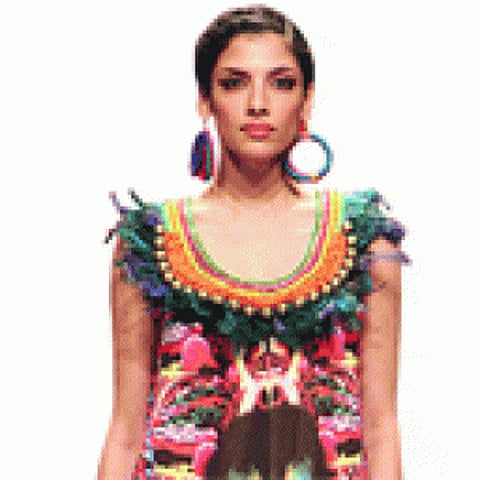

Prints and embroidery inspired by regional culture are getting a high five at the ongoing fashion event. Designers share their encounters with the folk motifs
What Preeti S Kapoor recently showed on the ramp was not something completely out-of-the box, but still her collection that boasted of prints inspired from the tribes Africa, managed to turn heads. It was not the first time that the African tribal prints were used by any designer, but the “good thing with the tribal motifs is that you have a variety of them and each time you can present something different,” said Preeti. The designer spent a good deal of time on research. “I didn’t get into the details of the tribes from Africa, since there was too much. I picked up the popular motifs and vibrant colours like red and black. I created the prints with the help of the tribal motifs and added a few faces to add some quirky element. The bead work done around the yoke area of the dresses was inspired by the jewellery that they wear,” shared the designer and added that the reason why she chose Africa this time was “because all the fashion forecasts for the season are hinting Africa.”
There has never been dearth of designers working with tribal inspirations. Designers like Atsu, who comes from the North East has always used the motifs from his region in an interesting way. His present range is inspired from the 60s and 70s evening dressing style. It has gowns and shimmering dresses made from the hand-woven fabrics. “But if you notice you will find that somewhere in the dresses some stripes are used, that are a common part of saris, dresses or shawls from the North East.
In one of the dresses I have used embroidered Tagopan as the motif. It is our state bird. So in my collection there will always be little things from my region, used in a contemporary way,” said the designer and added that tribal art used in designs has always been a hit with the buyers. Another designer, Jenjum Gadi has used the tribal geometric patterns as the base and has embellished the dresses, following the pattern. His chiffon saris with the multi-colour thread embroidered border will make you believe instantly that the designer has a deep understanding of the tribal culture. “But it is important to do something unique. I have used jardozi aari embroidery and sequin works in the garments, but the pattern will remind you of the tribal motifs. It is easy to justify the price of the garment with embroidery, therefore rather than presenting plain prints, it is always better to give the buyers variety,” said Gadi.
Designer Vaishali S, who hails from Maharashtra and has worked extensively to promote traditional weaves, believes that to make the world aware of our rich legacy in textiles and weaves, we need to present our folk art in contemporary fashion. For her recent collection, Vaishali chose Mekhla chadar from Assam.
“I went to the villages in Assam and worked with local weavers, who have looms at their places. If not engaged in something productive they make and sell rice liquor, which is harmful. So the work gives them employment and I get a chance to explore and learn more,” she said.
Trend of the day
Keep it simple
Simple and easy silhouettes were the order of the day three at the fashion week. Be it Joy Mitra’s maxi dresses or Abraham and Thakore’s collection, the focus remained on simple cuts and fine detailing. Designer duo Abraham & Thakore’s collection included saris, T-shirts, lehenga and skirts etc.
They used hand-woven brocade. Each fabric was specially woven by Ekaya from Benaras. “Benaras brocade is an iconic Indian fabric. We planned this last October and sketching work started late November. Our design inspiration has been taken from the simple intertwining of threads — the wrap and the weft, to create a strong modern geometry of horizontals and verticals,” shared the designers.
Celeb of the day
Bollywood bonanza
Designer Joy Mitra’s collection Abhinaya was an ode to 100 years of cinema. The collection had coin sized pictures of famous stars like Madhubala and Sridevi printed on the garments. Gauhar Khan opened the show and did a little act on Aaiye Meherbaan.