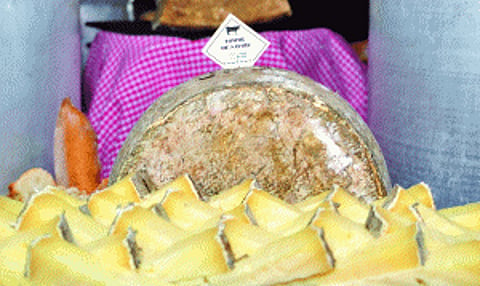

The days of processed cheese are now numbered as laurent Damiens, director CNIEl Communications, is on a mission to bring France’s finest fromages to the city. He tells TEAM VIVA that around 1,000 varieties can be brought here
Are these various varieties of cheese easy to import hereIJ
The Indian market is small right now, so a very small quantity or variety of cheese is available here. You can find Camembert, comte, brie, et al. As the market increases, more and more variety or range of cheese will be available. It is only the beginning with a small market offering different variants. We have around 1,200 types of cheese and even in America we export 25,000 tonnes of 450 varieties but not more. Also, the regulation is very strict so we cannot export everything. Same in India, its going to be a restricted because you would want to have the cheese made of pasteurised milk. The regulation here evolves all the time. Of course, you would not have all kinds of cheese but you would add 25 or 50 or maybe 75 per cent of the French cheese which can be exported.
Eighty-five per cent of cheese is pasteurised so getting the varieties here will not be a problem but some boutique cheeses will be a little difficult to export here. In France, 90 per cent of the cheese is made using non-animal rennet and the rest which is created using animal rennet is what we’ll not be able to bring here keeping in mind the religious sentiments. But we can export 1,000 cheeses so it okay. (laughs)
Did you do a market survey of IndiaIJ Did you see something encouraging about the cheese consumption pattern in this country that encouraged you to do an exposition to educate the massesIJ
We did one last year and what is encouraging is that in main cities like Delhi, Mumbai and Bengaluru, the distribution of cheese is suitable now because you have facilities to refrigerate and have cold storages in many shops and supermarkets. But that wasn’t the case earlier. This is one of the reasons for introducing cheese here.
The second reason is that, when people go abroad and visit different cities in the world, they want to mix their food and create a fusion cuisine which is also happening here and in those cities we’ve seen the quantity of cheese increase. That is why we think it it is a good time to enter the market. You can find Italian cheese like Parmesan, Danish cheese, Montego from Spain, brie and camembert from France, so for European cheeses, it is a good opportunity to start exporting and educating the consumers in maximum of six cities. But never in the countryside because it is more traditional there.
We also try to understand what kind of cheese can be exported because we don’t know what will be suitable for the local palate and how will it mix with the food. It is different in every country so then we have to listen to the chef and recommend fusion recipes. It is a three-year plan which we’ve begun with and there will be demos in supermarkets for people to get a taste of French cheese.
So what is the one takeaway you have from the study of Indian marketIJ What is the Indian market partial to and which French cheeses are they picking up since right now what we get is processed cheeseIJ
No, it is not only the processed cheese. You already have Brie here and also Camembert, there is not much of blue cheese yet but still you get it. You have Danish blue cheese from Denmark. I see a lot of Parmesan from Italy mainly used for pastas. I think the variety of cheese here is very large already. India is into soft cheeses and not used to the hard ones. I was in Bangkok the other day where we held a press conference and tried different kinds of cheeses. I was surprised that many liked the blue cheese which was a little hard to believe especially since they’ve never tried it. Sometimes you’ll think a particular cheese is not suitable but the people would go for it. Even when you go to Japan, they like the blue cheese but consumers in countries like South Korea or China don’t. In countries where you eat a lot of cheese like in France, when you’re young, you’ll like very soft cheese and when you’re around 10-11 years old, you’ll start eating Comte, Camembert and then Brie. Strong cheese like the blue cheese, et al. you start developing a taste for when you’re around 18. Basically, there is an evolution of taste and it will be the same everywhere. In India, the consumers will not start with the very strong cheese. It’s like when you first come to India, you can’t eat very spicy food but after 4-5 days, you get used to it and start liking it. That’s how the evolution will be here. Five years down the line, they’ll grow fond of the taste and the market will grow step by step.
Plus, Indian consumers are travelling more and are also open to trying new flavours and foods, so I think it is the right time.
How porous do you think Indian food is especially when married to French cheeseIJ
We thought that fusion with Chinese cuisine would be very different and that the consumers wouldn’t be able to adapt but they did very well. For their breakfast meals, instead of putting shrimp or pork, they would use cheese. They don’t do this everyday but to have some change one in a while. In Japan, they do sushi with Camembert once in a while. With Indian food, I don’t know yet but I think there will be something that’ll work. I think we could work with spices.
A lot of Indian dishes need the creaminess, so maybe you can use the cheese as a substitute...
Yes a little French touch. (laughs)
What is your perception of the change in cheese consumption or has the market changed to allow more cheese innovations. What is your assessmentIJ
In most of the countries, except in Europe, people only used to eat processed cheese. like in America, Australia, Japan or New Zealand, 99 per cent of the consumption was of processed cheese. The processed cheese market is going down everywhere and there is a substitution with good quality cheeses. This is a big trend.
In France, we export half of our production abroad so its huge because 20 years ago, we exported nothing. The world is changing from processed cheese to more natural cheese and that is why we are exporting more and more. There is another big trend, not only of cheese, but also of French pastry for the last five years in Japan, Taiwan, South Korea, et al. People are travelling and when they come to France, they try the pastries and love it. When they go back to their country, they want to have it there too.
Do you think that the slow food movement will have anything to do with the resurgence of the traditional, natural foodsIJ
Yes, it’s had an impact. I think that at the same time, the world is more homogenised with presence of food chains like McDonald’s everywhere but there is still trend for local food. The slow food movement wants to promote local production but there is no hard and fast rule that in Tuscany, one must eat Tuscanian and in Paris, one must eat Parisian, et al. We also like to open our minds to try more things as well. But when you go anywhere go and ask someone about the best meal they’ve had in the world, they’ll say my mothers cooking.
What is your soul foodIJ
Everything that my mother cooks. (laughs)
photos Sanjeev Kumar