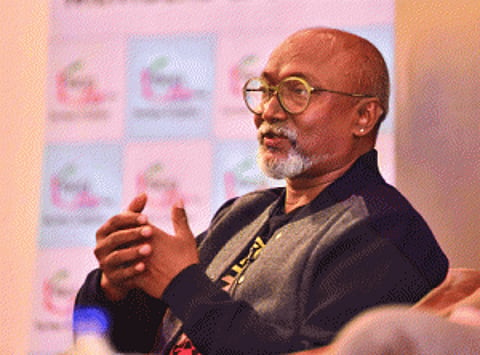

Bose Krishnamachari, the co-founder of India’s only biennale — the Kochi Muziris Biennale — took art beyond the galleries at a time when even speaking about it was an expensive idea. He speaks to Saritha S Balan about the third edition of KMB
It could be rare in the history of any biennale in the world that an artist’s wife offered her gold to help the event go on and not let it get affected by fund crunch. It’s rarer that locals, cab and auto rickshaw drivers guide tourists to see exemplary art works in galleries instead of usual haunts.
India’s only biennale — the Kochi Muziris Biennale (KMB) — has clearly benchmarked itself as a touchstone of outstanding contemporary visual art and is moving towards its third edition. The forthcoming edition of KMB is all geared up to be a major art event in South Asia. It will run for 108 days from December 12 through three months till March 29, 2017 comprising works by artists from either side of the Arabian Sea. “The event was made possible because of the state government, Indian artists, patrons and international friends of the biennale. The embassies, cultural institutions and artist-patrons have also supported the event in a big way. For the first edition, 63 per cent of the fund was provided by the state government and the rest by the patrons,” said co-founder and painter Bose Krishnamachari. “Once it started, the people took over with a sense of ownership. There was this instance of an artist’s wife offering her gold when there was fund crunch,” said the visibly elated artist.
Having won the admiration of art lovers and administrators the world over, the Indian artist is now among the big league of art curators. He has curated the inaugural edition of the Yinchuan Biennale in north-west China between September 9 and December 18 this year.
What differentiates KMB from the other biennales in the worldIJ “Kochi biennale is an artists’-curated biennale whereas the other ones are curator-created shows. KMB is the second longest running biennale in the world. We give the freedom to be creative for everyone. Artists are given the maximum freedom. In KMB, theory and practice go together. As many as 73 per cent of the works are done on the side,” he said.
The third edition of KMB attempts to question and blur the boundaries that categorise the various disciplines of artistic expression. It will feature works by visual artists, poets, musicians and performance professionals from diverse cultural and artistic traditions. Eminent artist Sudarshan Shetty is the curator.
On the cultural transformation of Kochi that happened through the biennale, Krishnamachari said that it boosts cultural activities, adds to the location’s value and creates an interest in its history. “May be it was in the first time in history that a biennale was extended for days. From the first edition we could create that momentum. There are 36 communities living in a radius of five kilometres. There are Marathis, Punjabis and Jews living in the area. At first people thought of it as an exhibition of paintings. later they began to look at it as an amalgamation of different kind of art works.” He added, “A biennale is about the city and its stakeholders. Kochi is the right location for the art event. Foreigners used to come there for trade in the past and cultural exchange was a natural corollary. We took art from the museum circle to the local people. We never expected such a massive acceptance. Somebody offered a coir factory for the artists to do this experiment,” he said.
KMB has also transformed galleries, believes the artist acclaimed for his bold abstract paintings. “From the first edition, we have been curating works at the Kerala lalit Kala Akademi. Now it has become one of the finest art galleries in India. We can bring any masterpiece there. There are biennales now which are inspired by KMB,” he concluded.