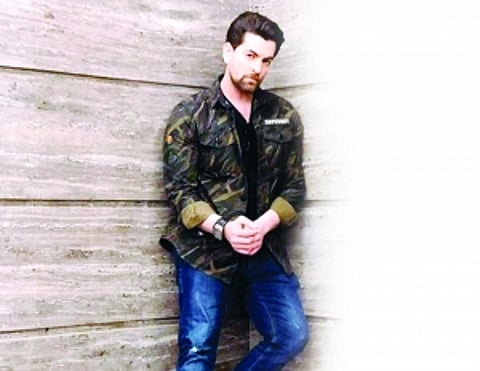

Actor Neil Nitin Mukesh tells Sakshi Sharma that Bypass Road will help the audience explore the home invasion genre as it is new in India
Nerve-wracking,” was Neil Nitin Mukesh’s exact feeling when he produced his forthcoming film Bypass Road. And for the first time, he has donned several other hats too — that of an actor, screenplay writer and playback singer. He says, “Creativity shouldn’t have any boundaries. This is what I was taught since childhood. As I come from an artist family, it’s very important for me to keep my forefathers name flying high. The constant effort to push the envelope from my end proves my overambitious nature.”
The drama-thriller revolves around a young successful fashion prodigy, Vikram (played by Neil), who is the prime suspect in a murder. Slowly and gradually the plot gets intense as a sudden turn of events makes the protagonist a victim of an accident.
Thriller is such a broad genre that there are many aspects to it which can be further divided into sub-genres such as psychological thriller, horror thriller, crime thriller, revenge thriller and many others. The sub-category of horror genre is home invasion, which Neil feels is unexplored in our country. It has a story whose thematic and plot elements deal with the forceful entry of one or more individuals into an occupied space. He says, “We have home invasions as one of the prime spots. When I realised that there’s a major dearth of home invasions in India, I started writing one.”
He recalls an incident that lead to the ideation of the film. “Four years ago while I was travelling back from Dubai, I read in the paper that OTT platform would come to India. I knew the moment they come, they are going to dominate the market big time. Before that it was important to educate our audience about the genres. So, I decided to make a home invasion film because the content needed to be developed soon to give the audience the best of both the worlds — digital and cinema.
The genre is popular in the West because people there are aware about its nuances. But in India it’s not easy to bring a novelty like this because the audience needs to be educated about it first. “The audience in the West don’t need a story or back story to understand the film, they understand it naturally. But here I knew if I left the plot the way it is, many questions would be thrown at me. For example, who is the man behind the mask? or why does he want to kill the protagonist? (scenes in the trailer). When these questions popped up in my mind I thought it’s important to address them and develop a sub plot that leads to home invasion. So, the first half explains each character and develops it gradually so that it helps the audience understand the plot in a better way. Each character has been given great amount of importance,” he adds. The film is an amalgamation of the murder mystery and the home invasion territory which blends in smoothly.
The film’s song So Gaya Yeh Jahaan is very special for the actor as it was initially sung by his father Nitin Mukesh in the 1989 classic Tezab. Neil says, “Recreating this song is a big honour for me. I couldn’t have asked for more. This is the smallest touch from my end to give back to my family.”
Talking about the genre the actor says that he hasn’t seen a good murder mystery after Badla. But he adds on that even that was a remake and questions, “What about an original idea?” He then talks about his film saying it is original and will keep the audience constantly on the edge guessing who is playing what?
There are many films which are quite predictable from the trailer. But that is not the case with this one. Here it seems as if the story is running multi dimensionally. It is hard to connect the dots. Is it a conscious move? “There’s so much happening simultaneously the audience will stay hooked. You cannot say it was planned but yes, we were prepared for it. In our screenplay we have consciously and seamlessly made an effort to make sure that the audience gets back on track if they feel deviated. Though, I don’t intend to spoon feed them,” says he. He adds that he wants the audience to understand the protagonist and see the film from his perspective.
The actor feels that one should always make the film from the audience point of view and not have an individualistic approach. Neil says, “I question myself first. ‘Would I want to see a film like this?’” As a maker he feels its his derogative to give the audience their money’s worth.
Talking about the challenges as a writer Neil says, “Writing the script in a controlled budget was tough. While writing I can have great visual sense and can write the sequences seamlessly. But being realistic to my budget was difficult. As an actor I can be selfish and ask for 25 safaris in a scene. But when you are a producer you know what you can afford and what you can’t.”
The script was initially written in a way that the scenes would look glorified on the screen but when Neil actually had to act, it was very difficult. He recalls a bath tub sequence where he was suspended on a harness and taken to bath. The scene shows that the harness falls into water and Neil starts drowning. “It was scary. Imagine yourself being submerged upside down into water and there you have to perform with your hands tied up with chain. Talking about it is scaring me again. It was more scary because my crew wouldn’t know that whether I am acting or I am actually in danger. That was a big fear point,” he says.
The protagonist, Vikram has many shades of human elements. He is initially a fashion prodigy in a glamorous world but his life changes after he is injured in an accident and is completely restricted to a wheel chair. This helplessness was challenging and made the actor bite the character strongly. “It is a subtly nuanced film. It is not unnecessarily melodramatic but instead tries to evoke some emotions naturally,” says he.
There’s a dialogue in the film, “Zindagi aur raaste kis mod pe badal jaaye kisi ko nhi pta.” (No one knows when life or its path change). The actor says that it is so ironic that the moment you start taking yourself too seriously, life has a way of getting you back on track. Same happens with Vikram. His life changed very unexpectedly after he met with an accident.
As more actors turn producers, Neil says, “It’s superb. Most of the actors are doing it because they are confident about their craft. How long will you wait for somebody else to trust you with something that you know you can trust yourself with? How long will I wait for that perfect script and role to come my way? And especially when I know that I have the acting skills in me.”
He recalls how his debut film, Johnny Gaddar, shocked the audience but worked. But then it began to be repeated thematically. So Neil wants to be a clutter-breaker rather than become a stereotype. For Neil, filmmaking is slightly larger than life. He loves the fact cinema has got that power to teleport the audience into the world it wants to. Citing the example of Steven Spielberg, he wonders how he made us believe in both Jurassic Park and ET: The Extra-Terrestrial.
This quest for breaking moulds has meant that Neil has made a mark with character roles too. “I am not one of those who always wants to be the lead. If the role is important, be it of a driver in the film, I’ll do it. The only thing that matters is that he should be important in the story. If he is then it doesn’t matters if it’s an ensemble film or the character is grey or he is the protagonist. In Prem Ratan Dhan Payo, Salman (Khan) was the lead but it doesn’t mean that mine or any other actors’ character was not essential to the storytelling. Also, now the audience is accepting and equally giving importance to diverse characters of the film,” says Neil.
(The film releases on November 8).