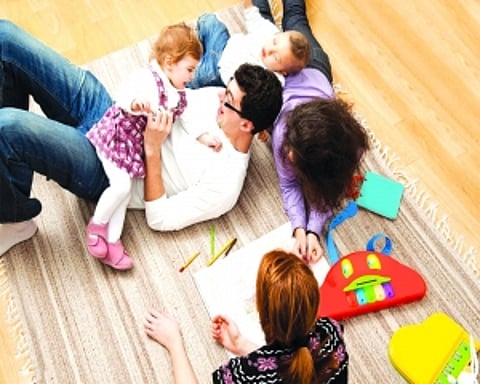

Sumedha Khoche and Shireen Sultana believe that parents can use the Montessori methods of teaching to devise activities for children using things easily available at home
The almost shutting down of the world and the restrictions around us has made not just adults but even children miss being outdoors. Staying at home all day can become tiresome for these active energy bundles and we need to think creatively to make staying at home fun for them. The Montessori teaching method fits in perfectly at this time and can be used to devise activities with things that are easily available at home. Children can learn important skills in a fun way and stay happily engaged.
Core Montessori ideas are supported by a strong body of evidence in developmental psychology. Dr Montessori was a physician and brought an observation-based, practical and holistic approach to the learning and development. Though over 100 years old, its concepts are extremely relevant in an age where children are exposed to screens even before getting their first tooth. Here are a few simple activity ideas that you can be done at home without any fancy equipment. A single activity can apply to more than one concept and can be tweaked to suit any situation.
Learn by doing
Children learn best with hands-on experience. Research has shown that we are more likely to remember a concept and understand it clearly when we do it on our own, rather than reading or simply hearing about it.
Let children decide
The Montessori methods are largely self-motivated as kids learn better when they are interested in a subject. They are free to choose what and how they want to learn with reasonable boundaries set by the parent.
Sensory tools
Most Montessori materials are designed to engage all the senses. These can be easily replicated at home with everyday items.
Attention and focus
Faced with so many options, children tend to get distracted at times. Enabling them to direct their attention in a certain direction improves concentration.
Goal-oriented activities help channel effort and focus. For babies, this could mean kicking a ball or grasping a favourite toy.
Use a mat or tray to place objects that relate to a certain activity. This directs focus on what is in front rather than all over the place. Similar to a work desk for adults, this defines a workspace and increases concentration.
Children get confused with if they are faced with too many choices and will feel empowered when allowed to make simple decisions. Limit the number of toys that a child plays with to avoid over-stimulation and boredom within a short period of time.
Schedules and routines give a sense of order and familiarity. Follow a set time for meals, naps and bedtime with activities that can be associated with them. Reading a bedtime story, dimming lights and a massage are signals of bedtime.
Movement enhances learning
Moving the limbs help the brain cells build a connection between a specific movement and its outcome.
Do things together
Children love to act like adults and doing things that they see their parents do. Activities designed around this make them feel like grown-ups and are perfect opportunities for you to bond with your child.
Handling tantrums
When children misbehave, taking a deep breath before reacting is sometimes all it takes to restore calm.
(The authors are the co-founders of KinderPass.)