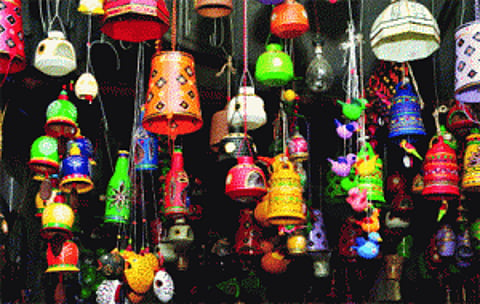

From eco-friendly soap bars created using local herbs of Uttarkashi to beautifully-crafted home decor items using waste wood, the Diwali Mela at the Blind Relief Association has much to offer at reasonable prices. Rupinder Kaur checks it out
The mela tale that the old-time Bollywood films narrated, where the siblings were separated followed by a good samaritan rescuing one of them and raising him/her as their own leading to their reunion years later, is now passe. What we saw at the Diwali Mela being held at the Blind Relief Association were old friends re-connecting, small family reunions where comments like ‘It seems the entire family has lost so much weight’ or ‘did you try the chaat at the Purani Dilli stall’, flew all around.
Upon entering, you know the chill will follow soon as colourful quilts with floral, block patterns have been folded and placed for sale. Moving along, we see a plethora of home and decor accessories like brass and bronze statues of Buddha, miniature painted wooden trucks, ceramic vases and sculptors of Ganesha, et al. The ladies shuffled through colourful kurtis, kaftans, silk dupattas, et al. while some carefully examined quaint metallic wall hangings and paintings.
A few steps further and the aroma of the frying tikkis and puris or maybe some fiery mirch pakodas from the Purani Dilli stall, hit your nose instantly. For your sweet tooth, you may savour the sweet little French macaroons or cream-lathered cup cakes. And a few burps later, if you need some tangy digestives then you can also get your dose of meethi saunf, heeng jeera goli, imli oramla candy, et al.
A few tired shoppers get a quick foot massage from the visually-impaired volunteers while others make quick calls to check if there is anything else to be purchased before they finally leave with their hands full.
You can also have someone predict your future with coffee cup, tea leaf reading sessions by experts and plus they can also look into the future with by gazing into the crystal balls. If that is not your thing, then one can also purchase various charms in the form of beaded bracelets, necklaces to control diabetes, Cervical spondylosis or to simply get rid of tension.
We soon spotted a gentleman perched on a chair with a wooden slab as he drilled someone’s name on it. The man, Gautam Swarup, makes use of wasted wood to create something even more exceptional.
“Most of the woods we are using, are exotic woods, fruit trees wood, roots which are normally burned down or just wasted away, that we slice and create things. The woods we are using are red cidar, Turkish neem, et al. We even use the bark off the tree and created table mats. The nature is so beautiful and I believe that one should not waste it, he shared.
“I started working on this concept in the 60s and in my school days, I was really fond of carpentry. I was also injured so you can see the mark here, he further added while pointing to a scar near his elbow. He gets the wood from his travel expeditions and is contacted by forest contractors for the scrap wood. “If, for example, roads are being widened, I’ll buy the wood from the contractors.
Even when I’m here, they’ll call me and tell me that they’ve received some wood and if I’m interested in buying it. But no chopping trees. If the wood, which turns soft and can't be used is then turned into a soft board,” Swarup said.
Some pieces have not been worked on at all. “We’ve left them in their natural form. like there is one which looks like Ganesha which comes from a red cedar tree and I found it like that. It was so unusual,” he told us.
From wall hangings, name plates, coasters of various kinds of wood, stools and tables, his collection of products attracted many around. “All this wood, even if you leave it outdoors for 20 years, nothing will happen to it. I don’t use chemicals but I leave them in sun and rain for two or maybe four years and for some I’ve put in ten years, he signed-off.
We were also intrigued by the au natural chunks of soap bars and facewashes in mini glass jars created by sadhaks from an ashram in Uttarkashi.
“There are a lot of combinations for soaps and facewashes that are made using the locally-available herbs for example, Himalayan neem, hemp, sage et al. We also have soap made of goat milk. All the soaps are for Rs120 each and the facewashes are Rs170 each. There are no preservatives,” a representative of Sundaram Udyog said.
“We are very environmental-friendly because we live in a very ecologically fragile zone. Initially, we used to give our facewashes in mud pots that weren’t even baked and once you’ve used the facewash, you can crush the pot and use it for your gardening. Now we found a person who makes recycled glass bottles and are easier to ship and transport. photos Sanjeev Kumar