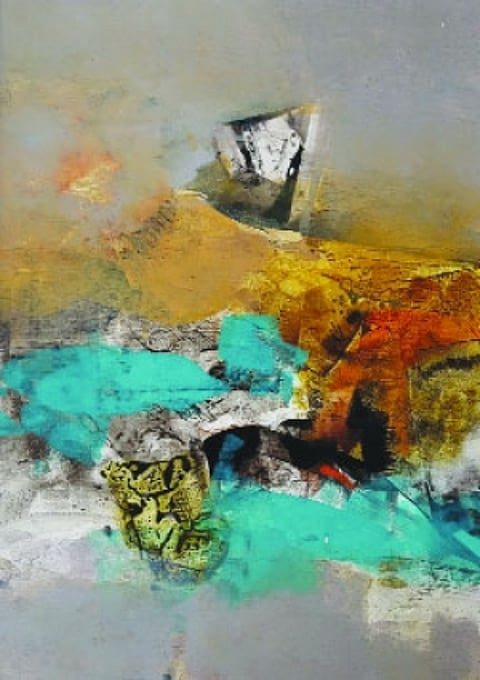

Mumbai-based artist Sabir Sardar’s abstract expression of life is about losing self-control, says Uma Nair
Lockdown revelations brought one face to face with the abstract world of Sabir Sardar. Upon questioning, he said his forefathers belonged to West Bengal and his parents settled in Bengalipura, a small pocket of a colony in Mumbai, which lies at the intersection of a railway crossing. So he uses this crossover icon of culture to give full play to his inspirations, both from his origins and his adopted home.
Minimalist Moorings
Sabir’s studio is situated under the railway crossing. When asked how the tracks affect his creative surge, he said, “It shakes me, feels like a drop of water falling on a reservoir of stable water. But the railway bridge inspires me to paint. It keeps offering me fresh perspectives.”
Sabir’s abstract landscapes move in the hinges of minimalist moorings. In the sensory works of Sabir, we find more than a thousand journeys. There is a succinct calculation and spontaneity in his work.
Irrespective of the colours he has used in his Yaatra, there is a mad freedom that operates beyond the restraints of his own control. “I create works as I look at the walls in the place where I live,” said Sabir who humbly stated that his inspiration stems from the lesser temporary structures of Mumbai’s slums.
Salt in weakened broth
Sabir’s work reminded me of the great poet Naomi Shihab Nye, who in her poem Kindness, wrote:
“Before you know what kindness really is, you must lose things,
Feel the future dissolve in a moment like salt in a weakened broth.
What you held in your hand, what you counted and carefully saved,
All this must go so you know
How desolate the landscape can be between the regions of kindness.”
The description of salt in a weakened broth brings us to Sabir’s many meditations that flow free and sometimes get entangled, too. From this poem of kindness and the many metaphors the poet gives us, we come to Sabir’s compositions where he plays with contrasting colours and brushstrokes. Minimal strokes lace his work, which break down into fractional elements, thus unveiling a light backdrop gradually taking over. Bright turquoise layers strategically make an appearance in compositions along with buttercup yellows and mustard mango hues, which brilliantly balance out the compositions, drawing the eye while providing a dynamic character to the paintings. Melancholy and solitude are Sabir’s companions. The appearance of a heavy dark corner of a rectangle with contrasted relatively light central brush strokes in the compositions become a liberation of sorts.
Brusque brushstrokes
Sabir quoted poet Robert Herrick and said he thinks of the “fragrance not the flower.” Then painting is both a physical and cerebral activity, a conduit for intellectual and philosophical enquiry. Whether employing strong linear elements, by turns painterly or rich bursts of colour, his work corrals diverse influences within a signature abstract language, often collapsing traditional distinctions.
His central and peripheral brushstrokes lend tonality. Each inclination of the brush produces shifts in technique and colouration, all of which encourage the composition to smoothen, expand and condense, turn dense and light at the same time.
The works lay bare the principles of light, colour and movement. We can understand why Sayed Haider Raza bought one of Sabir’s works from a show in London. Their abstract element lets the viewer submerge himself in sheer solitude.
Photo: Sabir Sardar Studio, Mumbai