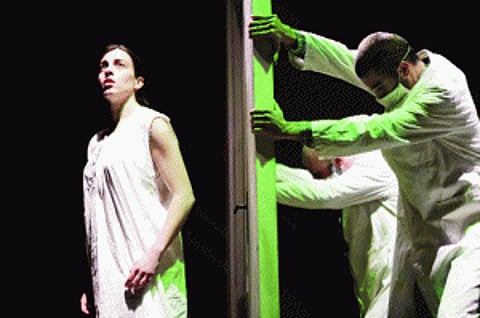

Desidera, an Italian non-verbal play co-directed by Sebastiano Coticelli and Simona Di Maio, captures the life of a man who craves to retrieve his past. Team Viva reports
As Sebastiano speaks passionately, Simona helps her friend to complete sentences in English. He speaks half-Italian, half-English while Simona acts as his interpreter, translating even his gestures. No wonder then that the two were able to spread their magic in the play Desidera, co-directed by both, at the Bharat Rang Mahotsav. Beginning with a simple storyline, the play captures the life of a man who craves to go back to his past and reclaim lost chances. It took almost a year for them to come up with a final script that was gleaned from their thoughts. The task lay in segregating the thoughts they needed for the play, since “there was just too much material.”
Sidera in latin means stars. The prefix de means loss, an impossibility, an absence. In Desidera, the audience can see the light without shadows which the directors explain as the balancing act of human beings to be optimistic, to see the stars even in the most unfavourable of situations. The duo, who founded the theatre group Teatro nel Baule along with their friend Dimitri Tetta, conceptualised the play in a non-verbal format. “We all are from mime school. We studied, decided to work together and formed the company. We love the idea of expressing our emotions without words. Even a gesture can communicate more than a hundred words. Desidera was a vital moment for us; by conceiveing the play we realised where we have reached,” says Simona. “We wanted the audience to feel the magic of silence,” says Sebastiano.
Both the directors have acted in the play as well. “In fact, you can see a mixture of sound, light and movements on the stage. Sebastiano and I know each other for years. We knew that our thought processes match and we can create something together. The creativity of each member of the group contributed to the play. One of the goals, when we formed Teatro nel Baule, was to make the theatre a place of exchange, open to discussions and to the study of different forms of expression,” she adds. “We worked a year to develop the story and finally we could make a script. We wanted to keep it simple and were particular that it should be about real lives. We don’t like the term experimental much, what is more important for theatre is that it should communicate with the audience. Theatre is our language and our own poetry on human beings.”
The duo believes that working together helped enrich their vision. “It was easy. We really trust each other; our imagination match. We walk on the same path when it comes to theatre. When I am on stage and he is out, he can be sure that everything works well. We argue a lot, challenge each other and exchange ideas, all to reach a common point,” says Simona. Sebastiano adds: “I would get an innovative idea from her which I wouldn’t have been able to discover myself.” Simona has been into theatre for the past 17 years whereas Sebastiano began acting during his school days.
The directors were unanimous in their expectation, they have come to India to gauge the audience here and know their response; how well they receive the idea of a play without dialogues.