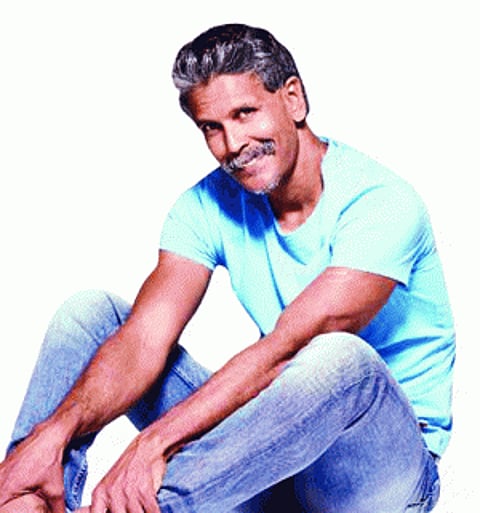

For the past three years, Milind Soman has been propagating the importance of fitness and the need to be aware of breast cancer through the Pinkathon. In a chat, he tells Shrabasti Mallik how it has evolved over the years, why it is important for women to devote time to their health and why the need for supermodels has come to an end
When Alisha Chinay released the video to her track Made in India, it made news for two reasons — the song and a ‘oh-so-hot’ Milind Soman. From being one of India’s biggest supermodels to a fitness enthusiast and from acting to being the ambassador of the Pinkathon to raise awareness about breast cancer, the man has come a long way. And time has treated him well, too. like old wine, he just keeps getting better and better.
He flagged off the fourth year of the Pinkathon, to be held on September 4 at JlN Stadium, at an event hosted by The Claridges Hotel and over a cup of tea we got talking.
Excerpts from the interview:
Tell us about the evolution of Pinkathon over the past four years.
It has been great. The evolution has obviously been more of the women who have participated and we monitor the 10-kilometer space and it (the figures) has really jumped a lot. In the first Pinkathon in Mumbai we had 230 participants in the 10 km and about a 1,000 participants in the 30km. So it just shows that mentally woman are becoming more comfortable in believing that they can do it. Because there are many things that are stopping them but society is the one making them believe that they are not cut out for certain things. We just want to say that all those restrictions should not be the end of the line and that you should devote some time to yourself. Because you want to be there for your family and manage your job and you want to give your 100 per cent and in order to be a 100 per cent you have to give time to yourself. And that is more important. It is not about money but devoting some time for yourself. So Pinkathon is more of a celebration because there is nobody judging you or watching you, you are dancing there and cheering there with thousands of other women and then you run and have a jolly good time. And in the midst of all, you celebrate your health and you know that you want to be like this, fit, for the rest of your life. But you need to make the effort.
Do you conduct special training sessions for women who like to participateIJ
Not specifically. Most of them start with the five kilometers run because they feel that that distance can be covered. If you walk for an hour, you cover five kilometres. What is interesting is that when you go to a mall and take a round, you most often end up walking almost five kilometres. Everyone is capable of it physically but they doubt, mentally. So the first step in being fit and healthy is mental discipline and awareness and then to develop the belief that you can do it.
But now we have training programmes every Saturday in every city. So here in Gurgaon every Saturday, there is a training where women can meet and it is not a hard workout training or anything but a comfortable space where they come and discuss issues that they have, exchange ideas and engage on light Zumba or pilates.
How far and wide is the influence of the PinkathonIJ
We have women from slums who come up and participate in the run and that is truly inspiring. We have women from NGOs who take care of specially abled women and we give a real deal of importance to that. We see them as a community because in society they are treated like that and we also label them as acid attack victims or visually or speech impaired. Its like we do not know anything about them. So we want to include all sections of society. Right from the poorest to the poor and also the affluent. So most of the women who run are corporate and housewives — those are who we look for. As for special communities we go to them because they are not normally made part of such events. We have to make them see that the Pinkathon is for them and that we want them to be there and that we would do workshops for you and train you. We also give them partners because if a girl is blind, she cannot navigate herself.
Have you special provisions for the specially abledIJ
We find them partners. In other marathons, the organisers allow visually challenged participants but do very little to offer help from their part. But here, we find them partners. We reach out to running communities and tell them that there are 50 women who cannot see but want to run the marathon and ask them to become their partners. From registering them to training them — we do everything ourselves. We do not want to leave out anybody and we encourage cancer survivors more.
Is there any reason why you feel so strongly about this causeIJ
No, not exactly. It is the first issue that I picked up. It was not that I have any special affiliation with it. Everything that takes away from you being able to live your life to the fullest is important. You need to be aware of it and how to avoid it and if you can’t avoid it then how to deal with it. So whether it is cancer, heart disease diabetes or issues like dowry or acid attack or whatever it might be, we want to talk about these things — things that are stopping you living your life.
Till today, women are apprehensive of speaking up about breast cancer. How do we deal with that kind of a situationIJ
We have to talk about. If they have people around them talking about they might just muster the courage to talk about it. They have to be made comfortable. We tend to be more conscious of it because of the word breast but it is the same for all diseases. The problem is that even to admit to any kind of sickness women believe that it reflects on the family. It is a notion that if I am sick then it will be difficult to get a prospective match for their children. They feel that they will bring a bad name to the family, they are still stuck in that era. We are still trying to convince them that all this doesn’t matter anymore and that women should talk about it. We don’t want to lose you and you do not need people in your family who feel any different.
On the bright side, it acts as a good filter because it segregates people who actually care from the rest.
There was a time when you smoked almost 30 cigarettes a day. How tough was it for you to quitIJ
It was really difficult because tobacco and nicotine are drugs. It is more difficult because firstly it is addictive, and secondly it is accessible. Every streetside corner has a cigarette shop. The third, and probably the worst, thing is that it is acceptable. Society accepts it, they do not shun it as a drug. If society had not accepted it things might have been different.
I did not start smoking till I was 30. I started doing TV and when you are acting you are sitting around most of the time. All my life till then, I hadn’t smoked and I caught on to it from the TV sets. At first, I could not take it but then I started to enjoy it and I could not stop. I smoked for about seven to eight years, 30 cigarettes a day but it took me more than a year. People say that it takes 21 days to break a habit but that is not true for many people.
The era of the supermodel was over with your batch. Tell us a bit about the fashion industry in the 80s.
The whole concept of the supermodel was the demand of the industry. If you see closely, internationally, too, there are no supermodels. The last one was Kate Moss, that, too, 15 years ago. But there was an ear when the industry demanded these kind of personalities and faces. Now they do not need it. in India, the fashion industry started somewhere in 1985 and the first boutique was Ensemble, co-founded by Tarun Tahiliani in Mumbai. Those were the times of Tahiliani and Rohit Khosla — they started the industry.
More than the designers, the media aped models. The moment they came to know of an emerging fashion industry they looked to the West and found that there were supermodels there. In fact, there were no male supermodels in America.
Cindy Crawford, Naomi Campbell and linda Evangelista were all women supermodels. There was Marcus Schenkenberg but even though he was so famous not everyone knows him because he never matched up to that ‘super model’ tag like the women had. But here, we had male supermodels. We just models but we were called supermodels. And not there is no need for that kind of a tag. May be the media still wants it but the industry does not.
And it is happening in other industries, too. Take the music industry for example. You will never have another Michael Jackson, another Prince or David Bowie or Madonna in the next generation. There is Rihanna and Justin Bieber and I wonder how many of them people will remember after a few years because they are not classics and there are slim chances that they will last. Same for the film industry. There is no Marlon Brando, Robert Redford, Paul Newman or Al Pacino in this generation. You will remember them even after 10 years in comparison to the new bunch of actors because they will be so superfluous. Even in India, after the four Khans who’s thereIJ The Ranbirs and the Ranveers are the everyday people.
Films, too, have changed. There is no hero anymore. Mostly they are about an everyday person with regular problems and how they solve it and that’s it. Because that is the way the industry is today. There will never be another Amitabh Bachchan.