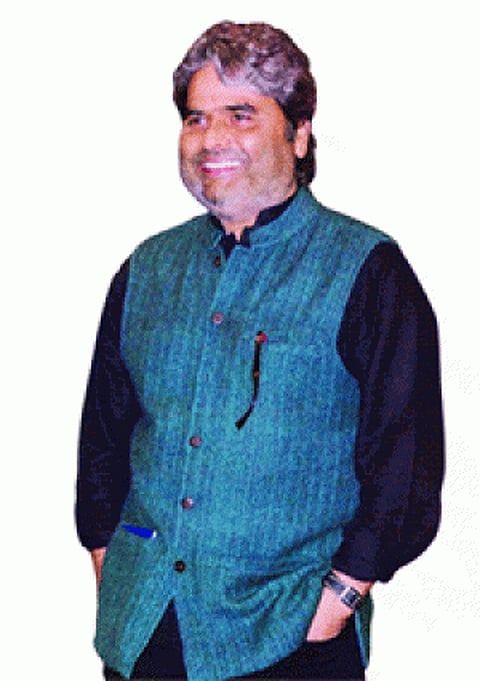

Vishal Bhardwaj will soon chat with Ruskin Bond over a glass of wine and decide on the third story to complete his trilogy with the author. He revealed such secrets in a discussion where he spoke about his journey in Bollywood. By Shrabasti Mallik
We look forward to his opinions as much as his films. But it is rare that we hear him talking about his style statement. So it was no wonder to see his fans turning up enthusiastically on a late evening event in Gurgaon to hear Vishal Bhardwaj speak about his style. The maverick filmmaker was present at an event that celebrated the spirit of individual expression with Blenders Pride Reserve Collection.
“Every person has his own unique style which is a reflection of his thoughts, the life that he leads, the way he conducts himself and the choices he makes,” he said.
He shared a lot about his journey that began as a music composer for popular jingle Jungle Jungle Baat Chali Hai. “I was a simple boy from Meerut. I was studying in a Hindi medium school but my father later realised the need for English education. He wanted me to shift to an English medium school but I was reluctant because I had already made friends. When I came to Mumbai, I was apprehensive to talk to people and converse in English because I was not fluent in it. I struggled and joined an art and repertoire company in Mumbai. I also worked at a record company before Gulzar saab gave me an opportunity to compose for Jungle Book,” he said.
He composed the score for Maachis and that was his calling card in Bollywood. “Gulzar saab always told me to be prepared for an opportunity that may come. It was after a long struggle that Maachis came and it was a huge success. I learnt the value of being prepared all the time,” he shared.
Although he was happy composing for movies, he was not satisfied. He was very inquisitive and always tried to add creative content to the movie he was composing for. That earned him a bad reputation. It was when the twin towers were attacked in New York that he suddenly realised how unexpected life could be and decided to take risks and ventured into direction.
Bhardwaj approached Shabana Azmi and the Children’s Film Society of India (CFSI) for his debut movie Makdee. He was cautioned by Azmi because he was changing streams. “Shabana said that she saw many music composers turning into directors and ultimately fading away if their film failed to work. I told her how I felt about the uncertainty of life and I wanted to direct. I suddenly had this do or die attitude and that convinced her to play the role of a witch,” he said. He showed a clipping of the movie to CFSI and they rejected it citing that the movie was not appropriate but the director did not lose hope. He raised finances money through his friends and bought the rights of the movie from CFSI and completed it. “I wanted to test myself. Now it is a much loved film and has almost become a cult,” he said.
It was interesting to find out that the first movie of his Shakespeare trilogy, Maqbool, faced rejection from the producers. “It was ahead of its time,” he mentioned. He was even advised by the IDBI jury, who were supposed to produce the film, to not associate the film with Shakespeare’s work. “They told me that people do not want to see a piece of literature when they go to watch a movie. I was fearless. I was so convinced that I went ahead and did the film on my own terms. It finally paid off,” he said.
That success gave him the platform to make Omkara and the freedom to present mainstream stars in unconventional roles. He wanted to prove that a film-maker can make an entertaining movie with literature. When his movies were critically appreciated, he faced opposition from art house directors and actors. “They thought I had gone mad,” he said adding, “When you hear that continuously, you begin to question yourself. But it did not affect me because I took up the challenge to break the glamorous image of actors. I was honest with my style and never compromised on creativity.”
It was his honesty, dedication and conviction in his work that made him choose Kashmir to shoot his film Haider.
When asked about the costumes in the movie, Bhardwaj said, “The shawl that Tabu was wearing in the wedding scene was very expensive. There was an old family and they had a treasure of traditional stuff. They lent us the shawl for the scene,” he said. Bhardwaj said the phiran that Shahid Kapoor wore in the film has become a style statement in the Valley.
His courage, fearlessness and honesty have given him great dividends as his Shakespeare trilogy is scheduled to be screened at the New York International Film Festival. “It is so humbling,” beamed the director, “It feels like yesterday that I faced rejection for Maqbool.”
Now that he has completed a trilogy of Shakespeare he plans to complete his Ruskin Bond trilogy, too. After The Blue Umbrella and 7 Khoon Maaf, he is now searching for the next Bond story. “My house in Mussouri is right next to Ruskin’s and in a few days I will sit with him over a glass of wine and decide on the story,” he revealed.
Bhardwaj has never stayed away from commenting on relevant social issues and here, too, he spoke about the documentary India’s Daughter. He mentioned that the ban is not justified because “everybody has the right of speech and creative expression. We live in a democracy and I think no voice or opinion should be clipped like this.”