
Ravinder Dutt has based his artworks on historical tales from the Indian subcontinent. While on one hand his creations define the glory of Delhi’s past, on the other they portray modern development in the city. He shared details with Divya Kaushik
Mughal king Akbar Shah II had two sons — Siraj Uddin Zafar (Bahadur Shah Zafar II) and Mirza Jahangir. The emperor was not happy with his eldest son and wanted to nominate his younger son as the heir apparent (wali-ahad). This move was not liked by the then British Resident in the Red Fort, Sir Archibald Seton. Once Mirza Jahangir insulted Seton in an open court. After a few days, when Mirza Jahangir was merrymaking on the roof of Naubat Khana in Red Fort, Seton was coming from the darbar. Mirza Jahangir fired a shot at the Resident from the roof of Naubat Khana. Seton escaped but his orderly was killed. For this act, Mirza Jahangir was exiled to Allahabad under orders of the British Resident. Mirza Jahangir’s mother, Mumtaz Mahal Begum, took a vow that if her son was released from Allahabad she would offer a chadar of flowers at the dargah of Khwaja Bakhtiar ‘Kaki’ at Mehrauli. After a couple of years Mirza Jahangir was released and homecoming was celebrated in a big way and a chadar made of flowers was offered at the Dargah of Khwaja Bakhtiar Kaki. Not many would know that this story forms the origin or Phoolwalon Ki Sair, a three-day festival that happens annually in Mehrauli. The fact that it being such a historical festival is not much known in Delhi inspired Ravinder Dutt to come up with an artwork based on it. It’s titled Homecoming and it is painted like a Rajasthani kavad. Kavad is a brightly painted portable shrine used for storytelling and is made of wood. In his artwork, Dutt has mixed several historical stories from Delhi and Dara Shikoh takes the centerstage. “I really liked him. The idea to present him this way is to convey what an enlightened person he was,” explains Dutt.
Homecoming is one of the artworks that will be displayed at an exhibition Flaneur in Old Delhi at Matighar, IGNCA. Each artwork, be it painting or an installation, is layered with stories from history mingled with artists thoughts. Dutt is a student of history and he gave up his management career for the love of art. There is a strong influence of ancient civilisations from Egyptian, Greek to Baroque styles in his art practice. His artworks are a result of in-depth research. Dutt’s family had left lahore, which is now in Pakistan, during the Partition of Indian subcontinent in 1947 and settled down in Delhi. He grew up with several historical stories and those stories have served as a template for his present works. He selected interesting pictures from the family album and merged them in different media with his own imagination and thoughts. His work shows reflections of memories over a period of three centuries and generations.
In his creations, where on one hand there are historical accounts, on the other there are modern traces, terms and elements, reflecting that he is trying to present history in the modern context — very much in a way that will suit the present times. One of his works titled Memoirs of a Travelling DNA vividly captures the beauty of land and water, of fishes and the flora and fauna, the regional garbs, the surahis and the spouted vessels.
He explains, “In the work you can see the memory scrolls that register the epitome of luxury, royal tales from jannat (heaven) on earth and paths less travelled, as in a tapestry. The path is an old route to the valley where people went to drink the mountain nectar in the hope of achieving immortality. This scroll is a reflection of panoramic views of how the journey would have been, with a fictional element added by the creative human mind. The scroll talks of conservation and restoration.”
The Great Black Erection is based on Taj Mahal but the way he has presented the work is totally different from other existing artistic works of the monument. “I thought that the Taj Mahal itself is so beautiful that nothing more can be done based on it. So I worked with the concept. The work that I created shows the modern elements and it hangs between time and space, myth and imagination and floats between Mughal, British and contemporary times,” he says.
His other work, Redefined, is set in two worlds — the outer and inner. It is a contemporary take on how urban landscape has been redesigned and redefined. It is a satire on bureaucratic policies, morals and ethics — everything that goes underground as in a charade. The evolution and change in the urban landscape has inspired the Redefined. The present day historic routes, have been presented as mere dots enroute to denote how minutely we perceive history today.
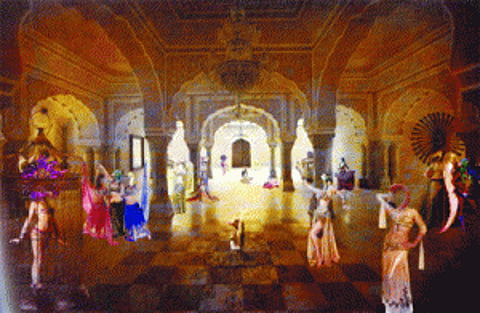
One of his award-winning works shows women in a harem with birds’ faces. The work is titled Birdcage. Says Dutt, “It is a tribute to the lesser known women of theharem both in India and elsewhere in the world. I see it as a reflection of today’s society. The work does not remain gender specific and assumes a multifaceted interpretation. It is also a direct satire on how we as humans are and how we all wear masks, the ‘forms’ that we have assumed. With this work I have thrown an open question to the society trying to relate to our contemporary lives, are we ever able to break our shells, break free, aren’t we all slaves to situations, institutions, circumstances, religion, elders, society, workplace, households, our own desires. Aren’t we all mere birds in our own cages with social restrictions imposed upon usIJ”
The exhibition will begin from September 3 and will continue till September 8.