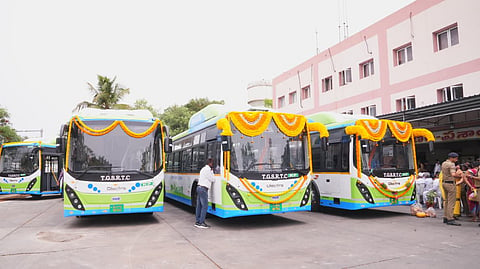

Hyderabad: The Telangana government is planning to add 2,800 electric buses to the fleet of the Telangana State Road Transport Corporation (TGSRTC) in a phased manner to reduce the number of diesel buses operating in Hyderabad.
According to a Telangana Today report, the TGSRTC is planning to induct around 2,800 electric buses in the city.
The report said the transition is expected to significantly reduce the corporation’s fuel expenditure while improving urban air quality. The expansion plan includes 2,200 additional electric buses under the PM E-DRIVE scheme, alongside the conversion of existing diesel buses through retrofitting, it said.
Earlier, Telangana Transport Minister Ponnam Prabhakar said that TGSRTC would add 2,200 more electric buses to the existing fleet soon.
He said that deploying 3,000 electric buses could reduce carbon dioxide emissions by 600 tonnes annually.
The Minister also said that Hyderabad should never become another Delhi. “That conviction is what drives our push for electric mobility, reducing pollution, cutting fuel dependency, and making public transport truly people-friendly,” he said.
According to the Telangana Today report, as of August 2026, the TGSRTC runs around 1,037 electric buses across the state, including 500 electric buses in Hyderabad.
“The financial benefits could be substantial. Based on an estimated daily operation of 200 km per bus, a fleet of 2,800 diesel buses would cover nearly 5.6 lakh km daily. For instance, at an average mileage of 2.7 to 3.4 km per litre and diesel costing around Rs 104 per litre, replacing these buses could eliminate annual diesel expenditure of approximately Rs 624 to Rs 786 crore,” the report said.
However, after accounting for electricity costs, the indicative operating cost advantage could be around Rs 245 crore annually, based on previously reported running costs of Rs 20 per km for diesel buses against Rs 8 per km for electric buses, it added.
These figures are projections, and actual savings will depend on operating conditions, electricity tariffs, and contractual arrangements.
Meanwhile, Chief Minister A Revanth Reddy has set December 9 as the target for making city bus operations entirely electric. However, it is still not clear whether the RTC will be able to reach the goal by then and make the city’s public transport completely green, the report said.