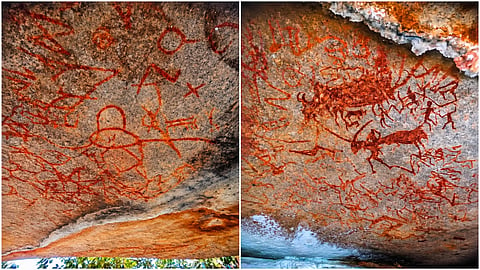

HYDERABAD: A rare prehistoric rock art site featuring red pigment paintings believed to be 2,500 to 5,000 years old has been identified by two researchers on the inner ceiling of a natural rock shelter within a massive granite formation in the Ponnal forest region of Medchal-Malkajgiri district in Telangana.
The site, around 40 kilometres away from Hyderabad, was identified by MANUU researcher Kondaveeti Gopi and history and heritage explorer Mohammed Naseeruddin, with the assistance of local guides.
“The paintings mainly depict human figures, hunting scenes, various wild animals, geometric patterns and abstract designs. They serve as valuable evidence for understanding the lifestyle, artistic skills and relationship with nature of prehistoric human communities,” the researchers said.
The researchers said the rock shelter contains paintings of long-horned deer, animals resembling antelopes, hump-backed bulls or wild buffaloes, and other four-legged animals. Some animals also feature internal body lines that appear to indicate their anatomical structures.
This style of depiction resembles the X-ray style commonly found in prehistoric rock art traditions, they said.
“Along with animal and human figures, several geometric and abstract designs are visible. These include star-like or sun-like motifs, square-shaped patterns with loops on all four sides, hourglass-shaped or damaru-like symbols, and curved zigzag lines,” the researchers said in a statement.
The researchers believe these patterns may be associated with the symbolic thinking, observation of nature and ritual traditions of prehistoric human communities.
“In certain areas, older paintings can be seen in faded layers, while more clearly visible red-coloured paintings appear over them. This suggests that different human groups may have visited the rock shelter during different periods and recorded their artistic expressions on the same rock surface,” they said.
Based on the style of the paintings, human figures, animal depictions, geometric patterns and overlapping layers, the researchers believe the site may contain different painting traditions associated with the Mesolithic, Neolithic, Chalcolithic, Megalithic and Early Historic periods.
According to preliminary observations, some of the paintings may be associated with traditions dating back approximately 2,500 to 5,000 years. However, scientific investigations, pigment analysis and comparative studies are necessary to establish their precise chronology.
“The red pigment used in the paintings resembles red ochre. We believe prehistoric humans may have prepared such pigments by grinding iron-rich minerals such as haematite. Further scientific examination is required to confirm this,” the researchers said in a statement.
The villagers of Poonla, who have observed the paintings on the hillock for generations, consider the area sacred. They worship the goddess here as ‘Sri Gandi Chittaramma’ and perform religious rituals and prayers.
The association of the prehistoric rock art shelter with the traditional worship practices of the local community adds to the site’s cultural significance, the researchers said.
The researchers said the rare rock paintings are vulnerable to damage caused by natural calamities, weathering and human negligence. They urged the Archaeology department, the Telangana heritage department and the forest department to visit the site and undertake a comprehensive survey.
They also suggested that the paintings be digitally documented, scientifically studied, accurately dated and protected through appropriate conservation measures.
The researchers said the Ponnal rock art shelter represents thousands of years of human experience, the relationship between humans and nature, and the artistic expressions of the past.
They emphasised the need to identify, scientifically study and preserve the heritage site for future generations.
