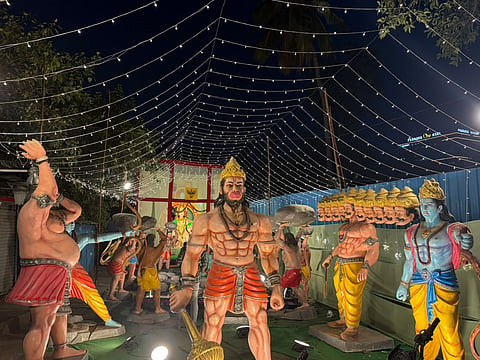

Hyderabad: Dasara and Diwali are barely behind us, and the festival calendar has already moved on. Kartika Masam brings its own round of gatherings, lamps and rituals, and with these festival seasons come the towering setups. Gods, temple backdrops and mythological scenes rise over open grounds. We stop, photograph them and move on. But who makes these worlds possible?
The question struck me after one particularly striking installation. It was not a collection of idols placed together but an entire world, carefully imagined and built. Behind it stands a community of artisans, painters, mould-makers, designers and workers, whose work begins months before the celebrations.
Thota Vishnu, who has spent nearly 25 years creating large devotional installations, leads one such team. For him, it is not simply a business of making decorative figures. It is a craft he grew up watching, learnt through observation and eventually made his own.
Learning by watching
His introduction came through his grandfather, P. Raya, a decorator and sculptor who lived to around 90. As a child, Vishnu watched him draw designs on sheets of iron and carve patterns.
"I learnt a lot simply by observing my grandfather. I watched how he drew designs and worked on the patterns. That is how my interest in this craft developed," Vishnu says.
His grandfather wanted him to continue the craft, but the journey was not straightforward. Vishnu studied up to Class 10, worked as a labourer for a few years and later ran a cable television business in Nallakunta. Eventually, he returned to the work he had grown up watching.
He began developing his own designs and took on ever more ambitious projects. What started as small decorative work grew into large devotional settings stretching 150 to 200 feet, with individual figures rising to 20 or 25 feet.
The ambition is not merely size. "I want people to feel that they are entering a temple when they come into the installation. It should not look like mere ordinary decoration. The entire setting has to create that feeling," he says. The figures, their placement and the background must work together.
There is a storytelling element too. The scenes come from religious narratives and can introduce younger visitors to stories and traditions they might otherwise meet only through books, family conversations or religious gatherings.

From Bengal's clay to a finished figure
Vishnu says the clay he uses is sourced from Kolkata, home to a long-established tradition of idol-making. The city's Kumartuli, the famous potters' quarter, is known for its sculptors and festival idols, and riverine areas such as Uluberia and Diamond Harbour are associated with supplying clay to idol-making centres in the region.
The clay is cleaned, soaked and kneaded until workable. A basic framework of straw and other supports establishes the figure's structure, and clay is then applied to model the body, limbs and finer features. Once the figure has taken shape, a plaster of Paris (POP) mould is prepared and fibre is cast in it, producing a lighter, more durable figure. Painting and finishing complete the work.
"The decision to make a figure in one piece or in several sections depends on the requirements of the project. The size, design and how it will be transported and assembled will then be decided. Large figures cannot always be handled as a single unit and may need to be made in sections and joined at the venue," he says.
Each stage has its own specialist. The person who builds the framework may not be the one who models the clay, and the one preparing the mould may not be the artist responsible for the final surface. A large installation is never the work of one individual, even when it carries the name of the person who leads it.
The painter’s eye
Among those who have worked alongside Vishnu for years is artist Raju Krishna Rao. With 35 years of experience in art and a Fine Arts qualification, Raju's contribution goes beyond painting. He works across clay moulding, fibre work and three-dimensional and texture painting.
"I have been working with him for 20 years. Whatever projects or events he takes up, I work on them," Raju says.
The final appearance of a figure depends greatly on the artist's eye. Colour, texture, ornamentation and expression must come together and suit the theme and setting. Raju has a team that works with him on painting and finishing.
"For a small idol, it takes at least two to three days, while a large project involves a much longer process. It depends on the size and the nature of the work," he says.
Months of work, a few hours to install
The scale becomes clearer in the time involved. "Ramayana installation with close to 60 figures took around three months to complete, Vanara Sena-themed took approximately seven months. A set depicting the 12 Jyotirlingas required around eight months," Vishnu says.
Around 30 people may work on the manufacturing. Transporting, handling and installing is a project in itself. "A crew of around 50 people may be involved in larger works, although the teams can overlap depending on the project," he says. Putting a set in place at the venue takes only four to five hours.
His projects have travelled to Karnataka, Maharashtra and Kolkata, besides different parts of Telangana and Andhra Pradesh. The work moves with the festival calendar.
The investment is considerable. "The cost of one large set is around ₹20 lakh, and the final expenditure varies with the number of figures, the materials, the scale and the work involved. The making of an individual figure can itself cost tens of thousands of rupees, with labour and other expenses adding to the total," Vishnu says.
Afterlife of an installation
What happens to these enormous figures once the celebrations are over? Do they simply disappear, like the temporary stages around them? Not necessarily.
Vishnu retains ownership of the installations and stores them in a warehouse in Nagole. There is a whole colony which came up for this purpose, rows of warehouses holding towering figures and temple sets.
"Fibre figures are durable, and damage can often be repaired without having to make an entirely new piece," says a worker there.
The same installation may return in another season in a new avatar. Colours can change, figures can be rearranged and new elements added. This is part of the economics of the work: making a large set from scratch every season would cost substantial money, time and labour, and reworking existing figures extends their life while keeping the look fresh.
Vishnu is particular about his designs. He does not generally sell completed sets or allow others to reproduce them. The work remains an ongoing body of creations rather than idols made and sold one by one.
Devotion in the making
For Vishnu, the devotion is not separate from the making. "Before we begin the work, we offer prayers and recite 108 chants. The figures may be made using straw, clay, plaster of Paris and fibre rather than carved from stone. But that does not mean the work is any less devotional," he says.
Perhaps that is what makes these installations interesting beyond their size. They bring together art, engineering, religious storytelling, inherited knowledge and the labour of people whose names rarely accompany the finished work. The visitor sees the completed figure; the artisan remembers the many decisions that brought it into being.
Vishnu's story is one of continuity. A craft that began with his grandfather's designs has grown into a larger enterprise of workers and artists. His two children, both engineering graduates, have shown an interest in joining the family business, so the knowledge that passed from grandfather to grandson may reach another generation.
The installations themselves are temporary. They rise for a festival, draw crowds for a few days and come down. But the skill behind them does not disappear with the decorations.
The next time a towering figure catches your eye, look a little longer. Beyond the colours and the scale is a story of people who spend months making a temporary world feel complete and who, once the crowds have left, begin preparing for the next one.