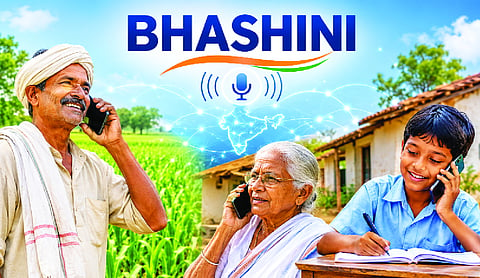

Imagine a farmer in Rajkot asking an app on his mobile phone, in Gujarati, whether rain is expected over the next three days. Or a small shopkeeper in Salem seeking help in Tamil with digital payments without having to struggle with English. Imagine an elderly woman in Malda asking a computer in Bengali to explain a government scheme. These may sound like simple possibilities, but they indicate a significant transformation in progress in India’s digital future.
For many years, people have had to adjust to technology, rather than technology adjusting to them. Computers, websites, mobile applications and online services have generally been designed with English-speaking users in mind. Consequently, those unfamiliar with English face a challenge, even though they are keen to use technology.
AI is now beginning to reverse this handicap, with technology learning to communicate in the user’s language.
Making digital governance inclusive
Last week Government of India’s national language technology initiative BHASHINI showcased its voice-based and multilingual AI capabilities on Dakshin Day 2026 in New Delhi. The demonstration included translation, speech recognition, spoken responses and several other language services. BHASHINI highlighted the role of Language AI as an important component of Digital Public Infrastructure (DPI), with applications extending beyond national boundaries and across diverse linguistic contexts.
BHASHINI is playing an important role in India’s efforts to make digital governance more inclusive. It supports 36 Indian text languages, 23 Indian voice languages and 35 international languages, enabling the integration of language technologies across government and public-facing digital services. Its ecosystem includes technologies for translation, speech recognition, speech synthesis, transliteration (writing words from one language using the letters of another language, without translating their meaning, like ‘Aap kaise hain?’) and other language services, helping make digital information and services more accessible across India’s linguistic diversity.
BHASHINI helps computers understand what people say, convert speech into text, translate one language into another and even speak out the translated words.
Its mobile application offers features such as text translation, voice translation and even a conversation mode which enables two people, who speak different languages, use a mobile phone as an interpreter. For example, one can speak in English and the other in Hindi, with the app helping them understand each other.
The real opportunity lies in taking this technology beyond translation.
Real opportunities beyond translation
Consider agriculture. A farmer could ask questions about crop diseases, fertilisers, weather conditions or government assistance in his mother tongue enabling easy access to reliable information to him.
Healthcare offers yet another important opportunity. Patients could explain their symptoms in their own language and better understand medical instructions, prescriptions and hospital procedures. AI could improve communication between healthcare providers and patients.
Education could be transformed as well. A student in a small town will not be at a disadvantage because learning material is available mainly in English. Lessons in science, mathematics and even engineering could be translated or explained in Indian languages.
Small businesses can also benefit. A local shopkeeper can seek help in preparing a business ad, understanding an online form or responding to a customer. Government services could become easier to access if citizens could ask questions and receive answers in their native language.
Real measure of success
The larger goal is to ensure that language is no longer a barrier to technology, governance or opportunity, making India’s digital transformation more inclusive and accessible to everyone. It could help people who are less comfortable with English, those with limited literacy and even persons who find reading difficult. Voice-based interaction is particularly promising because speaking is often easier than typing.
However, as Indian languages have many dialects, a translation that is technically correct may still sound unnatural or convey the wrong meaning. In sensitive areas such as healthcare, banking and legal services, inaccurate translations can have serious consequences. Systems must therefore be tested carefully, improved continuously and supported by human oversight.
There is also a need to protect personal information, particularly when people use voice-based services to discuss financial or medical matters.
India’s linguistic diversity is often viewed as a challenge for digital services. AI gives us an opportunity to look at it differently. The real measure of India’s AI success will not simply be how many powerful models we build or how much computing capacity we acquire. It will also be whether a farmer, a student, a shopkeeper or an elderly citizen can use AI confidently in the language of their choice.
If technology can speak to people in a language they understand, the benefits of the digital revolution can reach every corner of India.
The author is an alumnus of IIM Ahmedabad and Professor of Practice at IILM University, Gurugram, with an interest in AI, Technology and Strategy; Views presented are personal.
