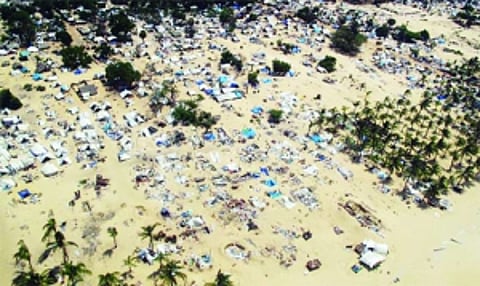

It's been four years since the horrifying massacre at Vanni on northern coast of Sri lanka, but survivors still get sleepless nights. Homeless children have been up for adoption but not many have found new parents. Children and women who have been exposed to chemical bombs are still being treated. Skeletons of those who died of hunger inside bunkers are now out in the open and houses that were abandoned still bear some resemblance to its owners. A recent book by Frances Harrison, who travelled across the globe to find survivors, brings into sharp focus the aftermath of this final assault. Deebashree Mohanty spoke with the author and some survivors to bring you a report
She has taken up a job at a community social service centre in Dublin. She prepares the best biryani in the locality. She giggles at silly jokes that her friends crack and loves dancing to Spice Girls when she is alone (a feat she is very proud of). But Rosy doesn’t sleep. She is scared to shut her eyes for long periods. She needs to be escorted to the bathroom each time, not because the lower legs have been amputated but because she cannot be left alone at any given time. She hates noise. It disturbs her. It is this sound that had rocked her world in 2009.
“We had not eaten for three weeks. My youngest daughter (then nine) had been crying incessantly and I was losing my mental balance. Both my elder sons had been snatched away by rebels to fight against the Army. They had been dead long back, or so I presume. Irritated with all the crying, my husband took my daughter outside the bunker to search for food. That’s when it hit them. The noise of the blast sent a shiver down my spine and I was numb for a few hours. Then I went out. There were so many mangled body parts — nose, ears, eyes, hands... It was difficult to identify one from the other. Today, when I close my eyes for longer periods, I see them again. Scattered and battered out of proportion,” the 52-year-old Tamilian tells you, recounting the horror of the massacre.
She has only one request now: “Do whatever but don’t disclose my real identity, or give them my name. I don’t want them to come looking for me to shut me up for ever. I want to live for my younger brother,” Rosy tells the correspondent in e-mail interactions. Her ID is a jumble of words and numbers that don’t make sense. There are a couple of more Tamilians who have settled in Dublin like her, desperately trying to stitch back the pieces of their life together.
Frances Harrison, ex-BBC correspondent and author of Still Counting the Dead, a book she released in December 2012, says it was tormenting for her to even hear out what the survivors had to say. “When I started writing the book, it was like I was reliving the massacre. Every story that I was writing about used to make me physically shiver. But the story had to be told. There were many things that needed to come out of the war crime. I have tried to make it as true and as poignant as possible,” Harrison tells you. She adds that it took her two long years to research for the book.
The Sri lankan Civil War which claimed 1,00,000 lives, ended in 2009 when the Government forces finally crushed a near-40-year-long insurgency by the Tamil Tiger rebel group. The final months were especially brutal and survivors will not easily forget what happened to them. “They are all in a state of mental shock. Most of them are scared to reveal much about themselves. Nobody who escapes Sri lanka wants to be identified when they tell their stories for fear of what might happen to their extended families back home,” Harrison tells you.
War victim Sharmila (name changed) in the US, for instance, is 45 years old but she doesn’t want to live. There hasn’t been a day when she has not hoped that she dies. Even after four years the word ‘war’ brings shivers and tears for this Tamil woman. Sharmila witnessed Sri lankan Air Force jets bomb an area designated as a ‘safe zone’ by the Government. On May 14, 2009, a day after she moved into the safe zone at Vattuvaha from Killinochi with her husband, a son, two daughters and three-month-old grandson, the zone came under attack.
Today she is half blind and doesn’t have an arm but that doesn’t stop her from replying to our e-mail. “The bomb fell on the place we were living. Those were the silent ones. We realised only after the area was bombarded. There was smoke all around. I didn’t know anything. My hand was sliced and splinters lodged in my chest. My son picked me up and hid me in a bunker. I asked him to look for his sisters. But it was too late. We knew that they were no more. All my children died. Nothing is left for me,” she says, adding, that on that day of the war she saw more than 5,000 dead bodies around her. “Do you think I can live in peace after seeing all this brutality,” she queries.
Many like Sharmila and Rosy attend remembrance ceremonies held for the massacre victims but that doesn’t bring any solace to them. “We hold a remembrance for such victims of war crimes. It is more to give peace to the survivors. They deserve their dignity to live. They deserve some sort of a closure. These victims, although physically impaired should be happy to be alive. Through these ceremonies we want to convey the spirit of life to them,” Professor Adam Wizkins, who is the head of a community in New Jersey, says. This particular community remembrance of Mullivaikal war massacre is one of the more populated ones. Held every year in the third week of January or the beginning of February, this ceremony sees many victims who come to speak about the horror that they have lived. “From a psychological point of view, it is good that they speak about their horrors. That way they vent out their frustration,” Wizkins tells you.
This year the ceremony held on January 29 saw the participation of 300 Tamilians who had come out to recount their horrific experience. Based on their accounts, these victims were referred to psychiatrists. “In some sense they all need to go through this process for their own good,” Harrison says. While most of them require frequent medical aid, they have started taking up part-time jobs wherever possible. “We have a lot of massacre survivors in New Jersey and other parts of the US,” Wizkins adds.
For Meena, another war victim, that day when she lost her husband, son and child in the womb, still brings back horrible nightmares. “I was eight months pregnant and in labour. My husband left with my son to get some medical aid. I waited for four hours in writhing pain but they never came back. I gave birth to a still baby. And I didn’t even have the time to cry for her. A neighbour dropped by to say that my husband and son were deeply wounded. Still very much in physical pain, I gathered courage to go to the area and look for them.
My son was already lying dead in a pool of blood. My husband was breathing. I made an effort to carry him back to the bunker but mid way he collapsed and died. My world ended right then and there,” she said at the remembrance ceremony. As for her own physical state, Meena is suffering from a uterine cancer. “I know I don’t have much time. Frankly, I don’t want to live any more. But I have only one question to ask. Is human life that cheapIJ,” she concluded her speech with this rhetoric.
Today Meena works part-time in a super speciality hospital in New Jersey and is also being treated for her cancer in the same ward. “Many of the victims are lodged here for the past three years. We are doing everything we can to rescue them from the physical pain. We also have on board a psychiatrist to attend to these survivors,” Wizkins says.
According to the UN, over 40,000 people were killed during the last stages of the 30-year Civil War that ended in May 2009, with a full military victory for the Sri lanka Army. Non-governmental sources put the figure at over a lakh and a half.
Execution style killings, aerial bombardment of hospitals and designated safe zones, sexual assaults on civilians and female combatants, use of chemical weapons, cluster bombs, denial of medical aid to injured civilians, illegal confinement without charges, these are some of the many war crimes Sri lanka is accused of.
Some say it is not just the Sri lankan Army that inflicted atrocities on the helpless civilians. The lTTE also has blood on its hands. “Most of the survivors recount their experiences of mass death through shelling and bombing of hospitals and Government declared safe zones and the use of cluster and chemical bombs (referred to by the survivors as koththuk-ku’ndu and eri ku’ndu). It is just scary that such weapons be used indiscriminate. Some of them even had tales of torture. But they were all innocent civilians,” Harrison writes in her book which was declared a best seller over night.
The list of war violations by the Sri lankan Army extends to the camps where women were harassed. Over the years there have also been accounts of women who spent one year at a secret camp, which was not revealed to the world by the Sri lankan Government. According to a report released much later, that camp was actually a torture camp. No basic amenities were allowed. The NGOs weren’t allowed inside. Most survivors speak of brutal rapes on them by Army men in the name of a secured camp.
‘Some things just stay with you’
A British journalist who worked for BBC in her prime, Harrison has told many horror tales of the Mullivaikal and Vanni survivors through her best seller. Even the UN has backed up everything she has written in her account, the author tells Deebashree Mohanty
You have traveled across the world to speak to survivors and workers of agencies to gather material for this book. What sort of a challenge was itIJ
It took about two years, including writing & editing the book. I didn’t need to look far for compelling stories. Every single person who came out of that final phase of war has an extraordinary tale of survival. It was a challenge because the war was reported based on what the Tigers or the Sri lankan Army said. Sometimes I discovered things that shocked me to the core like the deliberate shelling of hospitals. I am not sure I uncovered the full extent of some of the skullduggery and betrayal and when it comes to the scale of rape of Tamil women. A lot more research needs to be done. The social stigma means that we will never see the full picture.
You were a BBC correspondent in Sri lanka till 2004. What was the situation then. How did you deal with so much death around youIJ
When I went to Sri lanka in 2000, I was a mother with a three-month-old baby. I spent my days reporting on torture, disappearance and body exchanges. At night when I rocked my baby to sleep I found it hard to understand how people could inflict such pain on other human beings. The peace process, which began in 2001, allowed freedom of movement. Total strangers would confide their sorrows in me as I travelled around the Vanni.
They wanted an outsider to bear witness. My Sri lankan colleagues also found that very emotional and troubling. Of course, until the 2009 war, the worst thing that had happened to people in the coastal parts of the Vanni was the 2004 tsunami. I will never forget seeing the Sea Tigers pulling bits of rotting humans and cattle out of the marshes, wearing pink rubber gloves. Since then I’ve never bought or seen pink gloves without thinking of that tragedy. These things stay with you.
You were not there during the five months of the final war in Sri lanka. How difficult was it to stitch the story togetherIJ
Even if I’d been in Colombo then, I would have had to go through the same process of tracking down and interviewing survivors. Nobody knew what it was like to go through that hell because it was a war reported on from long distance.
What were the kind of stories that the survivors told youIJ
listening to these accounts in detail and in person felt a bit like hearing holocaust survivor stories. These were people who had survived a death march through the jungle with their starving children but at the time they didn’t even know they would live through it. Everyone had a tale of sitting next to someone chatting one minute and seeing them dead the next. The people who confided in me did so because they felt it was their duty to speak for the dead and tell the world the horror of what happened on that white sand tropical beach. Many of whom are now suicidal, broken people coming forward to tell their stories for the first time.
A doctor who served in the makeshift clinics saving thousands of lives can no longer stand the sight of blood. A photographer can’t look through a camera lens without seeing dead children. And a Catholic nun struggled to keep her faith in a loving God after everything she has seen.
From the book one gets the impression that the UN had become a silent party to the Tamilian genocide...
The Charles Petrie report, the UN Internal Inquiry released in November 2012, backed up everything I wrote in Still Counting the Dead. The UN’s own inquiry shows how its staff suppressed casualty information. The report said Sri lanka in 2009 was a grave failure. Some say it was Ban Ki-moon’s Rwanda moment. Of course, some junior officials in the UN and the local Tamil staff were extremely brave. But not their bosses who bear some degree of responsibility for the world’s inaction.
Do you think India failed to respond adequately to the situation in Sri lankaIJ
Yes, but I am not sure anyone expected India to stop backing the Colombo Government given its desire to see the Tigers wiped out. At least, last year New Delhi backed the mild resolution at the UN Human Rights Council calling for more accountability in Sri lanka. I hope this time India will be upfront and put international pressure on Colombo because it’s the only way to ensure improvements for minorities.
Any chances of resurgence of Tamil sub-nationalism or revival of the lTTEIJ
Tamil nationalism is alive. As for the armed struggle I don’t expect it soon because those who did fight are exhausted and crushed and struggling just to survive on a daily basis. But if the Sri lankan Government carries on as it is now, sooner or later this conflict will reignite. None of the root causes of the war have been addressed. All the grievances are there and multiplied a hundred fold by the unprecedented tragedy people suffered in 2009.
You have fond memories of your journalist friend Nimalarajan Mylvaganam who worked for the BBC in Jaffna...
Nimalarajan was murdered in his home in Jaffna before I got to Sri lanka. My first job was meeting his family. I have fond but very sad memories of his parents. His mother is a very dignified brave woman. His father bravely shouldered the burden of getting the extended family to safety.
I met them again recently, in Canada and it was emotional. Nimalrajan’s daughters are grown up now. I was shocked that they have nobody left in Jaffna now. That’s what happens to families like that — driven out. And 13 years later they are no closer to justice. The killers roam free. Just think how many more journalists have been killed in Sri lanka since that day in 2000.