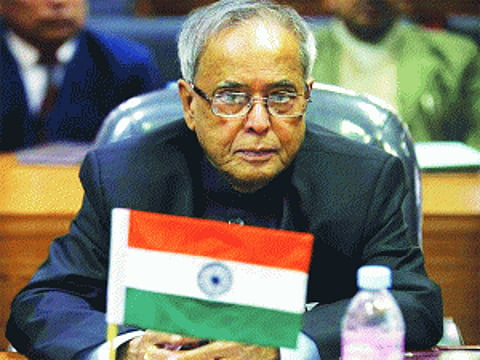

Pranab Mukherjee understands that time can be both ruthless and kind. So, his take on the Emergency; on the rise, fall and rise of Indira Gandhi; of factionalism in the Congress through the 1970s; and of the suicidal Janata Party months has come at a time when a large section of today’s generation was not even born, says RAJESH SINGH
British labour politician Neil Kinnock once said that “loyalty is a fine quality, but in excess it fills political graveyards”. Veteran politician and now the country’s President, Pranab Mukherjee, has in his five decades of public life seen many go to their political graveyards, and others resurrected after their political demise. There are few people better placed than him to vouch for Kinnock’s observation. It is for history to judge whether Mukherjee’s loyalty to Indira Gandhi, which remained undiminished and sustained till she lived, was of the kind that would fill political graveyards or was it just what it ideally should be — a fine quality. The near-invisible line which separates the loyal from the sycophant is thin and susceptible to many a breach.
There is another problem with loyalty: It colours the opinion of the loyalist towards the mentor who is a subject of criticism, often to an extent that what is palpably wrong is sought to be downplayed if not altogether dismissed as inconsequential. If the loyalist is a bit adventurous, he may even seek to justify the wrong or blame others for the blunder. Either way, the loyalist cuts a sorry figure.
The category in which Mukherjee falls will depend on the evaluator of the moment — ‘of the moment’ because the verdict given today may be different from what may have come decades ago, with everything else being the same: The incident; the person responsible for the incident; and the loyalist who backs the person responsible for the incident. Astute that he is, Mukherjee understands that time can be both ruthless and kind. And so, his take on the Emergency; on the rise, fall and rise of Indira Gandhi; of factionalism in the Congress through the 1970s; and of the suicidal Janata Party months, in his book, The Dramatic Decade: The Indira Gandhi Years, has come at a time when a large section of today’s generation was not even born — or just born — when the country was wracked by political tsunamis, when Government dissidents were picked up in the nights and thrown in jails, when Indira Gandhi and her party lost the election, and when she made a miraculous comeback aided by the stupidities of the Janata Party rulers who had, as its members, near-certified clowns such as Raj Narain and megalomaniacs like Charan Singh. The young have no connect with those turbulent times, of those dark moments in democracy, or those leaders — and they will, understandably, react less outrageously to Mukherjee’s defence of his leader.
As for the rest of us, it becomes really difficult to pass sweeping judgements, now that the author and Indira loyalist is the country’s President, and a marvellous one at that, especially given that his immediate predecessor had left nothing to chance in her efforts to ruin the reputation of the high office. And it’s not just the office he holds that makes us a bit reluctant to pull him up. Mukherjee was among the most erudite and mature politicians the country had — and his tenure so far at Rashtrapati Bhavan shows that he will go down as among the better Presidents of our Republic. Of the vices he may have, petty-mindedness is not among them.
Therefore, those who venture to comment on his book (as I do now), and comment less than favourably to some of his observations therein, do not run the risk of being misunderstood by Mukherjee as being mean-minded or plain stupid. With that relief in place, let us pick up the most contentious part in The Dramatic Decade — the Emergency. It has to be this because, but for the Emergency and its effects, the decade would hardly have been any more dramatic than politics usually is in this country. The period tested political values, held up leaders to their assertions, and exposed chinks in the country’s democratic armour. It made and broke careers, soon before and soon after.
However closely and between the lines you read Mukherjee’s account of the Emergency and the months preceding and succeeding it, you do not get the feeling that Indira Gandhi had struck a monumental blow to the country’s democratic ideals and on the Constitution itself. The author is, at the most, willing to concede that the decision was “perhaps an avoidable event”. But even that disapproval is diluted by arguments which seek to deflect blame away from the then Prime Minister and take it to her close aides, primarily the powerful Bengal leader, Siddhartha Shankar Ray — and to the ‘situation’ then prevailing in the country. This deflection is fortified by lengthy explanations (official and Indira Gandhi-friendly) on the state of the nation in the run-up to the Emergency. The grim economic situation as a fallout to the refugee flow from the then East Pakistan, the dramatic rise in international oil prices and the 1974 railway strike are among the reasons Mukherjee cites to build a case for the Emergency. The author merely narrates them all without questioning.
Does he really believe, even today, that the conditions had called for the suppression of democracyIJ After all, India faced a huge food shortage soon after independence; it had faced (and continues to face) external threats; the economy was in tatters when PV Narasimha Rao took over; huge public protests have broken out off and on against Governments — the most recent being the ones helmed by Anna Hazare. Yet, if none of these called for an Emergency, nothing back in 1975 did.
let’s return to Ray. He was certainly a powerful leader and proximate enough to Indira Gandhi to influence her. He definitely played a crucial role in her decision to impose the Emergency. But Mukherjee takes it a bit far when he swallows hook, line and sinker Indira Gandhi’s innocent claim that “she was not even aware of the constitutional provisions allowing for the declaration of a state of Emergency on grounds of internal disturbance...” Assuming, for a moment, that she was not, why did she acquiesce when Ray explained the matter to herIJ Surely she should have realised the grave consequences it would have on the freedom of expression and other fundamental rights of citizens.
The problem with such innocence is that it is put on. Mukherjee may have been a junior minister then, but he must have been sharp enough to see through the game. He must have realised, for sure, but he did not object. He was too loyal to Indira Gandhi to entertain any negatives about her politics and the dangerous road she was taking. Even with the advantage of hindsight, the author perhaps prefers to believe that a clutch of circumstances (including certain judicial pronouncements) had pushed Indira Gandhi into Emergency mode. It’s funny that Mukherjee spends many pages on the judicial challenges she faced and how certain orders were not appropriate. But he has little to say on how her regime superceded inconvenient judges and appointed pliant ones, who even went to the extent of endorsing, besides other atrocious things, that Parliament could suspend a citizen’s fundamental rights.
Mukherjee’s disapproval of Jayaprakash Narayan’s movement against Indira Gandhi is understandable, given his loyalty to the then Prime Minister. He found the campaign against her “directionless” and “contradictory” to its stated purpose of fighting corruption. While this contention is debatable, the author does admit that the after-effects of the Emergency “have significantly influenced subsequent events”.
Interestingly, he does not himself refer to the imposition in negative terms but uses the third person, as in: “Referred to as the darkest period in independent India’s history...”
Mukherjee is on more sure grounds — and his loyalty shines admirably — when he talks of the months Indira Gandhi spent out of power after she and the Congress were roundly defeated in the 1977 lok Sabha Elections. Senior leaders had left her side and crossed over to the enemy ranks just before the elections, and some of those who were in the party had begun to, in private (they couldn’t dare to do so to her face), blame the excesses she and her son Sanjay Gandhi had allegedly ‘unleashed’ on the people. After all, it was fine — though it was indeed not fine — for her men in uniform to swoop down on prominent Opposition party leaders in the middle of the night and put them behind bars, where some would spend a considerable period of time before being released. But it was shocking that common citizens became targets of forced family planning. It is the people’s anger more than the outrage of the Opposition leaders and the intelligentsia — at least some section of it was opposed to the Emergency — that turned the tide against Indira Gandhi. But Mukherjee deftly skips any judgement on the excesses and takes the position that “many of us who were part of the Union Cabinet at that time (I was a junior minister) did not then understand its deep and far-reaching impact”.
We are digressing here from the antics of Congressmen in the wake of Indira Gandhi’s rout. It is here that Mukherjee’s revelations are so precious because they come from an insider and are about the murky insider politics. It brings out the fighter in the former Prime Minister — the sign of a true leader, whether in or out of power. She faced criticism from, among others, Ray himself (who was under the scanner for having ‘misled’ her), Priya Ranjan Dasmunsi, Chandrajit Yadav — and even the ‘India is Indira’ remark fame, DK Barua. Mukherjee terms this bunch “neo-radical”; Ray did some deft political balancing, even congratulating Morarji Desai for becoming Prime Minister; other Congress leaders, believing that Indira Gandhi’s political future was over, stepped up their offensive against her.
In the chapter entitled, ‘Battle lines Drawn in the Congress’, Mukherjee highlights the fight-back that Indira Gandhi initiated, the most famous being the elephant ride to Belchi in Bihar. It had a tremendous impact on the people — just imagine how much it would have conquered the minds had it happened in today’s era of 24/7 television! The author talks of the ‘Thursday Club’ of certain senior leaders, including Vitthal Gadgil, targeting Indira Gandhi and finding support in the likes of YB Chavan. In the end, of course, these initiatives, just as those involving Brahmananda Reddy, who had been elected party president with Indira Gandhi’s support and had turned against her thereafter, fell apart as the vanquished leader began to rise.
The one narrative in Mukherjee’s book that cannot be disputed on both content and analysis deals with the series of blunders that the Janata Party Government committed, not just in governing the nation but also in politically dealing with Indira Gandhi. Instead of getting on with the task of governing, the regime’s Ministers made it their full-time business to persecute her, and they did that task in the most ham-handed fashion. The farce of her arrest and her dramatic release hours later caught people’s imagination. What the faction-ridden Congress had failed to do, the Janata Party had managed to succeed in: Resurrect her political career. And, a fortuitous split in her party confirmed her as the leader of the real Congress, which came to be called the Congress (I).
Mukherjee appropriately points out the silly games that senior ministers like Charan Singh played, weakening a Government in which he was de facto the second-in-command. The Jat leader’s visceral dislike for Indira Gandhi came to the fore when he pulled up his own Government for being a “pack of impotent people” as it had failed to act against the Congress leader and former Prime Minister. Morarji Desai was livid with the remark and asked him to quit the Cabinet. Although Charan Singh returned to the Cabinet after quitting and even became the Deputy Prime Minister, Desai had clipped his wings. It is ironical that Charan Singh, who was in the forefront of the hate-Indira campaign, should have taken the same leader’s help in toppling the Morarji Desai regime and becoming Prime Minister — if only for a short while before the Congress showed him the door.
Interestingly, Mukherjee informs that in the initial stages, while the “hawks” such as Charan Singh, and even Morarji Desai then, wanted the Government to deal sternly with Indira Gandhi for her Emergency, “doves” such as Atal Bihari Vajpayee felt that a strong “reprimand” would suffice. One wonders in hindsight if Indira Gandhi would have been able to bounce back through political capital at the Opposition’s cost had the Morarji Desai regime accepted Vajpayee’s advice.
Here, Mukherjee is candid in admitting that the Congress decided to support the Charan Singh faction because “we wanted to ensure that it (Janata Party) broke from within”. And so it broke, and how! It is only now, more than 30 years later, that it is being sought to be desperately re-assembled with a new look.
The Dramatic Decade could have arguably been more dramatic had Pranab Mukherjee been more forthright with his opinion of the Emergency. Nevertheless, if one keeps aside this disappointment, the book is an invaluable guide to the country’s political developments of the 1970s.
Hopefully, he will next write an account of how and why he fell from grace in the new dispensation that came in following Indira Gandhi’s assassination, despite his proven loyalty.