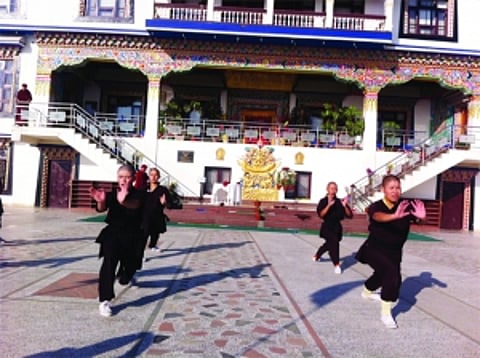

Buddhism has primarily been a male preserve with the women confined to doing household chores like cooking and cleaning for the monks. But at the Amitabha Drukpa Nunnery in Kathmandu, it’s the other way round as the nuns call the shots. Utpal Kumar visits the nunnery to find out how kung fu is silently revolutionising their lives
Buddhism is witnessing a revolution on the hills of Kathmandu. A kung fu revolution, to be precise. More than a dozen young nuns, in their traditional Buddhist attire, are punching and kicking, huffing and puffing in the backdrop of the majestic Amitabha Drukpa Nunnery. Sun is out shining in all its glory, but the wind is strong enough to take away much of its warmth, and dragon flags are fluttering vigorously all across. Amid all this stands the young Jigme Zekit lhamo, going through the drill like a true kung fu practitioner. An hour into the exercise, she remains as intense as ever.
“I came here from a village in Himachal Pradesh in 2007. You won’t believe,” she says with a coy smile, “I had to go to the extent of threatening my parents that I would kill myself if I was not allowed to join the nunnery.” She recounts how her father, a senior police officer in Himachal Pradesh, was upset with the decision and didn’t talk to her for days. Her mother was far more understanding, though she too was worried about her well-being. “She was not sure if I would be able to adjust to the arduous lifestyle of a nun, thinking I was too young for all this,” says she. Jigme recalls her mother telling that she wouldn’t have worried much had her eldest sister joined the nunnery.
Six years have passed by, but the 18-year-old Jigme still gets numb when asked about her family. All these years at the nunnery have not yet filled the vacuum left by the absence of her family members. “There are times when I miss them and question my decision to join the Drukpa order. But when I introspect, I realise that I am happy here. This is where I always wanted to be.”
Jigme is one of the 300 nuns who regularly assemble at the Amitabha to throw punches and practise kicks. Introduced in 2008, kung fu is mandatory for everyone, except those who are too old or unwell to participate. But unlike the popular perception, the nuns don’t practise this art in the morning. “We do it for 90 minutes from 8.30 pm to 10 pm,” says Jigme. “Our lives start everyday at 3 am and ends at 10 in the evening.” She then enumerates how a nun begins the day with a dose of meditation and prayers, followed by cleaning, sweeping, cooking and studying, which includes learning Tibetan grammar, Buddhist philosophy, English and computer classes.
Jigme is soon joined by Wangmo, who has been in the nunnery since 2005. Over the years, she has started teaching kung fu to the other nuns. “Everything, including food, is well-scheduled here. So much so that we are not supposed to eat anything after lunch, and never sleep for more than five hours a day. It’s tough to be a nun, but kung fu helps us cope with it,” says the 28-year-old Wangmo, who also hails from Himachal Pradesh.
Kicking off a new era
Amitabha’s tryst with kung fu began in 2008 when His Holiness the 12th Gyalwang Drukpa, head of the Drukpa school, saw nuns in combat training during his visit to Vietnam. “I was inspired because these Vietnamese nuns exhibited remarkable self-confidence and strength, both physically as well as mentally. I was, thus, tempted to invite four Vietnamese nuns to come here and teach our women,” he says. Sitting cross-legged on his traditional seat at Amitabha, the Drukpa comes across as a living example of the ‘laughing Buddha’. He smiles as he talks — and his smile is infectious.
“Kung fu has given us good name and publicity. It has raised global curiosity about us and everyone knows — or wants to know — us. So much so that this nunnery has become some sort of an amusement park. Initially, People would throng here everyday in large numbers, but we never wanted it that way. For us, the nunnery was a retreat centre for prayer and meditation, and the presence of so many people all the time wasn’t ideal for this; they were distractions for us,” says he. The Gyalwang Drukpa, therefore, decided to confine the entry of outsiders to just one day in a week. “Visitors can now come to the Amitabha nunnery on Saturday, which is also the official holiday in Nepal,” he says.
Kung fu, for the Gyalwang Drukpa, works on two levels. “At the lower level, it improves the mental and physical health of a nun. But at the higher level, mixing meditation with martial arts is aimed at gender equality.” For him, even the idea to import four Vietnamese nuns to train kung fu was deliberate. “We could have easily got male instructors, but this would have further reinforced our gender stereotypes. This is also the reason why we insisted on keeping it all female. Here all the chant masters are women and, unlike in other places, they sit in the front, while male members are supposed to be placed behind them. Our nuns can also perform the dragon dance, traditionally the preserve of a monk, and I have the privilege of personally teaching them this art,” says he.
According to the Gyalwang Drukpa, not enough has been done to improve the lives of Buddhist women. “Buddha never said women are less significant. He, in fact, always believed in equality of all beings. Yet, I find women not getting enough importance in our institutions. Our nuns have not been involved in anything substantially spiritual and confined to doing household chores like cooking, cleaning, etc. It is for this reason that I decided to build this nunnery,” says the spiritual leader of the Drukpa school, setup more than 800 years ago and has large followers across Tibet, Bhutan, China, Nepal and India.
Going universal
The transformation, however, isn’t just confined to the Drukpa school of Buddhism. Early this year, the Dalai lama confessed that he would be pleased if a woman were to succeed him. While reiterating the need to have more compassionate leaders, he said that “biologically, females have more potential... and have more sensitivity about others’ well-being”. As a result, he said, “if the circumstances are such that a female Dalai lama is more useful, then automatically a female Dalai lama will come”. This was apparently not the first time he had made such a comment: Way back in 2007, he had said that “if a woman reveals herself as more useful, the lama could very well be reincarnated in this form”. Two years later, the Tibetan spiritual leader had also famously called himself a ‘feminist’, saying: “Isn’t that what you call someone who fights for women’s rightsIJ”
This changing outlook vis-à-vis nuns is indeed momentous, particularly when one finds that Buddhism has essentially been an egalitarian religion, and Gautam Buddha never really differentiated on gender lines (no doubt, Buddha had his reservations in allowing women into the Buddhist monastic order, before he was persuaded otherwise by Ananda, but his opposition was more on organisational lines rather than ideological).
With the passage of time, however, the egalitarian character of Buddhism got submerged, and women were given the second-class status. Several Buddhist texts, for example, insist that a woman can only attain to ‘Buddha-hood’ if she reincarnates first as a man. Teachings went as far as to regard them as “agents of the devil” who would seduce men away from obtaining ‘Buddha-hood’. Japanese Buddhism, for instance, has taken an extreme anti-women stand, portraying them not simply as disadvantaged but “positively dangerous”. To this day, the nuns are expected to comply with 98 more precepts than the monks, including the rules that they would obey the monks; that they won’t give them any advice; and that even the senior-most nun would have to take a lower seat than the youngest of monks!
In this backdrop, when the 300 nuns are made to call the shots at Amitabha — from practising kung fu to running the café to fetching groceries from the Kathmandu valley on their own — it’s making a positive change. The Gyalwang Drukpa recalls how people as diverse as Princess Basmah Bint Saud of Saudi Arabia and Cherie Blair of the United Kingdom come forward to help the cause. “This experiment has aroused world-wide interest,” says he. “Recently, the Saudi princess asked me about the kung fu nuns and how they had been transforming the lives of women in Buddhism. She told me about Muslim women trying to come out of the age-old shackles of orthodoxy and how some of them could now be seen driving their cars.”
The Gyalwang Drukpa is happy that the Saudi princess has invited him and his kung fu nuns to Arabia. For, he believes that the kung fu model is universal and can be replicated elsewhere as well. It’s now the symbol of gender equality, and its scope goes beyond Buddhism, says he.