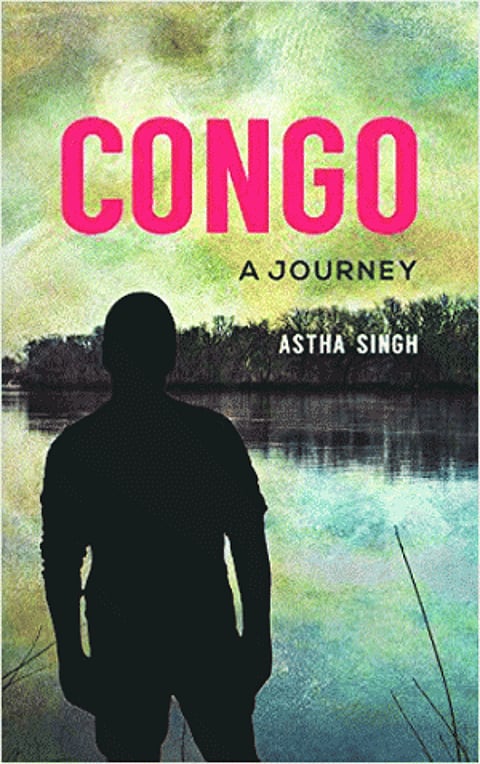

What makes Astha Singh’s Congo: A Journey enticing is its unusual setting. It’s a coming of age saga of a young, ambitious Indian in the Democratic Republic of Congo. It is also set at a time of internal political turbulence in Kinshasa, where a young Gujarati, Ramesh, rises to fame and glory as “big boss”, Manikchand Seth.
The story is a chronicle of the amoral Ramesh’s journey from anonymity and struggles in India to the murky alleys of fortune in Congo, within which, the readers are exposed to a shady maze of illegal trade and ‘exotic’ women.
The aspiration to be rich is so ingrained in him that it blurs the line between ambition and greed: “One day…one day…it will happen. I just know it will. I do not know howIJ WhenIJ I know I am going to be the king of Kinshasa. Then all those sucking mother******* will bow down and do salaam to me…”
It’s March 2006 and Vice President Jean Pierre Bemba and his troops have forcibly seized Kinshasa in a horrid coup d’état that bears testimony to incessant firing and ruthless violence. Amidst this mayhem, the readers are familiarised with the squalor that engulfs Kinshasa, which is still a swarming and growing city. Ironically enough, Ramesh sees this as a moment of ascent for himself and what follows then is a saga of overwhelming lust, conspiracies, and revenge. Adding multiplicity to the novella is the practice of voodoo in the story as well as Ramesh’s stint in the Congo prison.
The 150 pages long novella opens with a sexual context and prostitution remains a core part of it. In her debut, author Singh has allotted substantial attention to the women in the story as well. There is the conventional wife, duly following normative patterns assigned to her by society’s self-proclaimed custodians, the prostitutes, or the wife of a poor, helpless migrant. Other intriguing male characters include the ones who perform voodoo, the precarious warlords, the decadent businessmen and the rich Indian Belgian who merges his croissants with bidis.
The novella allows one a glimpse into the tumultuous and volatile world of African politics as well as civil life, if the word civil applies there at all. Nevertheless, within the multicultural ambience, it still echoes universal concerns.
Singh’s experience as a journalist in India and her years in Congo seem to have empowered her observation and narrative style. She has lived the life of an Indian expatriate in West Africa for a decade and the novella derives its authenticity from her eight years in Kinshasa.
Although it might not be regarded as a diasporic saga, it is indeed very rare where we read about the lives of expatriates in Africa, particularly the ones who have climbed the ladder of success and have established themselves with authority there: “Kinshasa was bursting at its seams. There was hardly any electricity and portable water in the interior of the city. Medical facilities were non-existent, and education was beyond the reach of the locals. However, the rich locals and the expats continued to live in a bubble, and shop at super markets like City Market or Alimentation Express, where a carton of milk cost $10”.
Written with much simplicity, it is laden with expletives but also brings out a realistic and debauched picture of what one can do to another. lust being a crucial and constant theme, it brings out the most repulsive, vile and sexually explicit thoughts of people. The most disturbing would be there chauvinistic, misogynistic overtones: “The wives should be kept busy with pregnancy and partying”.
Sexual acts and carnal fantasies expressed in the narrative might make most readers cringe: “Ripe, ready and juicy. Saala, I need her. She is a ripe Alphonso mango. I have to have her”. The nexus among politics, business and human follies have been significantly reiterated.
The novella is reader friendly and reaches out to the masses. But it is important that they see the poignancy of the lives as depicted in the unstable clasp of fate in Congo rather than being titillated by the sexual imageries, innuendos and expletives. There isn’t much subtility and literary experimentation done in the novella, but perhaps that could work as its primary lure as well, as an ostensible ‘metro-read’ for the masses.