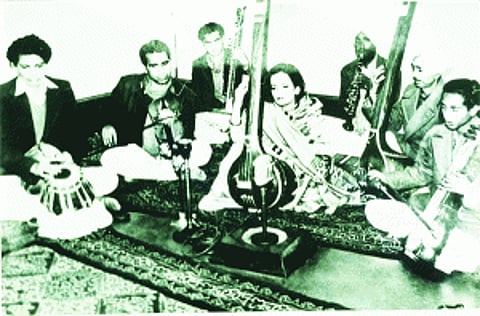

The fading sun usually brings darkness in its aftermath, but there is also the golden glow of the moon at times that bursts forth. As the sun began to finally set on the royals in Awadh in the second decade of 1900s, somewhere in a corner of the kingdom was born a girl who, battling odds, would flower into the world’s foremost ghazal singer, leave an indelible impression for centuries to come, and become the benchmark for ghazal singers and connoisseurs alike. She was Bibbi, later Akhtari Bai Faizabadi, still later recognised, respected and envied in the world of singing as Begum Akhtar.
Nothing, as it turned out, was ordinary about her. Not the circumstances that led her to singing; not the personal challenges that nearly left her a mental wreck; not her determination to make a mark and establish her writ in a world that deemed women and women singers as inferior; and, not her behaviour, which oscillated between childlike innocence and crafty and scheming.
In the four decades that she strode the ghazal canvas like a colossus, she had the world at her feet, and her peers either swept off their feet in delight or relegated to backbiting about the “means” of her achievement. But those were the others; she was the legend — in her lifetime, and after her death.
When she sang Behzad lakhnavi’s ‘Diwana banana hai to diwana bana de’, Begum Akhtar conjured the world of a lovelorn soul that yearned for salvation, and warned the world that the experience of pangs would leave it as bemused, as befuddled, and as desirous as she was, of more of the pathos. There wasn’t the slightest difference, at that moment, between the singer and the song. Popular poet and lyricist, Javed Akhtar, is reported to have once remarked, “I feel proud to say that ghazal and Begum Akhtar are synonymous.”
That, in a nutshell, is her legacy. There is no way it can be undone. Ghazal singers since her time have come and gone; some have even made a big mark. But none has been able to dislodge her from the pedestal that she occupies. She remains the sentinel of refined singing, that which does not fall prey to populist experimentation and yet reaches the deepest corners of the listeners’ hearts — even today when ghazals, or whatever goes by that name, has co-opted itself to the strains of populism.
In a way, despite the emasculation that has come, popular ghazal singers of the last three decades especially, have drawn inspiration from the legend. While they have not imitated her (for reasons of a ‘changed’ audience taste or due to their sheer inability to replicate her), they recognise and acknowledge that the foundational base of ghazals owes everything to Begum Akhtar. She is the mother, the ammi, of ghazal gayaki. The rest, whether it is Jagjit Singh or Mehdi Hassan or Ghulam Ali, or the others who have gained varied levels of acceptance, are streams of that fountainhead.
There are different versions of her first important public performance. In her book, Ae Mohabbat… Reminiscing Begum Akhtar, author and singer Rita Ganguly writes on this interesting episode. The year was 1925; Begum Akhtar was barely 11 years old; some of those who were scheduled to perform at an event in the then Calcutta had suddenly done the vanishing act. A terrified Akhtari Bai Faizabadi, who had shifted to the city in pursuit of her dream, was compelled to perform.
“Out of sheer fright, she (Begum Akhtar) shut her eyes while the ustad was tuning the sarangi, and he poked her with the bow to start singing, glaring at her that she better sing. Bibbi visualised her mother’s face and prayed to Hazrat Ali that he should sail her through. She knew it was a do-or-die situation she was trapped in,” writes Ganguly.
The rest, as they, is history. Begum Akhtar had become the new star on the music horizon, and in the years to come became the only star with such blinding dazzle, gaining shine performance after performance, cutting one best-selling disc after another. ‘Ae mohabbat tere anzaam pe; Woh jo hum me tum me karar tha; Dil ki baat kahi nahin jaati; Yeh na thi hamari kismet; Ab chalakte huey sagar… her songs moved the hearts and filled the eyes with tears.
And yet, despite all the unprecedented success, there were challenges. Or, it can be more appropriately said that the success brought along those challenges, and many of them were of a personal nature. Begum Akhtar lived in an era and in an environment where women achievers were looked at with some degree of circumspection, and women singers especially were bracketed with the kotha types. There were also men who were eager to shine in her reflected glory but never gave her her own personal space.
Begum Akhtar did not make things easier for herself when, at least in the initial years, she allowed herself to be used, manipulated and hurt — all because she regarded well or loved the people who tormented her. The episode of her marriage into an elite family which did not find merit in having a woman member singing in public, her withdrawal from the art, the resultant impact it had on her physically and psychologically, the marriage running into trouble, and her eventual escape from the circumstances and back to singing, have been documented extensively.
There are also other events that marked her tumultuous teen years and nearly threatened to nip a blossoming career in the bud. Had that happened, the world would have lost what became a legend.
Begum Akhtar’s musical journey was not an easy one. As a teenager, she initially did not have the patience to learn the basics of classical music, often imploring her eminent but exasperated tutors to teach her songs that caught her fancy. For instance, she took a liking to the Dadra genre just when her tutor was initiating her into the basics of ghazal gayaki, irritating him no end. It took a while for her to settle down to the serious intricacies of ghazal singing.
To add effect to her renditions, famed Kathak dancer, Pandit Shambhu Maharaj, was roped in. Her arresting looks coupled with the bhava she learnt from Panditji made her an instant hit at public and private concerts and even opened the doors for a few films which she did. But that was later; the beginnings were rocky.
Ganguly writes in her book that one of her tutors who trained her in ghazals, Ustad Zamiruddin, had to pull her ear when she lost focus or became unmindful of his lessons.
The ghazals that Begum Akhtar sang had been rendered, and were to be rendered, by different singers. And yet it was she who set the standards others would invariably be compared with. For instance, many singers gave their voice to ‘Mere humnafas mere humnawa, mujhe dost banke daga na de,’ but none managed to come anywhere near the magic she created.
And look how this stands from the loneliness she experienced in her personal life; she would often tell her worried well-wishers that they shouldn’t bother about her solitude because loneliness was a companion that never betrayed. Then there are ‘Ab chalakte huey sagar nahin dekhe jaate; Ulti ho gayein sab tadberein: Kuch to duniya ki inayaat ne dil tod diya’ — each one a gem and unparalleled in treatment and delivery. Begum Akhtar’s full-throated voice, and those little effects she added, left audiences mesmerised and her peers envious.
Once she was established on the musical firmament as a ghazal singer without compare, Begum Akhtar began to take up other genres as well — those that she had fallen in instant love with at the beginning of her journey. Soon enough, Thumri, Dadra and Khayal got added to her repertoire. Who can forget the Dadra: ‘Hamri atariya aao sawanriya, dekha dekhi balam hui jaye’; or, ‘Koeliya mat kar pukar, karijwa laage katar’, or the Thumri, ‘Akhiyan need na aaye, reh reh viraha sataye, hai’IJ
On a visit to lucknow, most people throng either to the ‘new’ areas littered with malls or the old city to absorb vestiges of the lost lucknavi era. Even those with a musical bent of mind rarely remember that this is a city inextricably connected with Begum Akhtar, and that it is here in Pasand Bagh that her tomb, her mazar, is. Superstar Amitabh Bachchan once so appropriately said that Begum Akhtar’s body of work “shall always remain a great heritage of our culture and tradition”.