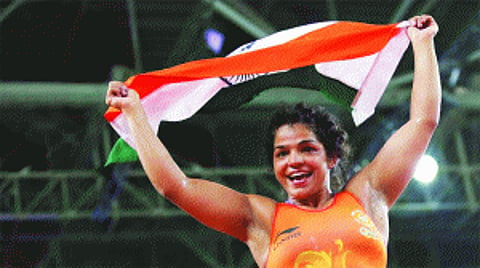

Performances from Sakshi Malik and PV Sindhu give us reason to be proud and buoyant about the future. Their staggering acts have given a lot of people, especially girls, a reason to go and venture into a field that is tough to break into
One has to be an eternal optimist to believe that sports can be a liniment to a nation’s ills, but there is something so delightful about them that allows people to take their minds off politics, despair, and grubbiness all around. The Olympics, of course, have their share of problems and the skeptics will argue that the aura and ethos of the Games vanished many years ago. Rio’s empty seats, public protests, doping crisis, global criticism and the scandal involving the arrest of the IOC’s Pat Hickey caused worldwide upheaval. However, watching the best athletes strive and work hard in their quest to win the Olympic medal is a joy that helps the cheers drown out the jeers.
Ultimately, how long can you stay a skeptic if you watch Syrian teen Yusra Mardini win her heat in the 100m butterfly for the Refugee Team in week one, a year after surviving the capsize of a six-man dinghy carrying 20 refugees towards lesbos. Mardini had then spent three hours in the sea helping drag the boat to shore. “I just thought it would be a real shame if I drowned, because I’m a swimmer,” she had said. If that wasn’t enough, watching Nikki Hamblin and Abbey D’Agostino help each other finish the 5,000m race would have certainly melted some hearts.
In the end, medal tables are not just numbers. They do tell stories of a country’s dominance, or decline, and point to trends that need to be observed and addressed. All time leaders, the US, crossed another landmark as they reached a record 1,000 gold medal mark. Michael Phelps was once again the most celebrated figure, as he won five golds. The number would have been six, but for Joseph Schooling beating Phelps in the Men’s 100m butterfly. Schooling gave Singapore its first ever Olympic gold and ensured that the present and in an almost poetic fashion, the future of swimming were together on one podium.
Nineteeen-year-old gymnast Simone Biles had spoken about her crush on American actor Zac Efron in an interview before the event, but she wasn’t just a gushing teenager while she was performing. She possesses jaw-dropping power, laser precision, and pure dynamism and for the uninitiated, she also boasts a flawless competitive record over the past three years. Biles came with massive expectations and somehow managed to realise them flawlessly. She had Efron compelled to fly to Rio to meet her, and there was also a small matter of winning four gold medals, making her the most decorated gymnast in American history. Nineteen year old Katie ledecky became only the third US woman to leave an Olympics with four gold medals. ledecky seemed to swim from nowhere to win gold at the london Olympics four years ago as a 15-year-old, and her trail of gold medals and broken world records since is unmissable.
It was an underwhelming outing for the Chinese though, for whom the medal table showed a severe dip in some events. The country came in third place in the gold medal count at the 2016 Summer Games, trailing the United States and Great Britain. Eight years ago in Beijing, China sat on top with a record 51 gold medals. There has been speculation indicating China has been slashing budgets spent on elite athletes and spending the sums across the general population. It might merely be speculation, but the economic slowdown was expected to hit the spending on sport.
The world will remember Usain Bolt as the most compelling figure of the modern Games. He was easily able to achieve the three-peat or the triple treble. The Jamaican has retired from Olympic competitions with an astonishing full house of nine successive gold sprint medals. Is Bolt the greatest of all timeIJ Probably yes. To win all three medals and do so while smiling and closing is something beyond mere mortals. Astonishingly, take Bolt away and the top 26 fastest runs for the 100m all belong to athletes who have failed a drug test. The boy who broke out in 2002 world junior championships in Kingston, coming first at the age of 15, possesses that same grand racing style even now, with an illusion of almost effortless superiority. At 30, he is still in control of his sport but him deciding to hang up is boots is perhaps simply a case of an athlete with nothing left to prove. He might have outgrown his own sport.
For Indians, the good, the bad and the ugly went hand in hand. India’s “national sport” is where the nation has been most successful in the competition. In previous Olympics, the men’s hockey team has captured gold eight times. No other country can boast of this kind of success. But what causes pain and despair are that the last time India won an Olympic medal in this sport was in 1980, and this still didn’t change in 2016.
Marathon runner OP Jaisha collapsed at the finish line and had to be rushed to the hospital. She claimed that she was not provided any water and energy drinks by the countries athletics contingent. If her claims are true, it is a truly despicable and astonishing act and simultaneously, her grit and determination to finish the race despite facing these problems in the scorching Rio heat is remarkable. Just winning two medals after winning six in the last edition, the doping and selection saga involving the wrestling federation and the pictures of the officials partying in Rio and flying business class in the flights while stuffing the athletes in the coach section is embarrassing and doesn’t do the country a lot of good.
But there is plenty of reason to be upbeat. Indians are extremely proud of some athletes for their rousing performances in the Olympics and bringing honour to the country. They have been rightfully congratulated and hailed by everyone.
Dipa Karmakar showed what was right about sports in India and what wasn’t. Her story is incredible, and one which could make an excellent Bollywood biopic. With humble beginnings, a leaky gym and mats piled on top of each other instead of a vaulting table; Karmakar pursued an impossible dream. She defied all odds in getting to the final, and despite not winning a medal (she narrowly finished fourth), she brought a country together as everyone paused from their routine to watch her vault. However, her success has little to do with “India” and more to do with her personal and her coach’s grit, hard work and perseverance. Her request for her longtime physic Sajad Ahmad to be allowed to accompany her at the Olympics was denied by the SAI and considered “wasteful” until she qualified for the final.
Deepika Kumari comes from a family which earned Rs 1,500 a month and lived in a modest hut, yet this never hampered the archer’s drive to succeed. The world number 12 finished 7th in the ranking round with her team before losing the quarterfinal match against Russia. It was her stellar performance against Kristine Esebua of lithuania in the individual game which caught the eye. She won with a score of 6-4. She went down in the round of 16, but it was an encouraging tournament for the 22-year-old who has a lot to offer in the future.
Babita Kumari also came very close to winning the medal in wrestling but unfortunately fell just short. The wrestler won a gold medal at the 2014 Commonwealth Games, so there was some expectation on her shoulder to perform well on her Olympic debut. What made things more taxing was her temporary suspension imposed by the United World Wrestling. There were further adversities inside the wrestling world, and in the non-sporting world that made her road to the Olympics rockier. Her father was ridiculed and ostracised for wanting his daughters to pursue the competitive sport. It’s little surprise that their story is being brought to celluloid by Aamir Khan later this year. While Babita did well in progressing to the quarterfinals, she struggled to find her feet in the first period and lost 1-5 to Greece’s Maria Prevolaraki. Her cousin, also a wrestler, Vinesh Phogat, was also gunning for a medal this year. After a lot of trouble with the Federation due to weight and doping issues, Phogat ended up participating in the final, but as the 21-year-old took the mat during the Olympics, an injury to the knee during the initial stage of her fight shattered her Olympic dream in a cruel manner. But she is a fighter, and there is no doubt that she will come back stronger in the next quadrennial event in Tokyo.
Sakshi Malik ensured India opened its account at the Olympics by claiming the first medal at the event. Trailing 1-5, with just 2 minutes left, the hopes of thousands of Indians watching, were sinking in the Barra Westling Arena 2, but Sakshi wasn’t ready to give up as early as the spectators. The double-left takedown, her signature move illustrated her power, strength, and endurance and helped the 22-year-old win the bronze as she beat Kyrgyz Aisuluu Tynybekova 8-5 and won her and her nation its opening bronze on Day 13 of the Olympics. It was Geeta Phogat who had received more of the spotlight in women’s wrestling till now, but the diminutive, strong and tactically smart Malik worked hard on her fitness and shocked the world by beating world champion Johanna Mattson in Istanbul in the qualifiers. Months later, she has scripted history by becoming the first woman wrestler from India to bag an Olympic medal and only the fourth female athlete from the country to climb to the podium at the biggest sporting event in the world.
The highlight of the Olympics was that millions of cricket-obsessed Indians cheered for 21-year-old Badminton player, PV Sindhu just as hard as they do during a cricket match. Saina Nehwal is the domestic name in Badminton, but the 2012 Bronze winner faced an injury and got out very early in the tournament. Sindhu made sure India had someone else to get a medal in the sport. While she lost the final match to the exceptional World number one Carolina Marin, the Hyderabad player’s march to the final was as good as anything else. If Sindhu’s quarter-final win was exhilarating as well as nerve-wracking, her semi-final win over Nozomi Okuhara was lucidly commanding as the girl from Hyderabad dictated the proceedings. When things got tough, she responded by winning 11 points on the trot. Her performance in the final against the girl seeded nine places better was praise-worthy, but she might have felt that she came up short on the occasion. There were some mistakes; there were inconsistencies shown, and it is evident that she has a lot to learn. However, Sindhu is 21, and she has already left a mark in her sport. She conducts herself with a lot of grace, shows sportsman spirit — her image of going over to congratulate a weeping Marin, flat on the floor, will be long-lasting. The Badminton star has the ability, technique and physique to outdo India’s best. India will not forget her long, hard paced rallies, her baseline drop shots, the manner in which she covers the court and that dipping smash anytime soon. She will be 25 at the Tokyo Olympics and considering her performances at Rio, will want to turn the silver into gold.
India’s best performances, medals, and hopes came from the women in the tournament. These young girls earned rightful praise and admiration from the country but it was downright irking when tweets and expressions such as “India’s daughter”, “sister” and “save our girl child” were delivered by celebrities and ordinary people alike. A woman doesn’t need to achieve something extraordinary to justify her existence. Some would urge that these remarks should be taken lightly and seen in a positive light, but upon pondering, there is something just so deeply unsettling about these terms.
The success of Malik and Sindhu is exceptional because the Indian society is a patriarchal and oppressive one. As in the case of Kumari and others like rower Dattu Baban Bhokanlal, we can see that the athletes so often come from a disadvantaged section of the society. What adds to the woes is that the facilities are not as good, and there is plenty of corruption, which ensures that coming from disadvantaged strata becomes an even bigger problem. This is what makes the achievement from any Indian sportsperson, man or woman, remarkable. Indian athletes are worthy of respect even if they don’t come back with anything significant. There are so many obstacles they have to cross to be simply able to compete at that level, that it should be enough to command our respect. This cannot justify every poor performance, and I am certainly not an apologist for the dearth of medals, but these factors should always be put in context to have an understanding of the wider picture.
Performances from Malik and Sindhu give us reason to be very proud and buoyant about the future. Their staggering acts have given a lot of people, especially girls, a reason to go and venture into a field that is so tough to break into. It might be too optimistic to hope that the “system” will change, and we can expect our athletes to have the facilities to make a bigger mark in the next Olympics. Sports other than cricket need further investment. Already, there are leagues for other games which might help, but a lot more has to be done rather than just have star-studded and glamorous leagues. There has to be a long-term vision to achieve our aspirations. Four years might be too less to bring in a lot of change, but already there have been a lot of positive changes. One can hope that it is enough time for provisions to be made to ensure our athletes have the facilities and infrastructure to get us the medals we crave for so much. We must target the 2024 Olympics as the one where we want to do particularly well as producing a champion requires that much time and over a sustained period, from the grassroots till the top. It’s a natural progression and development. More facilities and better infrastructure have to be in place so that our athletes don’t have to travel overseas all the time for something that can be easily carried out at home. It makes sense as they cannot keep going overseas to prepare as they live in India. They would only go for some time which halts their training which ideally should be for longer periods of time. This would naturally require massive investment and expertise, and we will have to get this from outside. Abhinav Bindra, who missed the Bronze by the smallest of margins, summed this up beautifully in one tweet: “Each medal costs the UK £5.5 million. That’s the sort of investment needed. let’s not expect much until we put systems in place at home.”
We need the top level infrastructure, the best coaches, qualified sports scientists, psychologists and physiotherapists to ensure that we can go head to head with countries which give these opportunities to their athletes. Our athletes, their coaches and their admirable work ethic, perseverance and talent can only do so much on their own.