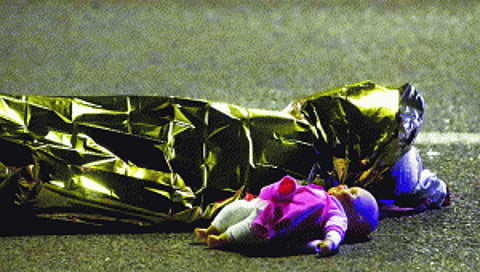

The institutions which profit from fear have resigned from the moral responsibility of trying to solve the problem. Instead they’ve chosen to leverage the situation and thrive. The political perpetrators of fear and the individuals reacting to such rhetoric are both to blame, even now
We have adapted our lives to the belief that we are not safe anywhere. The recent attacks in Nice and Istanbul, that took place within a span of just about a fortnight, made us wonder if the next attack might be in our city. We worried for the safety of our children. We felt helpless in understanding the motive of the attackers. The attacks were no longer even unusual and reminded us of the new normal we all now live in.
To count just a few in the past six months, not only have mass murders occurred in Nice and at the Istanbul airport, there have been massacres of Iraqi Shia families celebrating the end of Ramadan in Baghdad, of innocent folks inside a night club in Orlando, and of families at an amusement park in lahore.
In every incident, the attackers chose crowded spaces from which escape was difficult. Turning an ordinary object into a weapon is seemingly not shocking anymore either — on September 11, 2001, it was passenger planes, while it was a cargo truck used in last week’s attack in Nice. The ideology of the shooter in Orlando also seems just as incoherent as that of the one in Nice. So much so that it appears that mass murder can occur at any place.
And each time the media broke the news of yet another act of terror, we hoped that the attacker would not be a member of a minority community of the land. Yet when this was the case, it left the remaining innocent members of the community to absorb the rebound of shame, anger and blame.
I would much rather write for you about brilliant scientists or those breaking new ground on our sense of aesthetics, rather than about a man with the nerve to murder en masse. I feel that the attention we give to the profile of a killer plants a murderous idea in a new head.
But this is why it also worries me that the institutions that profit from fear have resigned from their moral responsibility or from trying to solve the problem. They have chosen to leverage the situation and thrive.
Conservative parties are more nonchalant in whipping up emotions around people being attacked, and then denouncing the liberals for lack of patriotism and for exposing the country to danger. Many years ago, Gustave Gilbert had already explained in his account of the Nuremberg trials of Nazi leaders that people can be made fearful such that they will be convinced to support a cause they otherwise would oppose. Indeed the political perpetrators of fear and the individuals reacting to such rhetoric are both to blame, even now.
Media houses that gain eyeballs with every sensational story about the attacker or gory images of the dead are going about their business to do so with zeal. As a result, the television coverage of death in the attack in Nice was unprecedentedly dehumanising.
Writers who trade on sensational stories of violence are surfacing on social media with shrieking comments, sharing their personal involvement in the issue, while finalising their book proposals on gore and death. Violence sells. There is also a new breed of braggarts and pseudo-intellectuals, who point out even before the blood has dried off the bodies of the victims that they had indeed made an exacting prediction of the event.
Our own reactions to people dead and their families mourning has taken a quotidien approach. ‘laptop bombardiers’ amongst us compete with one another in expressing their levels of distraught on social media about each such tragic event. It builds up to high levels of unproductive hysteria. It is perhaps a desire for social status, or a lack of civic sense, or at times the disability to manage the self in digital public space by a generation that ironically is least likely to be at the ballot box to vote for the change they demand on social media.
We have accepted to react uninhibitedly to the symptoms of a deadly problem. Whichever way I look at it, recurring terror attacks are ultimately stoked byincredibly inward looking politics these days. let’s be realistic — cute little projects for peace are not cutting it because we desperately need responsible political collaboration at scale for this. We have also realised long ago that there can be no expectation from the United Nations at all to broker a political alliance to effectively counter terror. And unfortunately national Governments are getting increasingly insular at a time when they need to collaborate the most. A myopic approach to democracy is keeping many influential political leaders busy looking inwards.
We have allowed ourselves to be ruled with such hideously contracted political vision. Yes, if we have the skill then you and me must dare to step into a role in political governance and be the change ourselves that we wish to see. We can also just exercise our right to vote and bring in the political leadership that swears to work with Governments elsewhere to ensure our children will not die in a tragic massacre. Or at the least, let us be clear-headed on where the solution lies, and goad our present Governments to move towards it.
If we can be united in fear — as is the case these days world over, then why can we not be at least somewhat united in overcoming itIJ Fear indeed triggers a faster reaction than does opportunity, but let us try.
The culture of fear thrives on people feeling helpless that the enemy is permanent and irrepressible. We cannot underestimate the magnitude of the problem. At the same time, we cannot allow ourselves to feel lost and helpless anymore, or turn willingly to leaders offering simpler and more radical solutions to society, such as Marine le Pen in France or Donald Trump in the US, as that will only exacerbate the situation.
We could to snap this vicious circle of fear and create a new political imagination of liberal Governments collaborating responsibly with their counterparts towards a solution. This is very complex work. But it is important because there is nothing more saddening than our babies dead under a cargo truck.
The writer is Chief Sustainability Officer for the group of companies, Jindal Steel and Power ltd.
She is a Global leadership Alumna of the World economic Forum. miniya.chatterji@jindalsteel.com