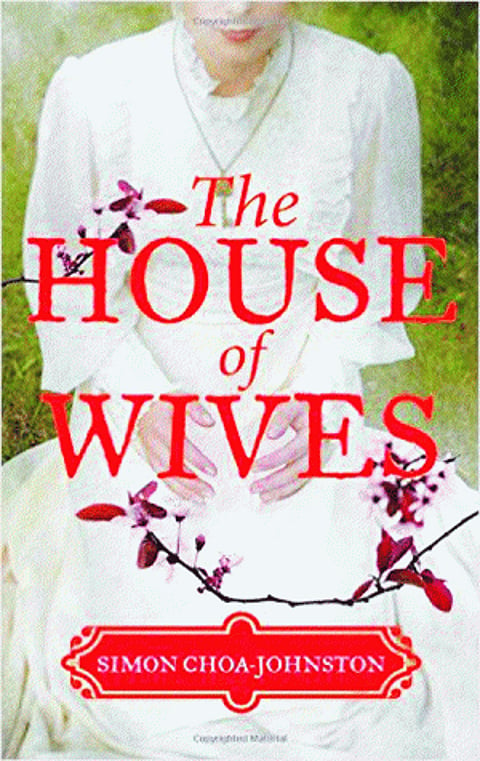

From playwright Simon Choa-Johnston comes a powerful narrative that could only be delivered by a perceptive mind enriched by a worldview formed by decades of multifarious experiences which, in turn, are articulated with nuanced literary finesse. With strong familial overtones, Johnston’s debut novel (because he refuses to acknowledge an old novella he had written more than 30 years ago), The House of Grace, is an exploration of his family’s origins, a quest that conundrums history.
The protagonists are Emanuel Belilos, a young Jew who is an opium seller in Calcutta in the 1800s, and the two women in his life — Semah and Pearl. Semah is Emanuel’s compliant wife whose dowry sponsors his business mission to Hong Kong and Pearl is the beautiful and much younger woman (and the daughter of his Chinese business partner) he falls in love with in Hong Kong. As Emanuel’s opium business flourishes, he builds a glorious mansion for his new wife Pearl, except that his previous wife Semah joins them surprisingly; the mansion then comes to be known as the ‘house of wives’. Johnston’s grandmother Felicie Belilios was the daughter of Emanuel and Pearl.
When the author was about eight, he learned his great grandfather’s name and vocation from his mother but also understood that he was never supposed to inquire about his ancestors again. In the 2000s, when his mother was in her mid-90s and had moved into a senior’s residence, he chanced upon her papers, letters, diary entries, photos that he never knew existed. Driven by a relentlessly inquisitive urge, he sought to finally dig up the past and learn his family history. The House of Wives is the product of persistent online research as well as many trips to India, China, and Hong Kong.
The novel revolves around Semah and Pearl and their unrelenting endeavour to secure a legacy for their respective children. Interestingly, their saga is set in the British Crown Colony in Hong Kong, making the clash between diverse cultures palpable yet intriguing.
Not only delightfully written, but the story also gives an insight into the impeccable research done for writing it. Johnston has mentioned in an interview that he read up on Sephardic Jews and Jews in India, which in turn, helped him trace their lineage to Iraq and Venice. Reportedly, 14 million pounds of opium was sold to China in that era. He also found Emanuel’s name in a history account of Jews in India written by Rabbi Musleah, in Calcutta.
He has mentioned in an interview earlier that the dates of births, marriages, deaths, historical events such as the plague, Emanuel becoming the Chair of the Hong Kong and Shanghai Bank — which is today known as HSBC — his stature in Hong Kong politics, his palatial houses, facts about his two wives including their burial sites are all part of the public record. At the same time, things that he could not verify were imagined and concocted by him. Attributes such as how his characters thought, spoke and formed their opinions and ethics were enabled by imagination.
It starts with a prologue that is set in 1860 in China; a gripping narrative about a defenseless child Bo Jue witnessing her parents being physically attacked by a vicious group and as her severely injured father manages to rescue her, she hears her trapped mother’s shrieks as they run away from their village. After this unsettling prologue, the narrative goes back to 1841 as the first part of the book (1841-1862) starts. Each chapter is named after either of the three main protagonists and reflects the story for their perspective. In part one, both Emanuel and Semah, right from an early age, have an uncanny association with the opposite sex: Emanuel and his dependence and fondness for his Ayah Gita (his Indian nanny, “the 14 year old Hindu slave”) and Semah’s disillusionment caused by her father as she catches him in a compromising position with another woman. Growing up, she incidentally faces a similar fate as her mother, when Emanuel cheats on her with Pearl. Pearl, on the other hand, is introduced in second part of the novel that dates from 1862 to 1875. She is the same Bo Jue from the prologue. It is thereby not just a chronicle of love and kinship, but also gives us two extraordinary women with their own personal histories.
It is easy to choose between right and wrong, but doubly hard to pick a side when one is empathetic to both. Johnston successfully takes his readers into an enigmatic dilemma. His flair for writing is evident and the novel ends up being thought provoking. Jews, Chinese, Parsis, Indians — various cultures are brought alive and a vivid insight into the working class life in the 19th century as well as fascinating facts associated with opium trade back in the day are brilliantly evoked. Given the pleasantly aesthetic jacket, it would not be a bad idea to judge this book by its cover too.
Although set two centuries back, The House of Wives, reinforces how human associations, and notions of love, family, betrayal, ambition, happiness, poignance, have always been consistent and will continue to be universally so.
ananyapioneer@gmail.com