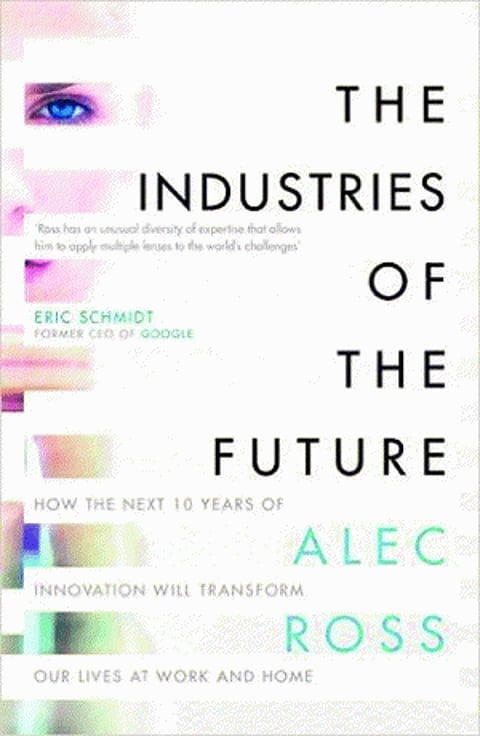

The way we use our money is on the path of a massive revolution in the form of coded money, YAMINI AGARWAl writes about Alec Ross's new book
It isn’t all over; everything has not been invented; the human adventure is just beginning.” These words by the Star Trek creator Gene Roddenberry would fit pertinently in the context of this new book by Alec Ross, The Industries of The Future. The author has served as Hillary Clinton’s senior advisor for innovation when she was the Secretary of State and has an immense experience of travel across countries which has given him a close up view of the forces shaping the world.
The last wave of globalisation witnessed billions of poor coming out of poverty. The new- fangled idea of World Wide Web has absolutely transformed our lives. Buying a new mobile phone, selling your old furniture, transferring money to your child’s account, taking a language class; to each and all, Internet is the answer.
Are these answers going to change in the next 20 yearsIJ Is there another leap of innovation awaiting usIJ How is it going to make the world look differentIJ Is there something we should be scared ofIJ This book by Alec Ross has it all. It lets you time travel to human life post 20 years when industrial firms with robot labour, designer drugs melting away some kind of cancer, older population being taken care by humanoids, robotic gloves turning sign languages to voice would all exist in veracity. Some of these developments have already happened in different parts of the world and if there is any advancement that you can imagine, someone must already be working on it. This might seem magnificent but it also holds some serious repercussions.
The book covers five important industries encircling the society for the next 20 years:
Next generation robots are soon going to become a regular part of the social and economic system which was once thought to be exclusive to human domain. Their presence could span from being a family member performing household chores to trained labour in industrial units to nanorobots treating human diseases at the cellular level. With advancements in machine learning, data analytics and cloud robotics, their reach could further increase. The degree, although, of this robot era is limited by the culture of countries and how people adapt to these pseudo humans in their lives.
Forthcoming innovations in life sciences could be another ground-breaking field. Targeting cancer cells with true precision, humans using the organs transplanted from farm animals, bringing the extinct back to life are the sneak peeks to the future that lies ahead. Genome research and its greater commercialisation by countries like USA, China and others lying not far too behind assures belief in the much talked about vicissitudes of life sciences.
The way we use our money is on the path of a massive revolution in the form of coded money. Innovations like PayPal and Alibaba have already set the ground and there is no looking back now with newly coded international crypto currency, Bitcoin. Trust, of late, has also been veiled in this new version of sharing economy. eBay being one of the first means where buyers and sellers entered into trade agreements with an implicit coded trust without ever seeing or meeting each other. Amazon, Airbnb, Uber etc. have been added to this endless list of participants of sharing economy. These novel concepts of market do not just end with their local effects but have larger global consequences.
Cyberspace and its security is another incipient area discussed by the author. large corporate cyber attacks such as the one on the world’s most valuable company Saudi Aramco looks frightening keeping in the mind the magnitude of damage. As the costs of cyber attacks are rising, cyber security is going to be the most germane domain in the future. A bigger question: Is the prospect of cyber war sparking the next arms raceIJ Well, it looks like it. In words of the author: “All of the exciting things that come with connecting our ‘things’ to the Internet are also accompanied by dangers.”
Big data is the raw material of the ongoing and upcoming information age. Big data approximating real time will be crucial for strategic decisions as used by Barack Obama in his presidential campaign. Data analytics, as a tool, has a huge potential in improving the world remarkably be it the social issues such as hunger and poverty or enhancing operations in the financial world. Prevalence of data, however, also acts like a double bind as it infringes on people’s privacy.
These developments reaching the world’s most isolated regions is an insignia of development. Banking tools in Africa where there are no banks (m-pesa), sustaining health equity by delivering basic services to hardest-to-reach communities using mobile phones are few examples of the bright side of digitisation.
The book envisions ginormous breakthroughs for the future which might seem too much for reality. Nonetheless, the pace of technological advancement is a harbinger to something radical in the future.
The language is easy to understand despite the presence of some complex issues. Quoting examples from movie scenes makes the reading more vivid. Insights from tech experts, young CEOs, start up founders, women entrepreneur from Afghanistan etc adds to the positives of this book. This one is a recommended read for everyone who is a part of this transition phase as it will enlighten you about your present and future.
The Industries of the Future is written by Alec Ross and published by Simon & Schuster, Rs599
The reviewer is an Assistant Professor of Economics, Miranda House, DU
