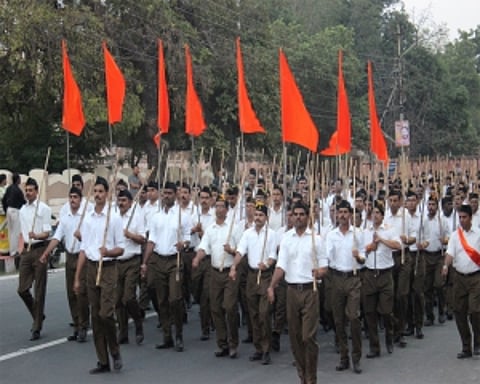

RSS has endured enough but is as committed to its goal of national service as ever
The history of RSS reveals one interesting aspect. It has always been surrounded by challenges since its inception, and they have been both the cause and effect of its moral and physical strength. Dr Hedgewar founded it in 1925 with a sole vision to uplift the nation from the miseries of ideas, an unevolved national character, fractured social life, and above all, the state of amnesia of its own glorious life in its thousands of years of history. This is known as a task of nation-building. Dr Hedgewar made it a futuristic movement. This is a reason there has not been any moment in its 100-year history to take pause to feel it has accomplished its task. RSS visualises India as a nation based on organic civilisational ideas and legacies and believes India has a world mission, re-humanising humanity to achieve an ideal of the world as family, which is expressed as “Vasudhaiva Kutumbakam”
Mohan Bhagwat, in his Vigyan Bhawan speech, unfolded this futuristic agenda of RSS to reach out to people of the world and present RSS as an imitable example before them. This is an indication that cultural nationalism, as explained by him, is not at all envious and doesn’t cause binary either inside or outside India. The series of lectures had twin purposes. First, it was intended not to celebrate but to present before the nation a social audit of its hundred years.
He aptly said that the biggest voluntary organisation in the world, RSS, has faced unbridled criticisms. He cautioned the critics that their criticisms were like corrupted coins that lose their monetary value. Seventy-five years ago, a senior Congressman , A G Kher, local self minister in the United Provinces, in his article, “Admit RSS in Congress fold”, in the English daily Mahratta on 18 November 1949, said, “repeating the same allegations again and again against the RSS does not serve any purpose.”
The criticisms against it by left liberals and Nehruvians were not without motive. They were mentally hegemonised by the West and subordinated themselves to their ideas. For them, any quest for originality means feuds, confrontations, rigorous intellectualism, and activism. They realised its futility for their mental and physical comforts. RSS negated it. It made its mission to explore its philosophy, cultural ethos, progressive ideas in its thousands of years India’s history and to remake the nation on its own foundation. In brief, it is a revivalist quest for redefining “who are we?” It was the longest way to regain our identity, but the only way,
so for the RSS, it was the shortest way. This gave it the stamina to bear unfounded criticisms and unwarranted repression. Bhagawat reminded the historical events in
the life history of the RSS in these terms. In fact, ideological adversaries who controlled the state power made arduous efforts to declare the RSS as a legitimate entity that was against secular democracy and the idea of India. Bhagawat was right, the RSS crossed that stage, and now it is being heard both in India and outside with an emotional bond with it, expectations from it, and also curiosity about it.
No leader, whether social or political organisation, had ever spoken before the people and addressed all types of critiques about himself and his organisation. They enjoy super celebrity status. RSS presents an exceptional example. Bhagawat explained it, “I am at the disposal of the organisation. Even at the age of 80, the Sangh can ask me to run a shake, and even a Swyamsevak at the age of 35 can be asked to sit in the office.”
It is not a simple statement. It carries the basic characteristic of the Sangh, where individualism has no place. The hierarchies in the organisation are based on not position or power but responsibilities and ethics. It is difficult to realise, he said, “unless you come to see the real happenings inside the organisation.” This shows with millions of swyamsevaks, RSS still carries the ambition to expand to those who could not reach its basket. It is not a numerical target. In his speech, he articulated RSS’s perspectives on the great social transformation. The most important among them, he argued, was to create a new consciousness of casteless and classless feelings among the people.
Therefore, expansion means creating a new wave. Marx preached struggle to end Inequality. RSS addresses the problem by creating social sensitivity. That is a reason he appealed to the people to take their children to localities where the poor live and see their miseries.
RSS treats society as a laboratory to achieve an egalitarian social order. His speech represented RSS’s vision of an inclusive society and holistic development. RSS had crossed various phases of national life.
During the lifetime of Dr Hedgewar, it contributed more than its capacity in anti-colonial struggle and faced repression, ban on drill, arrest and martyrdom of its volunteers, and the ban on the organisation, its training camps. Golwalkar faced the attacks of ideological adversaries controlling the state. He was arrested and abused. Then the task of the RSS was to give maximum assistance to protect Hindus who were victims of the partition. Thirty-three years (1940-73), he stood like a Himalaya before the state power and its patronised intellectuals. His successor, Bala saheb Deoras, faced no less suppression than the past. More than lakhs of swyamsevaks were put into jail. He himself spent 19 months in jail.
During his time, RSS initiated social actions, and now its impact is more than visible. When Bhagawat became sarsanghachalak, the Indian state made its last attempt to cut it into size . Never before have such attempts been made. It was linked with terrorism and compared with Islamic terrorist organisations. The ruling elites failed to reconcile that Bhagawat’s RSS was not the RSS of the 1940s. The narrative of Saffron terrorism was an effort to defame the organisation all over the world. It failed. Nevertheless, none of the RSS Sarsanghachalak, Hedgewar, Golwalkar, Deoras, or Mohan Bhagwat spoke a single jealous, bitter, revengeful word against their adversaries. Rather, they emphasised to all of them.
It is another exceptional instance in the history of the world’s social and political movement. Bhagawat’s speech was an endorsement of an open society, fraternity, and harmonious social order, and unfailing democratic dialogues. His speech was a decolonised speech and ended with a call and determination of a new horizon of world mission. He propounded a new vision of unity of opposites. As a great social democrat, he spoke with optimism as well as with firmness. It was an expression of the organic will of the RSS that we will work both in summer and winter, in the forest and the metropolis, with the same mission and vigour, with our own progressively evolved capacity to minimise their impact, and will continue till civilisation exists.
(The writer is former MP, Rajya Sabha and RSS ideologue)