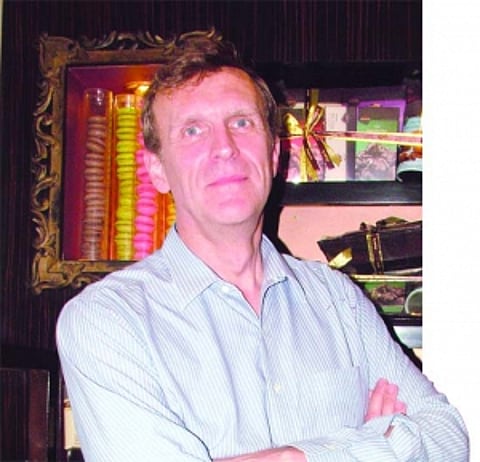

When Simon Denyer first came to India in 2004, the country was dreaming big, very big. And then within a couple of years, it all turned gloomy and pessimistic. In an interaction with UTPAl KUMAR, Denyer explains why India missed the bus, and how the ‘silent’ decline of Manmohan Singh has led to the rapid rise of Narendra Modi as also Arvind Kejriwal
September 2012. The phone rang. Not an unusual sound for a journalist like Simon Denyer. But that day was different. Simon thought of letting the phone ring out, fearing some bad news coming his way. He had, after all, just written an article in the Washington Post, claiming Indian Prime Minister Manmohan Singh was in danger of going down in history as a tragic figure who looked the other way as his colleagues filled their pockets, and probably should have resigned at the end of his first term. He had also mentioned the jokes that were in circulation for months — about officials going into meetings with their phones on the ‘Manmohan Singh mode’, and a cartoon of a dentist pleading with the Prime Minister to ‘please open your mouth here’ at least.
“When I saw the number, I thought not to pick the phone and call back a little later. But there didn’t seem much point. Stepping out into my garden, I took a deep breath and answered,” recalls Simon. Pankaj Pachauri, the Prime Minister’s communications adviser, was on the line. And he was furious for projecting his ‘boss’ in a bad light. But why was Singh so angry at a foreign correspondent when the desi media was full of such criticisms about himIJ “I later learnt that Prime Minister Singh was not just angry but also hurt. His reputation at home might have been tarnished, but he was still respected abroad and he clearly valued this standing. My article threatened to make him lose face with the Americans,” says Simon, as he reminds how a senior Congress leader told him that the Prime Minister “was more concerned about his constituency in Manhattan than in Mumbai”.
Simon, in his latest book Rogue Elephant (Bloomsbury), tells us how Singh’s political career has always been about “loyalty, timidity and exaggerated deference.” These, he says, “have constantly been preventing Singh from asserting himself vis-à-vis Sonia Gandhi”. He, however, falls short of calling him a typical Indian babu who would do what his political masters would want him to do. Former Cabinet Secretary TSR Subramanian, in his recent book India at Turning Point, brings out this side of the Prime Minister when he tells how Singh changed from being an ardent critic of the West in the late 1980s to an American admirer within a couple of months just because his then political master, Narasimha Rao, wanted him to do so. “Strange as this may seem, those familiar with Manmohan Singh’s career would not have been surprised at all,” says the former top bureaucrat, adding how everyone in the bureaucracy knew that Singh was destined for ‘greatness’ and that he would go ‘far’ as he was quick to grasp what the boss wanted, forward the same even before he was told, “couch it with arguments replete with economic theory, make it sound profound and put it up for the boss’s approval”. No wonder, Singh became the ‘father’ of India’s liberalisation in the early 1990s and the destroyer of the same legacy two decades later when he was told to do so by his new political master.
In a free-wheeling interview with Agenda, Simon Denyer talks not just about the ‘silent’ fall of Manmohan Singh, but also about Rahul Gandhi not learning the right lessons from his family history, as well as about Narendra Modi transforming himself from having disdain for foreign media to an outright charmer, and Arvind Kejriwal being honest, impatient and autocratic at the same time. Excerpts:
What made you write the book, Rogue ElephantIJ
I arrived in India in 2004 before the lok Sabha elections and followed lK Advani on his rathyatra. I also followed the Gandhis, all three of them, particularly when they were campaigning in Uttar Pradesh. The entire process of going to people and convincing them to vote was fascinating. That was my first introduction to India and the complexities of its democracy.
Indian democracy gets a very bad press globally. Everyone thinks it’s ruining the country; that it’s democracy which is bringing India down. I must say that it’s not right; in fact, democracy is India’s strength. When you go to fringe States like Kashmir and Manipur where it doesn’t function well, then you realise the importance of democracy. You value it when it’s gone, where it’s not working properly.
When I first came to India in 2004, the country was all gung ho to join the superpower club. The air of optimism was everywhere. But it all had changed when I was away from India for 18 months. When I returned from Washington I found gloom everywhere. I could see the dream of India as a prospective superpower crumbling and the mood changed from complacent optimism to resigned pessimism. I saw it happening almost instantly. I believe complacency in the earlier phase was overdone, so was pessimism that followed soon after. The reason for writing Rogue Elephant is that I wanted to chronicle and examine the so-called lost decade wherein the power of democracy hadn’t always been channeled into productive things, but in reality saw some of the interesting developments like the Right to Information Act or the movement against corruption.
Why did the mood of the nation change so fastIJ
I trace it to so many corruption cases in the country, particularly the 2G and CWG scams. In the end the Commonwealth Games went off well, but the run up to it was quite embarrassing, particularly when the Indians saw China organise the Beijing Olympics so well and use it to enhance its global image. These things made a dent to the national confidence. Another reason was the UPA’s political indecisiveness. As time went on and more and more difficult decisions were put off even when the economy was going down, there emerged a sense of anger and frustration. People could have forgiven the UPA-I because of the overawing presence of the communists in the Government, but in the second term when the Congress came up with greater numbers and there was no left presence in the coalition, there was no excuse for such politico-economic indecisiveness.
You talk about the decline and fall of Manmohan Singh. How do you see himIJ
Prime Minister Singh is in the danger of going down in history as a failure, as a silent, tragic figure who probably should have resigned at the end of his first term in 2009. The tragedy is that on one level he undoubtedly cares for the poor and is dedicated to his work and his country. He hasn’t used his office to personally enrich himself. And he is hard-working to the point of obsession. I remember one of his daughters telling Caravan magazine’s Vinod K Jose in 2011 that she had only seen him take one vacation in her lifetime, and that was a three-day family trip to a hill station outside Delhi.
Yet, if a decent man can’t stand up to his values, he should put in his papers. He should stop doing the job. lame excuses like ‘my hands are tied’ or the ‘compulsions of coalition dharma’ don’t cut much ice after a point of time. There came a time when Singh started blaming the media for exposing corruption and at that moment I realised that he was looking at the wrong direction. There’s no doubt that he’s a decent man but in the end you have to perform or allow someone else to do the job.
No one questions Manmohan Singh’s honesty, but there’s a feeling among most Indians that he is a typical babu who will do whatever his political master will tell him to do…
That’s what I believe too. loyalty, timidity and exaggerated deference: These have constantly been preventing Singh from asserting himself vis-à-vis Sonia Gandhi.
Why was there so much brouhaha when you did the story in the Washington Post, particularly when there was so much negative being written and said about Manmohan Singh in Indian media alreadyIJ Does it in any way show that he was more concerned with his American constituency than the IndianIJ
That’s the question I ask myself. And that’s the impression that I got. When you look at Singh, you find out that on only two occasions he stood up to be counted—first was the India-US nuclear deal, because of the promises he had made to George W Bush; and the second was the FDI in retail, because of his assurances to Barack Obama. When the Washington Post criticised him in 2012, one senior Congress leader told me that he was more concerned about his constituency in Manhattan than in Mumbai. So, yes, there’s that feeling.
You say that Rahul Gandhi hasn’t learnt lessons from his family history. WhyIJ
I think that Rahul’s father and grandmother did some things very wrong. I am not saying they didn’t do anything right. For example, the kind of secularism we saw under Rajiv Gandhi which was nothing but appeasement for Muslims, followed by pandering to Hindu extremism, was not in any way ideal. If you don’t view them uncritically, as Rahul has often done, then you know that he hasn’t taken the right lessons from those mistakes. I strongly believe in democracy, freedom of speech and secularism — some of the things that I admire about India. When you exploit or mess around with them, then that’s dangerous. If you don’t learn from history, you are fated to repeat it.
I do think that Rahul’s heart is in the right direction. But I also think that there’s a fundamental contradiction when somebody who says that he stands for a new type of politics, a cleaner and merit-based one, and yet he remains the beneficiary of an undemocratic, sycophantic party that elevated him without any track record to show. So the fundamental contradiction is what he says he believes in and what he stands for.
last 10 years have been a huge wastage of opportunity for him. He was found missing whenever he was needed. I remember people asking me during the December 16 Delhi gang-rape protests where Rahul Gandhi was. He could easily have become the youth leader then, but he was found missing. In 2004 when I met him, he appeared humble and frankly confessed that he had to learn. But in politics you have to stop learning at some time and start delivering.
You say that Priyanka Gandhi has a star quality which her brother lacks. Why do you think the Congress shies away from promoting herIJ
It is possibly due to the internal workings of the family, Sonia’s desire to protect her family from politics and not have all of them at the same time. But the fact remains that Priyanka is a natural campaigner. When I followed her during a campaign trail, I saw a group of people setting up a microphone for her to chant a few slogans. But Priyanka would instead mingle with the people, talk to them. She has the natural way of interacting, which I gather her grandmother had too.
You have mentioned about the transformation you saw in Narendra Modi from when you first met him in 2007 to the second time in 2012. Why were you unsettled on both occasionsIJ
When I met him for the first time, Modi was quite disdainful of me. But if Modi made no secret of his disdain for foreigners in that first meeting, my next interview with him, five years later, was very different. To my surprise, he was extremely nice this time. He seemed keen to impress me, to make a case for his international rehabilitation, but then I wasn’t sure if that was sincere. Because when you meet someone for the first time and if he is not that welcoming, then you are not sure if the good gesture in the second encounter is at all genuine. You wonder, “Why are you suddenly so nice and joking with meIJ” I must admit both the encounters were unsettling for me.
What explains the rise of ModiIJ
A decade of weak leadership and inept governance has made people look for someone strong and decisive. Modi’s governance record is clear and has something to talk about. The other reason is the strong desire for change. We saw this happening in Delhi when a political novice, Arvind Kejriwal, could unsettle the political apparatus. He had no organisation, no money and no hope. And yet he became the Chief Minister. So, there’s a deep desire for change. Also, there are a lot of young, first-time voters who are worried about their future. They need jobs, they need an assuring figure and Modi fits the bill as his economic record in Gujarat is good. Also, to Modi’s advantage, these young voters don’t have any personal recollection of the 2002 Gujarat violence.
In your book you call Arvind Kejriwal an honest person who is impatient and has elements of autocracy…
I haven’t been in Delhi during the last few months but the autocratic, impatient elements could be seen in Kejriwal’s early days as well. I reached this conclusion after talking to people he had worked with at some point in his life. For them, he picks up an issue, pretends to consult people, but ultimately goes ahead with the conclusion he already has in his mind. He goes into the battle sincerely and much before he could reach the logical conclusion, he gets bored and moves into something else. We saw this in the corruption movement. We saw the same in the Robert Vadra land deal. We saw it in almost everything he did.
Yet, Kejriwal’s ‘break-down-the-door’ politics has its relevance. It galvanises people brilliantly. But clearly we see the disadvantages when it comes to governance, and he has squandered credibility in the last few months, for which he seems to have lost the support in the elite and upper middle class voters. But I don’t think he is too worried about it as he has compensated the losses with gains that he has made in the lower middle class voters. In the end, however, it’s dangerous for Kejriwal to lose the English-speaking middle class. This class, after all, not only shapes the opinion of the nation, but also is its conscience-keeper.
You also talk about the media particularly Arnab Goswami and his “journalism of outrage”. How do you see the Indian mediaIJ
When I first came to India, I was actually impressed with the media and the debate conducted by it. I had the feeling that the 24x7 television was a positive force. Over the course of the last decade I have also seen some ugly incidents. We must understand that we have a weak leadership and have politicians who don’t talk. In this scenario, the anchors will dominate the show. When politicians don’t talk, anchors like Arnab Goswami will do the talking.
There are many other good journalists, but the reason for talking extensively about Arnab is that he is an apt example of what’s good and bad about Indian media. The 24x7 television has played an important role in bringing about change, setting a agenda, and providing support to the anti-corruption movement. What worries me is its interference in the country’s foreign policy. The perception, rightly or wrongly, that the Government is weak, provides space to the media to assert itself and take up an ultra-nationalistic stand. That can be a worrying phenomenon.
Now that you are based in China, tell us how the Chinese are reacting to the emergence of Modi.
China has other areas of concern right now. The issue of Japan is of greater relevance and urgency than the relations with India. So, the feeling in China under the new leadership is probably to bash Japan but be relatively friendly with India. I may be wrong, but that’s what I feel. China is right now not alarmed by the rise of Modi and his aggressive foreign policy assertions. The Chinese largely believe that once Modi will come to power, he will adopt a more moderate path. But at the same time, it needs to be understood that China is sensitive about what it calls southern Tibet, and must be watching the situation in India closely.