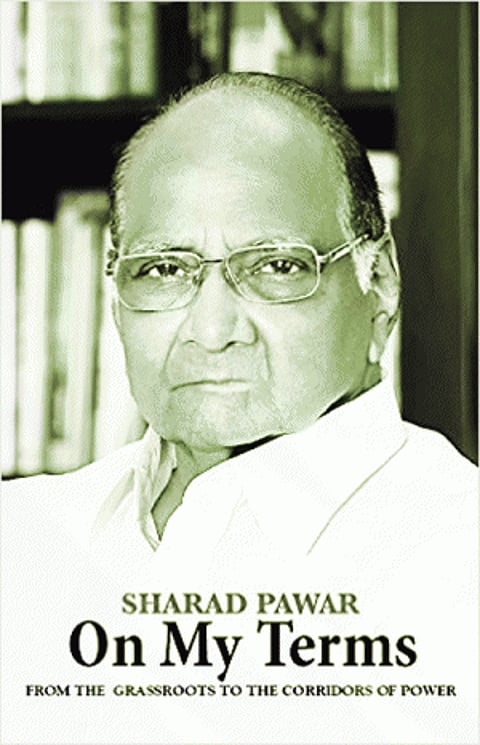

On My Terms
Author: Sharad Pawar
Publisher: Speaking Tiger, Rs699
There have been many flip-flops in the course of Sharad Pawar’s association with Indian politics but they did not diminish either his stature or his acceptability across the political spectrum and in this aspect, we need more like him, writes RAJESH SINGH
Sharad Pawar would like people to believe that he has traversed the long road stretching to decades from the grassroots to the corridors of power “on my terms”. At least that is how his autobiography is titled. Among the most seasoned politicians with heft the country has had, he has certainly had his way on most occasions. But there have been quite a few times when he had to eat humble pie, compromise and swallow his pride. Did the sacrifice by the self-confessed strong-willed leader further his careerIJ You bet. Sharad Pawar is another name for flexibility, and when it comes to staving off an impending crisis that can ruin his plan, he has not been one to stand on prestige, false or real. So, what does that make him: An opportunist, a pragmatist, a focussed politicianIJ His book leaves you with an impression that he is a bit of all of these.
Yet, to attribute his success to these qualities alone may not be appropriate. If they had been the only ingredients of unquestionable political potency, they would have spawned more of his kind — after all, there is no dearth of leaders in India who possess the three components. As you read his account, those special, additional attributes which have made Sharad Pawar a politician like none other, begin to unfold page by page. In recounting his successes, Pawar is neither self-effacing nor overly boastful, and as for failures, he does not identify any by name.
Given that he has been a close observer of and even participant in many ways in the tumultuous happenings of post-Independence politics of the country, it is not surprising that he gives his perspective on them in the book. His narrative takes us through his love-hate relationship with the Congress before, during and after Emergency, and post-Rajiv Gandhi’s assassination, particularly since the rise of Sonia Gandhi as the party’s numero uno. He deals with the controversies surrounding his alleged role in blocking Dawood Ibrahim’s return to India to face trial for the Mumbai blasts. He also dwells on the politics of Maharashtra and people who helped him climb the ladder and those who tried to pull him down, even if covertly. Pawar also waxes eloquent on his interests: Agriculture and the cooperative movement, and his personal take on some of the important leaders he had the opportunity to interact and deal with (Narendra Modi’s name is missing from this long list, although he has enjoyed a cordial relationship when the former was Chief Minister of Gujarat and even after he became Prime Minister).
Of these, the most fascinating parts have to do with his take on the direction the Congress has taken over the last decade and half; not surprisingly, they are also the most quoted passages in the media. And yet, despite the clarity with which he presents his opinion on the subject, it is not clear as to why he continued to do business with a party with which he broke off on fundamental issues that are still the core of the Congress. He does not also sound convincing when he justifies the merger of his party with the Congress when Rajiv Gandhi became the PM. All he offers as an explanation is the following: “I think my decision was correct. The merger decision was taken after considerable deliberation and was born of a genuine feeling that it would be in the interest of the nation at that point in time.” Interestingly, Pawar merged his outfit with the Congress although the party and Rajiv Gandhi (who coaxed him into the decision) had come under a cloud for their sloppy handling of the anti-Sikh massacre in the wake of Indira Gandhi’s assassination.
There is another paradox. Pawar readily acknowledges that so-called loyalists in the Congress were actually loyalists of the Nehru-Gandhi dynasty — and yet he happily became part of that same party which expects total submission to the dynasty. He writes, “So-called loyalists in the Congress (I) never really bothered me. loyalty to the Congress’s First Family was the only USP of these gentlemen and good women. Hence, they never liked mass leaders or leaders who had risen on their own strength.” Well, this explains why the Congress has never liked him and why he had to split yet again from the party.
Pawar says that leaders such as PV Narasimha Rao and Manmohan Singh had to “suffer these loyalists”, and that while he stood by them in Cabinet meetings, others “cowered in fear of the First Family…” But he cannot ignore the reality that the support of his party, the Nationalist Congress Party, kept Congress regimes going even as he watched with distaste the growing sycophancy in favour of the Nehru-Gandhi family.
Interestingly, as Pawar admits, he was part of a delegation of senior Congress leaders in 1988 that “requested Sonia Gandhi to take charge as Congress president”. This, he claims happened after former bureaucrat PC Alexander advised him to forget his ‘personal interests and initiate a dialogue with Sonia Gandhi’, since only ‘then can the Congress be saved’.
Alexander added that Sitaram Kesari (then party president) ‘will not be able to hold the party together in the present circumstances’. Once Sonia replaced Kesari, things began to sour for Pawar. It’s amazing that an experienced and shrewd politician like him did not foresee the inevitable — or perhaps he did but believed that his interests lay in backing the winning horse, even if it meant dealing with a relationship marred by “distrust”, the word that he uses to describe Sonia Gandhi’s attitude towards him. It’s thus difficult to appreciate his “hurt” by the decision to make her the Congress Parliamentary Party chief although she was then not a member of either Houses of Parliament. He should have known that sycophancy can be limitless, and propriety is the last concern of sycophants in the Congress. Eventually, his adventure led to what he has called the “final breakup” (is it all that finalIJ) between the Congress and him.
Pawar believes that Chandra Shekhar was ill-treated as Prime Minister by the Congress, with whose support he gained the top position. Reflecting on the party’s ire at the then PM over the alleged spying on Rajiv Gandhi by two police constables, he says that the Congress had decided to rattle him for a while before pulling the rug from under his feet at an opportune time. “However, Rajiv went wrong in his assessment of Chandra Shekhar. The Congress’s intention was to only humiliate Chandra Shekhar and not to remove him from office yet. But Chandra Shekhar was made of a different cloth. He believed in calling a spade a shovel. He promptly gave up the prime ministership, and the Congress’s political calculation went haywire.” That was in March 1991.
Pawar confirms what has been often talked about: That the Chandra Shekhar regime had progressed significantly in finding a solution to the Ayodhya Ram temple-Babri mosque dispute which would be acceptable to all the stakeholders. He writes, “If only the Government had survived for another six months or so, the issue could have perhaps been resolved. The efforts halted with the fall of the Government.” Indeed, as subsequent events were to prove, the matter turned more serious, eventually leading to the mosque’s demolition in December 1992.
There have been many flip-flops, but those did not diminish either Sharad Pawar’s stature or his acceptability across the political spectrum. He has candidly said that he does not believe in “political untouchability” and that he evaluates a politician not on his or her political affiliation but the work the person has put in. We need more like him — at least on this aspect.