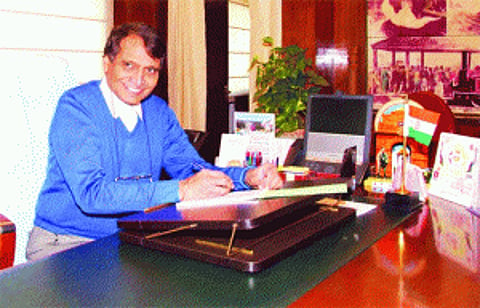

Suresh Prabhu is a man in a hurry. As Railways Minister, he has inherited an organisation that had been shoddily managed for decades. It suffers from multiple wounds, and he has to heal them all, almost simultaneously and before they get incurable, says RAJESH SINGH
It is difficult to understand what Suresh Prabhu specialises in or enjoys doing the most. As a chartered accountant by profession, his core competence area would be matters related to finance and accounting. And yet, he has donned so many different hats, and wore them with distinction, that it appears he is at home on issues ranging from finance to power to climate change to water resources to coal — and now railways. It is little wonder that a few years ago, prestigious magazine Asiaweek had identified the versatile politician as one of the three future leaders of India to watch out for.
It has taken a while for that prediction to come true. He would have been occupying the centre-stage, at least in terms of performance, long ago, had his then party, the Shiv Sena, not lost confidence in him (and it had nothing to do with his abilities), and pulled him out of the Atal Bihari Vajpayee ministry sometime in 2004. By then, Prabhu had done stints in the Industries Ministry, Environment and Forests Ministry, Fertilisers and Chemicals Ministry, Power Ministry and Heavy Industry and Public Enterprises Ministry. That’s more than what many politicians get to tackle in an entire career.
As the Minister for Railways in the Narendra Modi Government, Prabhu is one of the rising stars. It is generally believed that if there is anybody who can reform the behemoth, it is him. He is certainly among the three most watched-out-for Ministers in the Cabinet. And, if the conventional definition of a leader is stretched beyond vote-catching and crowd-pulling, he is definitely a leader of substance. He is an outlier of sorts, without doubt, but is also now an intrinsic part of the dramatic changes that the Government has promised to unleash. Asiaweek may yet be vindicated.
But Prabhu’s importance does not stem only from his role as the Railways Minister. Before Prime Minister Modi picked him to head this ministry, he anointed the latter as the ‘Sherpa’ to represent India at the G-20 Summit in 2014 on climate change talks. Also, within less than two months into power, the Modi Government had appointed him to head a panel — Advisory Group for Integrated Development of Power, Coal and Renewable Energy — to suggest ways and means to revamp the power sector in a holistic manner.
The respect that Prabhu commands in the new dispensation became evident when the Prime Minister went out of the way to include him in his Cabinet as Railways Minister. Prabhu, who was then technically still with the Shiv Sena, quit the party, gained membership of the Bharatiya Janata Party and was inducted into the Council of Ministers. His resignation from the Sena, induction into the BJP and inclusion in the Cabinet all happened within a matter of hours. The only other person whom Prime Minister Modi plucked with such determination and by going out of the way, to be included in the Union Government, was Manohar Parrikar, who, from being Goa’s Chief Minister straightaway became the country’s Minister for Defence.
What explains Prabhu’s dramatic revivalIJ After all, he had been all but forgotten in the circles of power in lutyens’ Delhi, having slipped into political wilderness for nearly a decade. Perhaps his stars were in the right configuration. A more rational explanation is that talent does not remain suppressed for long. Just a half-chance is often enough to give that break. Prabhu got it with the arrival of the NDA Government and Modi as the Prime Minister. He is determined to make a mark. But when can the people expect to see, and more importantly, feel, the changesIJ He grins and responds. “If I were a magician, I would have said ‘now’! Since I am not a magician, people have to wait for a while. But it will not be forever. Real changes will be evident soon.”
That he intends to make the best use of the opportunity became evident when he hit the ground running. Having handled multiple panels on varied subjects, he was very much a ‘committee-man’. little wonder, therefore, that, soon after assuming charge as Railways Minister, he announced a slew of panels headed each by former Delhi Metro Rail Corporation Chairman E Sreedharan, former Comptroller and Auditor-General of India Vinod Rai and former Union Financial Affairs Secretary DK Mittal, to recommend changes in various aspects of the railways’ functioning. The panel led by noted economist (and now member of the newly created NITI Aayog) Bibek Debroy had been set up before Prabhu took charge of Rail Bhavan. The numbers are quite a handful, but then so are the problems that Indian Railways is saddled with. Putting the railways back on track is like cleaning the Augean stables. Prabhu certainly does not exude the physique of a Hercules, but the determination, the focus and the roadmap are all there.
Each of the eminent panel heads is supposed to suggest improvements (and even comprehensive restructuring) in areas they have been mandated to study. A few suggestions have already been submitted, and more are on the way. One thing is for sure: The recommendations, unlike those of earlier Government committees such as the ones headed by Rakesh Mohan and Anil Kakodkar, will not gather dust.
In fact, the Minister has already begun to implement the suggestions which have come to him from these groups. For instance, following a recommendation from the Sreedharan panel, Prabhu has given up his powers to decide on tenders, and left it to be finalised by Additional Members of the Railway Board (if the amount is up to Rs500 crore) and to a tender committee appointed by the Board (for amounts exceeding Rs500 crore in value). It is rare for a Minister to give up such powers — any power for that matter. This is not symbolic renunciation, but a bold move to empower experts in decision-making and insulate extraneous governmental influence.
Prabhu realises that, however revolutionary and long-desired the steps he has been taking are, they are still baby steps. Indian Railways has been allowed to bleed for far too long. It has become anemic and caught on a host of other ailments as well. Its immune system is in ruins. The steroids, which Prabhu hopes to administer, are just about enough to keep the patient alive. But for it to come out of the danger zone and be on the path of sure revival, sweeping and more audacious methods have to be adopted. The cumulative damage which previous Governments and their Railway Ministers have inflicted cannot be undone in a matter of months. But the right, if bitter and painful, treatment, had to begin without delay.
The immediate task for him is to find the resources for all the revamps and enhancements he plans in the coming months. Getting money is not an easy task, and it has not been made easier by the fact that Indian Railways has for decades run like charity (that too in an inefficient manner), with Governments milking it without giving it any fodder. Now it has gone dry. Its operating ratio is 94, which means that Indian Railways has just four rupees to spare for investments out of the Rs100 it gets by way of revenue or funds. Nearly everything, from improvements in end-user basic amenities to laying of fresh tracks to enhancing technology, has to be managed in that four rupees of every Rs100. Nearly Rs6.5 lakh crore worth projects are lying pending for want of money. (It is easier for Railways Ministers to announce grand schemes than to find resources to implement them.) Prabhu is clear on why this happened. “Years of neglect have brought the railways to this state. It was never run like a professional body.”
And that is not all. Recommendations of various earlier committees have gathered dust because money is needed to implement those ideas. For instance, the implementation of the Kakodkar panel report suggestions needs, at present estimate, roughly Rs20,000 crore every year over the next five years. The proposed White Paper on railways, which is expected to be presented before the coming rail Budget, should give a comprehensive idea of not just the challenges Indian Railways faces but also the financial mess it has been plunged into as a result of under-investment over the decades.
The Minister sees a ray of hope, though. “Resource mobilisation efforts are on, and we shouldn’t have any serious paucity of funds for the projects that we have in mind.” On the possibility of World Bank funding, his response was candid. “The World Bank can only offer us this much and not more. We have other sources.” It is the campaign to tap these ‘other resources’ that is keeping him busy. Before he met me for a brief interaction, he had been closeted with a delegation from the World Bank.
Prabhu does not believe in the longevity of panels. “Committees that I had set up have given their suggestions and we are already in the process of implementing them. The panels had short durations and they have done their job. No committee exists as of now, except the Debroy panel.” Any other Minister would have thrown up his (or her) hands in despair and reconciled to the drift to continue. There is never a paucity of excuses for not doing anything. From all accounts, Prabhu is not running away from the challenge. He is working on two fronts: Raising resources and implementing ideas. While there is Government support in funding, it is far from adequate. Thus, there is a fierce focus on private funding through public-private partnership or foreign direct investment.
Prabhu has even asked his people to explore the possibility of tapping into global pension funds whose managers are seeking avenues to invest and earn decent returns. With sovereign guarantees and a business-friendly Government in place, pension fund managers should find that an attractive option. The ‘best’ is the target that Prabhu has in mind, and in working to achieve that, he is hopeful of at least reaching the ‘better’. He has before him an internal report prepared by the World Bank on the global benchmarks that Indian Railways must strive to meet on myriad aspects, ranging from technical to operational. It’s aspirational goal-setting, but at least there is a clearly defined goal and the determination to get there.
The coming Rail Budget will be an occasion for Prabhu to demonstrate his resolve. He does not like to fail. He may be a bean-counter by training, but bean-counters had brought to life a near-dead US automobile industry not too long ago. Also, bean-counters can become innovators when the occasion demands. Many years ago, Prabhu had proved that he is worth more than the beans he counts so effectively. If he has to prove himself all over again, he is not the kind to flinch.