
As the debate over ‘Indian’ writing gains momentum in an urban, cosmopolitan context, this volume reinforces how pertinent it is to acknowledge the trials and indignation of the tribal people as well as their literature, writes ANANYA BORGOHAIN
Amidst the growing debate over what exactly Indian literature in English is, there is a notable fresh turn that Indian tribal literature has made in contemporary times, with the competence of maverick writers being published. Hansda Sowvendra Shekhar’s The Adivasi Will Not Dance is one such collection of 10 short stories that revolves around self-transformation emanating from a unification of the personal and the political. Shekhar, also a doctor by profession, whose novel The Mysterious Ailment of Rupi Baskey was critically acclaimed, returns with stories from rural Jharkhand that steer us through its humdrum lanes, into the routine lives of its people, largely that of the Santhal people. Although the stories are remarkably different from each other, they are united by a reciprocated theme of despondency and the sincere dearth of belonging. Most of the time, they exhibit an existential plight and display human beings as victims of circumstances.
Although written a while back, the opening story, They Eat Meat! seeps deep into the concerns of a homophobic, religious and hence volatile society, reminding one of the recent furore over meat ban and the killing of a Muslim man for ‘eating beef’ last week. Getting Even is about a kid being accused of raping a child, and told from the perspective of the doctor in charge; Shekhar ostensibly, but aptly, commiserates it from his personal experiences as a medical officer in Jharkhand. Baso-jhi revolves around the horrid practice of witch-hunting, Blue Baby is about a jilted lover’s dilemma about choosing between her husband and her estranged lover who is the father of her unborn child, Eating With the Enemy is about the parallel lives of two lower middle class women who had once shared the same man, and so on.
Many of the stories are brief at a peripheral level, but are intricately woven by engrossing anxiety. Merely a Whore is arguably the most provocative story in the collection; with its overtones of prostitution and misogyny, it is the most gripping and appalling. The concluding story, The Adivasi Will Not Dance has the strongest and most political prose: “They turn our land upside down, inside out, with their heavy machines. They sell the tones they mine from our earth in faraway place — Dilli, Noida, Panjab. They have built big houses for themselves in town; they wear nice clothes; they send their children to good schools in faraway places…What do we get in returnIJ Such diseases that we can’t breathe properly, we cough blood and forever remain bare bones”. It is about a troupe master, Mangal Murmu, who refuses to perform for the President as a mark of rebellion. His name is worth mentioning because the original Santhal rebellion against the Raj and feudal system in the 19th century was led by the Murmu brothers: Sido and Kanhu, with Chand, Bhairav.
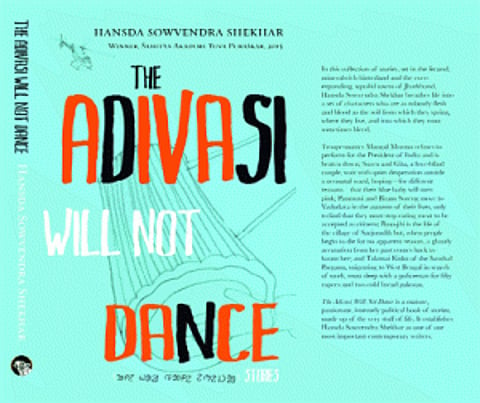
Not only are the stories intelligently titled, but the lure is also heightened by an appealing cover that also features cultural indicators such as a madal (a type of handrum) and words written in the Olchiki (the script in which Santhali is written). Shekhar has been careful in highlighting the nuances further with cultural markers in these delightfully written stories as well. For instance, honorifics such as jhi and baahu are frequently added to elevate the socio-cultural contexts of the plots.
In the thriving but insalubrious corners of Jharkhand, Shekhar’s characters cultivate resilience in the face of predicament. He is also exceptionally sensitive towards his female characters and almost all of them have been assigned a distinct individuality. They are brutalised, humiliated and abandoned after being mentally distorted, and yet they are not predictable, and have the fierce resilience to find their way back from an abyss. They are flawed too, but that is what empowers them.
The writer has been careful in denying his readers catharsis at many points so that they provoke the readers to think and react, rather than have their trauma purged with happy endings. Stories such asMerely a Whore and November is the Month of Migrations leave a hollow scar in the mind and compel one to loathe the sordid existence of self-degradation that humankind has reduced itself to. In fact, November is the Month of Migrations will remind one of Jayanta Mahapatra’s poem Hunger, in which a father pimps his young daughter for food.
The story tugs at the conscience and reiterates the perpetual conflict between body and soul, the individual and society. It narrates how the Santhals leaves their farms and lands and set out to West Bengal to plant crops in farms owned by the zamindars of Bardhaman. like the poem, the story too alerts us to the viciousness of the dilemma of a young girl exploited by who supposedly serves to protect her. The sexual deviance in it recognises the social agonies that curtail all traces of compassion. In all of the stories, the writer gives voice to a political, cultural and psychological ambivalence, to the deeply obscured sentiments of people.
Shekhar steers his readers through the boorish racket of prostitution, vile practices of witchcraft, child abuse, and much more, forcing the readers to overcome the ennui that they have associated with Indian literature whatsoever. Even if the debate over ‘Indian’ writing gains momentum in an urban, cosmopolitan context, this volume strikes hard in reinforcing how pertinent it is to acknowledge the trials and indignation of the tribal people as well as focus on their their literature.
ananyapioneer@gmail.com