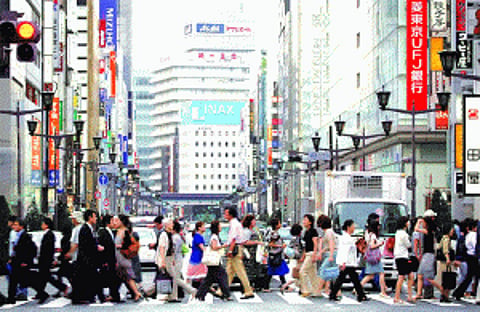

Despite the declining population, Japan is reluctant to open its door to large-scale immigration as it fears that inter-cultural marriages would result in children out of mixed parentage, threatening the nation’s racial purity, writes RAJARAM PANDA
Japan is sitting on a demographic time bomb. As an inevitable consequence of modernisation fuelled by rapid economic growth, Japan emerged as one the first few countries to face a new challenge of a declining population. This unprecedented population challenge threatens the nation with serious social, economic and political consequences whose impact is going to be felt for years to come. There have been several studies around the world on the issue of declining fertility of Japanese women, the real reason behind the declining trend in the nation’s population. Not only it is not at the replacement level, even the existing rate continues to show declining trend. This is at the core of this challenge.
The past and the present Governments have taken several measures to correct this worrying trend but since birth or the issue of having or not having a child is an individual choice, no Government measures howsoever attractive by offering incentives have been of any help to address this issue.
Early this month (April, 2017) a Government-affiliated research institute in Japan made the projection that Japan’s population is expected to fall below 100 million in 2053 and further plunge to 88.08 million in 2065, marking a 30 percent fall from the 2015 level of 127.09 million. The announcement by the Health, labour and Welfare Ministry’s National Institute of Population and Social Security Research confirms that depopulation, which started in 2008 after Japan’s population peaked at 128.08 million, was to stay as years pass by. The Institute therefore urged the Government to prepare for consequences in wide-ranging areas, including the pension and health care systems.
As regards the average life expectancy, it would increase to 84.95 years for men and 91.35 years for women by 2065, from 80.75 years for men and 86.98 years for women in 2015. According to the latest estimate of the Institute, people 65 or older will account for 38.4 percent of the total population in 2065, a rise from 26.6 percent in 2015. The nation’s total fertility rate, or the average number of children one woman is expected to give birth to in her lifetime, it would be 1.44 in 2065, slightly higher than 1.35 projected for 2065 in the previous 2015 estimates. It is projected to dip to 1.42 in 2024 before rising to 1.44 in 2065. This shows that the number of women in their 30s or 40s who get married or have babies would increase.
The estimate in the birth rate would mean Japan’s population would drop below 100-million-threshold five years later than what was projected in the previous estimate in 2015. It is unlikely that the government could achieve its goal of maintaining a population of 100 million into the 2060s. The estimate suggests that Japan is having difficulty halting the acute population decline and the rapid aging of society.
Based on the census results, the government announces long-term population projections every five years, based on the number of births, deaths and cross-border moves of people. These are basic materials, which help the government to work on the design of the country’s social security system, which includes the pension and health care systems.
In the age category of between zero and 14, the number is estimated at 8.98 million in 2065, down from 15.95 million in 2015, with the share of this group in Japan’s total population falling to 10.2 per cent from 12.5 percent. The number of people aged between 15 and 64, the productive population category, is also expected to fall to 45.29 million from 77.28 million in 2015, with their share sliding to 51.4 per cent from 60.8 per cent. In the estimate, the elderly population would be 33.81 million, almost unchanged from 2015. The latest estimate would mean that each elderly person will be supported by 1.3 people in the productive age group in 2065, down sharply from 2.3 people in 2015.
This declining trend is disturbing for the Government as this is going to impact the nation’s economic future and leading to social chaos. Prime Minister Shinzo Abe has made countering population worries one of his top priorities, aiming for a birth rate of 1.8 children per woman from the current 1.4. Despite this worry and unlike many other advanced countries where immigration makes up for declining birth rates, Japan remains reluctant to open its doors to large-scale immigration. There is a fear that Japan’s racial purity could come under threat if liberal immigration laws open door for foreign migrants, leading to inter-cultural marriages and resulting in births of children out of mixed parentage. Children of mixed parentage are contemptuously called ‘hafus’. In 2016, when Priyanka Yoshikawa, a 22-year-old born of an Indian father and a Japanese mother was crowned Miss World Japan, many in social media disapproved her selection as she was seen as half Japanese and questioned on the relevance of the beauty pageant.
The estimates put Japan at the forefront of the uncharted demographic territory, though many other industrial countries, including even Japan’s neighbours South Korea and China are also beginning to enter this difficult terrain. Though the consequences of this demographic shift are going to hugely impact the nation’s future in almost all spheres, predicting precisely the intensity is not easy. If the political leadership in Japan is serious to arrest the trend, a number of interventions are needed including political, cultural and economic parameters, besides opting for liberal immigration laws or create environment that could lead to robust fertility rates.
Japan is going to host the Olympics in 2020 and that would be a good time to rethink the immigration issue as Japan would require extra labour force to cope with the daunting construction work and making other preparations to host this international event. But given the conservative attitude of Japan, the change is unlikely to happen. Even on the healthcare service sector where Japan is in urgent need of health care givers for catering to the needs of the aged, Japan has put stringent terms for the Filipino care givers, thereby restricting their numbers and making many ineligible.
However, it would be incorrect to see the issue pessimistically. The Government has put in place some corrective measures with a long term perspective to create a more liberal environment for people to accept presence of more foreigners in the society. The popular Jet Program (Japan Exchange and Teaching) at school level to create a large pool of English-speaking youth is one. Another is accepting certain number of women from some Asian countries, such as the Philippines, in the rural parts of Japan for the purpose of marrying men who find it difficult to get a wife among the native population. This way, a new situation could be created, leading to increased openness to immigration in the coming years. Though there is a sizable section of people in countries like Brazil and Peru who are of Japanese origin, they are unwilling to return to their country of origin as they are already well settled in services or other businesses and would not like disruption.
To put in perspective, the demographic time bomb that Japan is sitting on is because of low fertility combined with increased life expectancy, thereby creating a population structure that is significantly weighted towards older members of society. There are fewer people under 30 than there are between the ages of 30 and 60. When the middle-aged section of people grows old and die, there will be far fewer people remaining behind. To put it differently, the current middle-aged generation of Japanese has failed to replace itself.
The reasons why such is the case is not difficult to identify. less noticed but closely linked to low fertility rate are other factors such as increased education of women, delayed marriage, economic opportunities for women, the fear of increased financial burden in modern, urban societies, etc. Even in case of marriages, if both the man and woman are working, they do not want to have babies for the lack of child support system at home when parents are in office. This group of people belong to the category of Double-Income-No-Kids or DINKs. For others, when the marriageable age at some point of time gets over, many chose not to marry at all and lead a life of melancholy and suffer from stress-related diseases.
When they retire from service and grow old, loneliness leads to depression and many commit suicide. Such a situation has given rise to new areas of study such as how to handle grief, death, loneliness etc. As a result, old-age homes have mushroomed all over Japan, with cases of dementia increasing. Because of few children, in the medical science paediatric as a branch of medical discipline has lost its lustre and not many students chose to specialise in this branch of study because of lack of demand. In the hospitals, paediatric wards have disappeared because few children are brought for treatment. Places that were playschool for kids are converted into offices for making funeral arrangement. In malls, corners meant for kids to play when parents go for shopping are being converted for aged people to relax and spend some time over coffee. One can find tables in restaurants meant for one person occupied by a single man or woman after office enjoying a beer and food as no one would be waiting at home and they do not know what to do when they return home early. Japan may be a modern and advanced society but it still remains conservative in many ways. For example, child-birth out of wedlock is stigmatised, which is why the decision not to marry also means that one has chosen not to have children.
Interestingly, owing to the shortage of labour, the Government is trying to create situation whereby more women are drawn into the country’s labour force. Normally, a woman who is working and finds a husband chooses to leave the job after giving birth to a child and take up domestic responsibility solely. The modern woman is unwilling to surrender the freedom to remain independent, which is why marriage is not an option. Child care centres close to office arranged by the employer if a woman chooses to continue to work, is found inconvenient. Women face social pressures to manage a career while also raising a family. The responsibility usually falls on the woman as balancing work with child-rearing because there are not enough nursery schools to look after their infants, leaving them with no choice than to quit the job. This also puts financial constraint on the family.
A Government survey of people between the ages of 18 and 34 in 2011 showed that over 61 per cent of unmarried men among those surveyed lacked a girlfriend and 49.5 unmarried women had a boyfriend. The same survey showed that 49 percent of women found no need to marry, while 45 percent of men showed no interest in dating the opposite sex. This shows that there are also attitudinal issues in the Japanese society towards life. Some surveys done recently also show that the percentage of young people losing interest in having sex is decreasing.
The decline in population is going to impact more severely on Japan’s economic future than now, and impact the social security system, a mechanism by which the fruit of a nation’s economic growth is distributed through tax and insurance systems. Japan shall find it hard to meet the social security needs of the people without growth, and without wealth distribution through social security, steady growth cannot be achieved. Japan needs to notice warning signal in the social security and growth cycle matrix.
The writer is currently Indian Council for Cultural Relations India Chair Visiting Professor at Reitaku University, Japan. The views expressed are his own and do not represent either of the ICCR or the Government of India. rajaram.panda@gmail.com