
Today, it is in the Indo-Pacific that India’s opportunities, strongest partnerships and principal challenges lie. The new Government needs to reconfigure the look East Policy for development and invest it with new meaning as a key pillar of India’s foreign policy
From both the economic and security perspectives, India’s ties with the Indo-Pacific region have assumed increasing salience since the country began to actively engage the world in the 1990s. As the new BJP Government assumes office, it will find that the look East Policy articulated by the Narasimha Rao Government is not only fundamentally important for its rapid development but needs to be invested with new meaning so that it is recognised as a key pillar of India’s foreign policy with dimensions that are vital to its well-being — economic, security and political. Today it is in the Indo-Pacific that India’s opportunities, strongest partnerships, and principal challenges lie.
An Intertwined Region
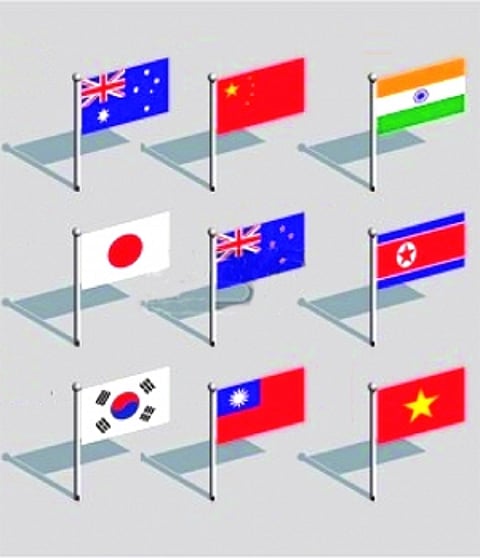
The Indo-Pacific is a recent geopolitical and regional construct; its significance is still evolving and being grasped and defined. It engulfs the largest and some of the most important states of the world — India, China, Japan, the states of Southeast Asia, Korea, Australia and New Zealand, and the US. The deepening economic interdependence within this region has come about as a result of the end of the Cold War and rapid globalisation. The largest economies across the region are being stitched together. To be stable and sustainable, economic interdependence necessitates political and security cooperation, a vision of common interests and collective future, and construction of multilateral institutions that enable the states to govern better, overcome security dilemma and cope with the sovereignty limiting effects of globalisation.
The region has a history of multi-ethnic and multi-religious coexistence much like India. From Gujarat, to Kerala, Tamil Nadu, Andhra, to Orissa and Bengal, sea-faring India over 2000 years has had intensive trade, religious and cultural, political engagement with Southeast Asia, China, Korea and others that have left their deep imprint. These ties weakened when India turned its back on trade and investment ties with the outside world for four decades after Independence. They are being forged again as India returns to its historical role as a great maritime and trading power. Already over 60 per cent of India’s trade is with the region. The United States, China, Southeast Asia, South Korea and Japan are India’s leading economic partners; Japan, Korea, Singapore, Malaysia and the US are key investors, and the US and Japan crucial strategic and security partners. If India is to grow at 8-10 per cent over the next two decades deeper partnership with the region and interest in its stability and well-being is essential for the new leadership and policy-makers.
China’s Rise and Regional Turbulence
However, the region today is deeply troubled. China’s military build-up and its expansionist nationalist agenda cast a huge shadow and threaten to unravel the regional order constructed since the 1990s. Beijing’s large territorial claims on Japan, South Korea, Vietnam, the Philippines, the East and South China Seas, and across the Himalayan border with India, and PlA’s steady military build-up and seizure of claimed territories has emerged as the single most important cause of turbulence. Already counter-nationalisms and military building are growing in Japan, Vietnam, South Korea and the Philippines. Popular anger against China — a major economic partner of all the states — is rising. Vietnam has witnessed large-scale rioting against Chinese workers in the country, following the placing oil rigs by China within Vietnam’s maritime zone. Rising nationalism in Vietnam can threaten the Communist Party’s rule, and in Japan undermine the faith in Article 9 of its Peace Constitution that restrains its military power. The Chinese Communist Party on the other hand is fanning nationalism to legitimise its monopoly of power. Historical wounds are being reopened as nationalism grows in China and Japan. The regional architecture in Southeast Asia — the ASEAN — has been rendered ineffective because of its internal divisions on China, and the affected states are seeking US security protection. Other institutional arrangements such as the ASEAN Regional Forum, the East Asia Summit are all being undermined. This is a recipe for potential armed conflict, and has wide ramifications for India.
China has been pursuing high nationalism and interdependence simultaneously, in the belief that the Asian states will be so dependent on it that they would rather give in than displease it. Its earlier restraint on nationalism has given way as the Chinese elite have convinced themselves that the US is in decline and would not act against China. The US remains the dominant military power and is committed to the security of its allies — Japan and the Philippines, and to the freedom of the SlOCS. Most states want the US to raise its profile and engagement. While the US has promised to enhance its role in the region and continue to guarantee overall security, there are also huge doubts whether the Obama Administration has the will to play an active security role that has the potential for conflict with China in the post-Iraq, post-Afghan era. Uncertainty is growing, creating conditions for miscalculations.
India’s Interests
India has growing stakes in deeper engagement with the Indo-Pacific region. Sustained peace and stability is in its best interest. The Government needs to initiate policies that would enhance trade, investment and security ties across the region, as well as be active in strengthening norms, multilateral institutions and the security architecture.
All-round ties with Japan and the US are increasingly vital, and those with Southeast Asia and China are crucial. A broad Indian policy framework exists but more substance and ideas for effective pursuit of the goals are needed. Security engagement in particular were stifled by the previous Government to the detriment of India’s and the region’s interests.
At the centre of the policy challenge in the region is China. like much of the rest of East Asia, China is India’s major trade partner as well as its principal security challenge. China policy has since the 1990s rested on the dual pillar of ‘engagement and balancing’. India’s doors have been opened to trade, political dialogue and military CBMs. There is a national desire for improved relations and resolution of disputes. But there has been little progress on territorial and security issues, or an improved trade mix. Chinese territorial claims and actions destabilise Arunachal and ladakh. Its maritime policies, encroachment into Vietnamese EEZ, and claims for the control on the South China Sea pose critical challenges to India’s economic and security interests. Its military profile in the Indian Ocean is set to grow. India needs to engage China politically across the entire gamut of trade, security and regional institutional issues with a focus on problem solving. It needs a stronger military, an effective security policy and a show of resolve that it will deal with China on the basis of reciprocity and pragmatism. China must be made to see large benefits in cooperation with India and considerable pain if ties turn sour. Ties with the US, Japan, Vietnam, and Indonesia are important in themselves but they are also significant for restraining China’s ultra-nationalism. India’s position on China’s sovereignty over Tibet and Taiwan similarly must be shaped by China’s continuing claims on Arunachal (shown in Chinese maps as part of Tibet), occupation of large segment of ladakh (merged with Xinjiang), and non-recognition of India’s de jure sovereignty over POK. Finally, the Dalai lama and the 150,000 Tibetans in exile in India since 1959 deserve to return to their homeland. This is a global humanitarian issue. The survival of the ecology, culture and habitats of Tibet is vital for India, China and Asia. It is a matter that requires attention in relations with China.
In brief, India’s foreign policy under Prime Minister designate Narendra Modi can and must significantly contribute to stabilising the Indo-Pacific, help build confidence and work for a security architecture that would sustain peace and enable the long-term development of the country.
The author is Professor, Nelson Mandela Centre for Peace and Conflict Resolution, Jamia Millia Islamia