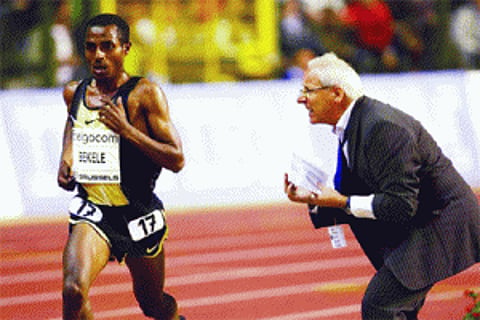

From representing the Netherlands in Olympics to coaching and managing world’s top athletes, Jos Hermens has done it all. As an athlete, he held world record in hour run for close to 15 years and, later as a coach and manager, he unearthed talents like Haile Gabrselassie and Kenenisa Bekele. The Dutch legend is in India with his athletes for the Delhi Half Marathon and on the sidelines of an event, he shared his experiences with Amit Chaudhary. Excerpts You’ve donned many hats in your life so far. Tell us something about your journeyIJ
I competed in 1972 (Munich) Olympics but we had to return home because there was problem with Palestinians. In 1976 (Montreal Olympics), I competed in 10,000m. I was in the final round but finished only 10th. Not that good. I ran the world record for one hour run on the track — 21 km. When I was 27, I was already injured. When I was in Geneva, they injected my muscle with cortisone and at the age of 27 that muscle broke and could never repair. But I like this sport so I studied to become coach and slowly I moved into management because all the athletes have the same questions, when do I train, how do I train, when they are injured they ask which doctor should they go and how do I travel. So that’s how I started, when I was around 32, to do this management and my hobby became my business. Originally I was a teacher, so I like to work with young people. I met Geoffrey Kipsang when he was only 18. I tried to bring him on board and educate, not only for running but also for school and other things. The biggest example is Haile Gabrselassie. I discovered him when he was 18 and we worked together. Now he is 40 and we are still working together for 22 years. As a person my dream is to see how young people can be followed up. My dream is to see Haile become president of Ethiopia and I think that’s possible.
You arrange athletes for other races tooIJ
Yes, we do more than 20 road races, including 10k and half marathons, in India, in Europe and other places as well. We specialize in this. We also did races in China. We do Diamond league competitions in Shanghai. We are quite worldwide. We also manage athletes and we also work as consultants to organisers about many tactical things not only the athletes but also about the course, the drinks, the separations and other things. When they have questions how can we get these athletes, how do we know that they are in shape, how can we discover new talents, what can be changed about the course, what about the climate, what time of the day should we start, we try to provide answers of all these questions to organisers.
How has been your experience with Indian marathonsIJ
We started only a year ago in Mumbai and yes it’s challenging because it’s different. The organisation of the course is very difficult. Here in India, you know, cars and bikes are coming from all directions. So it’s difficult to get the roads clear for the safety of the athletes as well as the people in the car. There are still a lot of things that you can do better with drinking stations, with courses. For the rest, it’s a very good system. Of course I don’t know what’s happening in the rest of the country. I have only seen the four major competitions (Mumbai, Delhi, Bangalore and Kolkata).
What are your views about Indian athleticsIJ
I can’t say enough yet about the Indian system. I hope to learn more about it. The problem is that we don’t have many good Indian runners at the moment. It always helps because people have someone to look up to. What I understand is that around 19 million people live in high-altitude in India, so there must be some good runners in the mountains. But we have some challenges like education, how can we reach them, how can we find the talent. For me it would be a big challenge to try an Indian girl or a boy who, may be, come and train with those guys in Africa and develop their skills. We are doing that in China.
For how long have you been doing thisIJ
I’ve been doing this for the last 25-30 years. I am an old guy (laughs). I used to be an athlete myself. I was a coach too and then we started to do management and we have 150 athletes. In our company — Global Sports Communications — we have 25 people worldwide who are working very closely and indirectly there are more than 100 people involved in our organization. So we manage 150 athletes like Haile Gabrselassie (two-time Olympic gold medalist and four-time World Champion in 10,000m) and Kenenisa Bekele (three gold medals in Olympics and five in World Championships in 10,000m and 5,000m). So we have lot of long distance runners from Africa.
These athletes come from very different countries, have different cultures, different languages. It must be very challenging to manage them.
The biggest challenge is of course the visa. Especially in India, it is not easy because in some countries like we have athletes from Eritrea, they don’t even have an embassy there so passports have to be sent there and it takes a lot of time before you have all the papers for the athletes. It also includes a lot of traveling, you have to see that athletes have proper training, some people pick up injuries, they get flu, malaria. All these things are pretty complicated because we are also dealing with their managers. These athletes are not necessarily our athletes. They come from different managers. The good thing is that we know all our colleagues as we organise several events every year so they know they can’t play games with us because if they send the wrong athlete to us, they are going to meet us in another competition in one month or so. So we need good professionalism and relationships with other managers to work together. We pick out the best managers, people who are well organized. They make sure that their athletes have all the facilities.
Does the fact that you yourself were an athlete and competed at the highest level help you win the confidence of young athletesIJ
Of course. They know I have trained very hard. I used to run 50km per day so I know what the suffering is, I know the pain that they take, I myself made many mistakes and I can prevent them making those mistakes. So yes, they know that this guy has been training and sweating himself and he was an Olympian, may be not the world champion but he knows about training and he is a coach.
As a manager, what has been your biggest challenge so farIJ
I think one of the biggest problems with the African athletes is the lack of education because they haven’t done much schooling. Sometimes it becomes difficult to explain. They are poor and with this sport they can earn money. They say ‘let me run every week’ but we all know that if they run every week, within two years they will be dead. So you have to tell them, ‘No. Go back, relax, train, go to the physio’ and things like that… prevention of injury, planning, what are they going to do with their money. We tell them not to buy five cars, instead buy a house, land or buy a farm for the future for your family. These are the big challenges.