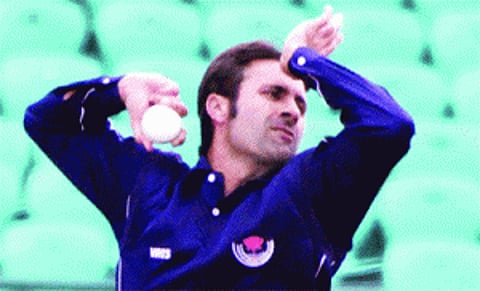

Not allowed by the BCCI to talk to the media one month before and after being in the team, Kashmir Valley’s emerging youth icon PARVEZ RASOOl ZARGAR is quietly touring South Africa as part of India’s ‘A’ team. KHURSHEED WANI tells you how the youngster from South Kashmir has battled all odds to make it to Indian cricket’s elite zone despite once being wrongly accused of carrying explosives to blow up the Chinnaswamy Stadium and how his presence in Team India has ushered a dilemma for the Valley’s fan fraternity
like most Kashmiri boys, this 24-year youngster loves celebrating Eid-ul-Fitr at home. However, this year, he could only call up his family from South Africa to extend his Eid greetings. His parents missed him but understood his absence. After all, they have just begun to enjoy their son’s celebrity status.
Parvez Rasool Zargar, the most-talked-about cricketer in India these days, reached South Africa directly from Zimbabwe. The only regret he carried with him was that he could not play for India in the five-match ODI series that the Virat Kohli-led young team won against Zimbabwe 5-0.
The buzz around his inclusion in the Indian squad was in equal measure to the disappointment on his exclusion from the playing 11. Chief Minister Omar Abdullah and Congressman Shashi Tharoor expressed dismay over delaying Parvez’s debut. But, the lad himself chose to quietly fly to South Africa to be part of the India ‘A’ squad to play a few first class games. His family is confident their son will represent Team India sooner rather than later.
On July 5, Parvez Rasool’s name figured in the 15-member Indian squad touring Zimbabwe. Among many debutants, he was the lone one to receive extensive media coverage. His distinction was that he belonged to the troubled State of J&K and was the first ever man to represent the Valley in Team India.
Back home, his historic inclusion was more a political statement than the acknowledgment of his cricketing talent. He was projected as a Kashmiri youth icon who had made it big despite serious glitches like the 2009 episode when he was picked up on suspicion of carrying explosives in his cricket kit to blow up the Chinnaswamy Stadium in Bangalore. Then, a call from Jammu and Kashmir Cricket Association (JKCA) chief and state’s ex-chief minister Farooq Abdullah saved the day for the lad.
Parvez belongs to Bijbehara, one of the oldest towns in south Kashmir on the banks of the Jhelum. Nestling on many plain fields and a thriving cricket bat manufacturing industry, its combination of geography and business has developed a strong following of the game.
Parvez’s father, a Government employee, is a former cricketer as is his elder brother. Both played district-level cricket and his brother even graduated to playing some first class games.
“Cricket is in our blood. My father has also played cricket at district level,” Parvez said, recalling his childhood days when his father used to take him to watch the cricket matches played in the vicinity.
His all-round cricketing talent was spotted at an early age when he qualified to represent under-14 and under-16 teams in south Kashmir. The prominent Bijbehara Sports Club (BSC), a reliable base for south Kashmiri cricketers, offered him a berth which eventually helped his national take-off. He was lucky to find patronage of his father’s friend Abdul Qayoom Bagaw, the pacer who missed representing India by a whisker in the mid-1980s. Bagaw introduced him to the City Cricket Club in Srinagar, a move that earned him a chance to represent J&K in the under-19 and under-22 teams.
Parvez’s first class career started in 2008 with a debut against Himachal Pradesh. It was a disappointing start. He scored 40 and 16 in two innings and failed to get a wicket. His team lost comprehensively.
For the next four years, he was in and out of the J&K team. But, the 2012-13 Ranji season proved to be a turning point for him. By now, he had mastered the art of handling the blade and cherry with equal skill. With notable 594 runs in 13 innings at an impressive average of 54 with two centuries and two fifties beside a haul of 33 wickets (including 7 for 31 against Assam), he made his presence felt. His stars began to fall in line and there was no looking back. His mentors Bagaw, Rajesh Dhar, and Bishen Singh Bedi (then JKCA coach), honed his skills to make him a promising cricketer.
Interestingly, Parvez’s career began to shine when the JKCA was going through its worst phases. A multi-crore scam involving chairman Abdullah had surfaced and septuagenarian coach Bedi was being projected as a misfit to lead the J&K team, which banks on pacers and batters, not spinners.
In fact, the Ranji selection was perceived to be so biased that the team split vertically with many Valley-based players boycotting the tournament. Parvez, however, clung to Bedi and this paid dividends. After impressive performances, he was selected to play against the Aussies in Board President’s XI where he rendered a stunning performance taking seven wickets for just 45 runs. In quick succession, he signed a contract with the Pune Warriors ahead of the sixth edition of the cash-rich IPl.
In the company of world class cricketers, he began to steal mention in the media too. Many a times, he was the subject of tech-savvy Omar Abdullah’s tweets and netizens’ discussions on Facebook and Twitter.
Parvez’s impending entry into Team India will bring in a dilemma among the Valley’s cricket watchers who are known to be diehard fans of the Pakistani cricket team and are overtly against Indian cricket.
As soon as Rasool’s selection made headlines, social networking sites began discussing what that would mean for the fan fraternity in the Valley. While many Kashmiris admired his cricketing talent, others dubbed him a traitor.
“Rasool belongs to a conflict zone. Therefore, his selection will be viewed through that prism. He has to receive bouquets as well as brickbats”, said political commentator Haroon Rashid.
Gowhar Geelani, a keen cricket analyst, asked “why ostracise and isolate Parvez Rasool, a cricketer from the small south Kashmir town of Bijbehara and a boy with humble background, for getting selected in the Indian national teamIJ Don’t we have our people joining as police officers, bureaucrats, politicians, collaborators and sarpanchs tooIJ For now, Parvez’s selection should be taken on face value. Some Kashmiris would want him to score runs and take wickets but still pray for Pakistan’s victory over India. That’s the reality”, Geelani said.
As for Parvez, he will be walking a tightrope, especially when he is a part of the Indian squad against Pakistan. “Fielding a Kashmiri against Pakistan carries a strong political message which few in the Valley will like. On the other hand, if Parvez fails to give his best during such a match, many will question his loyalty. The 24-year carries a double-burden on his shoulders,” analyst Rashid Ahmad said.
Post the 2008 and 2010 youth disturbances in the Valley, the Central Government initiated several programmes to offset the youth’s “sense of alienation”. If Parvez Rasool kicks off brilliantly, he can boost this national campaign.