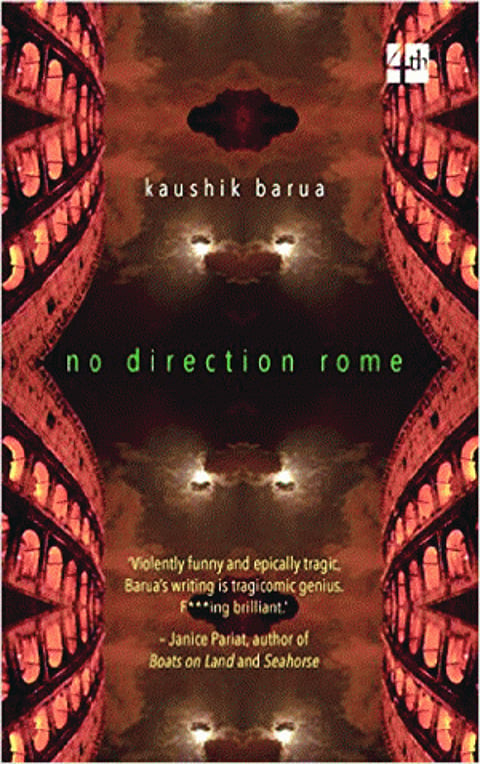

Be it known at the outset that former Sahitya Akademi Award winner Kaushik Barua’s new novella, No Direction Rome, is not for the purists. It cossets dark humour, chaos, and scatology. It concentrates sincerely on an imagined conversation among turtles, it has a chapter titled ‘Kim Kardashian’, and scratching arse, defecation, and hemorrhoids are integral to its narrative. In short, it upholds a paradigm that seeks to find meaning in nothingness, in unsettling every shred of stabilised meaning. To a large extent, it’s essentially postmodern in its tone and tenor since it offers hitherto unthinkable parallels to canonical entities. In fact, at a point, Barua’s protagonist, Krantik, compares Monet’s art with the shape of the curve of his excreted waste, or in another, he crosses a Protestant cemetery and remarks that Antonio Gramsci and John Keats are decomposing there. No Direction Rome, in every way possible, is a pursuit to subvert institutional standards. But it is still vivid in imagination and displays both clarity and creativity of thought. It is fairly noticeable in the way it is titled, as one may be reminded of Martin Scorsese’s No Direction Home, a tremendous archival account of Bob Dylan’s life, from his rise to his retirement from touring after an accident.
This is the story of a ‘directionless’ Krantik in Rome, whose fiancée Pooja has attempted to kill herself and the onus ostensibly falls on Krantik’s shoulders, especially when pressurised by Pooja’s conservative political family in India. Krantik seeks directions to ancient Roman ruins from pedestrians and happens to meet Chiara in the pursuit. Chiara implies that she is headed the same way as he is, but in reality both of them are equally directionless. They develop an inexplicable liaison which is more of a curious confusion. Besides being directionless, they are also similar in their physical inhibitions; he is a hypochondriac who is scared that his bowel disorientation will kill him, and she can slit her wrist with ease. Ironically and on par with the narrative’s warped humour, the name Krantik means ‘the fighter’.
At the same time, the bizarreness of the novella is what sets it apart. Its drama reflects some melancholic truths about our contemporary times with modern, materialistic pleasures found in Facebook ‘likes’ and cat videos on YouTube. Occasionally, it also oscillates between the inner dilemmas of Krantik and the wacky turbulences in his social milieu. It is almost as if James Joyce has found his alter ego in Albert Camus!
Cultural geography seems to be important for Barua. His award-winning earlier work, Windhorse, narrated the lives of a group of young Tibetans who take up arms to form a resistance movement against the Chinese occupation of Tibet. No Direction Rome, on the other hand, is substantially distanced from its predecessor but the Roman landscape that Barua familiarises his readers with is as gripping and fascinating. At many levels, Rome is a character in itself and a steady partner for Krantik’s altering moods. And this Rome isn’t the expansive cosmopolitan city with all its artistic and architectural glory, but a very routine and real city with regular people. From the very beginning, Krantik’s scepticism is displayed through equally cynical imagery, particularly through twisted interpretations of classical structures. The glimpses of Rome that we get are these: “I didn’t know what the Colosseo was still doing there. It had been around for two thousand years, its massive open mouth gaping at the skies like a toilet bowl for the gods. The gods taking a dump on us all for two thousand years”. The attack on iconoclasm is consistent: “For Berlusconi, God is probably a big blue Viagra pill in the sky”, or “Why should I ask ‘Mother Mary’ about anythingIJ What would she know about sexIJ”
Krantik’s Rome eschews all its former romantic depictions. In many ways, he subscribes to the inescapable capitalistic existence and tries to find a leeway between communism and fascism: “In Rome, communists and anarchists are always taking over old buildings and turning them into clubs. Which is what communism should be about. And then they abuse Berlusconi who’s as f***** up as they come”.
The Indian mores employed in the narrative too are as contemporary as they can get. Cricket and Goa serve as momentary refuges for the tormented Indian souls. While the former, as Krantik observes, is a pre-conceived marker of Indianness, Krantik sees the later as the getaway to an ideal future.
But amidst the chaos, there is also an urge to find meaning and hope in bleakness. A very interesting conversation in the novella goes like this: “Palaconto” “What does that meanIJ” “It’s a nothing-word. It means we don’t want the global capitalist aristocracy we have inherited...We don’t want Elvis. We don’t want Che. All we want is Palaconto”. And that is what makes the novella post modern.
Krantik’s frustration, opinions, disenchantment with romanticism and expatriate nostalgia, et al, strikes a chord with the young readers. He is real and would not apologise for it. He knows that life, both in India and outside, is filled with problems and the future is waiting to tease everyone.
In the meanwhile, he finds meaning in everything through his creative imagination and madcap comparisons. As a little towards the end, he defines life as: “life is a lot like Kim Kardashian. There’s no reason for it. There’s no point to it. But it’s there”.
ananyapioneer@gmail.com