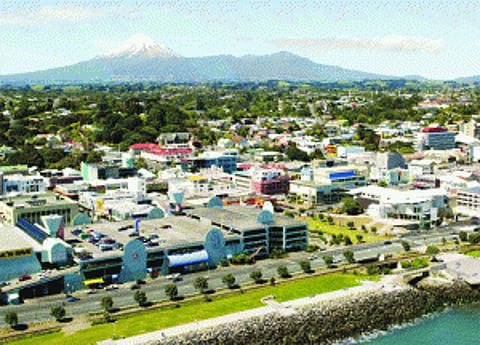

New Plymouth in the Taranaki region of New Zealand is where the first humans entered the paradise of birds. MEENAKSHI RAO soaks in the history of this beautiful uncharted town
It is an altogether different experience to breathe the air of a place which gives purity a complex. The largely unvisited region of Taranaki and its showpiece town New Plymouth fall in that category.
This picturesque town has its crowning glory, Mt Taranaki, rising in the horizon, ruling over lives much less important but no less meaningful.
Divinity here rests on the forehead of this double edged mountain, revered by the ancient Maori tribe as a divine entity. Standing over a lush green goblin forest with gurgling waterfalls and orchid blooms, and covered with an unending canopy of stars, some of them falling to adorn its crown, this mountain, which rather stylishly wears its whites in the winters, gives life fitness, not to mention raison d etre, to all those who care to climb it. To the rest, it is wonderment with a rugged exterior but soul defying gentleness.
But New Plymouth, a quaint town fledgling under the shadow of Mt Taranaki, is not just about its rising God. It has history so rich that you may want to spend more time with Mike Nightingale. So who is MikeIJ You could call him the lone bullet left behind by those war days of yore — bullet yes but no lose cannon. He is one of the lesser sung wonders of this town, the other being the more famous, philosophical and fierce artist-activist lyn lye.
The stunningly modern structure of the lyn lye Museum is a showstopper spreading its mirror-like steel exterior in the heart of town. It encloses lifesize sculptures of lye and gives you a feeling of vertigo with its sprawling empty spaces. One of the creations of this iconic artist, the wind wand, towers over the beachside on the other end of town, so big, high and different that you wonder at the imagination IQ of lye who may have spent a better part of his life in Europe but is serenaded in solitary splendour at this facility.
Even the less arty gentry would love the way this museum has been constructed and the size defying modern sculptures that pillar its interior.
Mike, meanwhile, is in his late 70s with hearing aids in both ears. He has white eyelashes over grey blue eyes and a smile so electric that you might catch the current. He is man with history, not his own but of his region. Besides having bullet speed and becoming humour, he also has that ability to connect you to New Plymouth even if you are far removed from it culturally and geographically. From the 1800s to now he knows all about the place he calls home and volunteers to tell you all about.
This is the place where the Maori boats arrived almost 2000 years ago to mark the first human presence on this island of birds, butterflies, turquoise lakes, snow covered mountains and miles of green land stretching your imagination to limit.
It is also the mouth of the arrival of the first British ships which followed two decades of bloody wars between the Whites and the Maoris only to culminate in a treaty heavily sided with the Europeans. Today, the truce and togetherness speaks of the inclusivity the Kiwis are known for.
Mike, being a White, has no hesitation in admitting that the lovely roads and the landscaping came through British organisation but the heart and soul was never limited to just one community after the wars ended.
Strolling through the gentle mounds on which New Plymouth languorously stretches, you can’t imagine the bloodshed ever having seeped its lush green cover. Mike says many died, but disease got the civilians more than the battles did.
Sitting next to the grave of Mary Jane and her three young children in the quiet nook of the town, covered in old world maple trees rustling their condolences with grace, you know pestilence can come in all forms — both war and disease.
The Taranaki region, not so touristy but floating in history & culture, reminds you of this. It is a perfect mix of old and new worlds. The main marketplace is replete with 200-year-old buildings wherein unique boutiques, Manuka honey shops, apparels by newest designers, eateries and even barber shops exist.
Talking of eateries, the town’s place to be for dinner is the happening and friendly eatery Social Kitchen where fun and food come tapas style on sharing platters. It has snacks to die for, particularly its chilly chicken which knows what chillies should taste like.
For that perfect ending to a lovely day, go for your after-dinner coffee brewed freshly at the only coffee warehouse in New Zealand. The warehouse looks like a warehouse and the coffee tastes like real, authentic coffee even though not a single coffee plant grows in New Zealand and the islands of birds is just about concerning itself with this very South American brew.
Mike tells you — and shows you — the other wonder that New Plymouth gets its faith and uniqueness from — the offshoot of the original thorn tree from which the thorn crown of Jesus was made!
He also talks extensively about the rarest of rare Maori artefacts that the New Plymouth houses with pride. They come all the way from a British collector who bought it from an explorer who shipped away the treasures secretly. And then there is this very quaint house of the 1800s where the richest English couple lived in the 1800s.
Quite something this yet to be charted place where a lonely volcano rises up from the rugged west coast to salute human endeavor. Quite something too that the region is part of the world’s largest pest eradication programme.