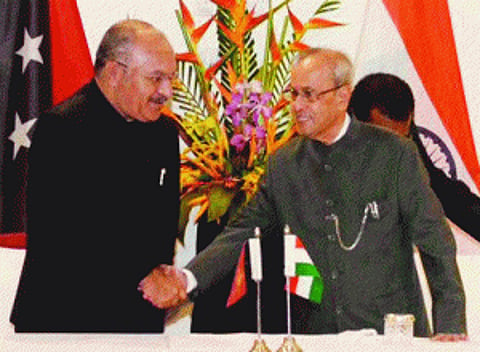

President Pranab Mukherjee’s visit to Papua New Guinea assumes importance as a key component in India’s Act East policy, explains Rajaram Panda
India’s diplomatic outreach to the Oceania that started with Prime Minister Narendra Modi’s visits to Australia in November 2014, the first by an Indian Prime Minister in 28 years, was followed by President Pranab Mukherjee’s visit to Papua New Guinea (PNG) in April 2016 — again first ever by an Indian President to visit that country.
As India incrementally raises its diplomatic profile commensurate with its increasing clout in regional and global affairs stemming from its high economic growth, one cannot miss the strategic as well as the economic dimensions of such visits.
While Australia’s importance to India as a source of critical resource is given, which is why Australia is important for India economically, the strategic dimensions are equally important. Same is the case with PNG and other Pacific island nations.
Seen from this larger perspective, President Mukherjee’s visit to PNG assumes importance as a key component in India’s Act East policy. President Mukherjee also visited New Zealand.
It was in last August that PM Modi had met his PNG counterpart Peter O’Neill in Jaipur on the sidelines of Forum for India-Pacific Islands Cooperation (FIPIC). This was the second FIPIC summit organised in less than a year; the first was held in Fiji on November 19, 2014.
The FIPIC summit is seen as India’s aim to expand its economic and strategic footprints in the region amid China’s increasing presence. The role of the 14 Pacific island nations (Fiji, Marshall Islands, Nauru, Niue, Palau, PNG, Samoa, Tuvalu, Vanuatu, Cook Islands, Kiribati, Micronesia, Solomon Islands and Tongo) is important for India as their support at international forum, where India has stake, would be valuable.
With 7.1 million population and 462.840 sq km area, the PNG is the largest Pacific Island nation, both in terms of population and area. Over 3,000 Indians, mostly businessmen and professionals, work in that country in different areas, including IT and IT-enabled services, education, and technical personnel in mining.
The island nation was looking for strengthening cooperation in defence, agriculture and healthcare sectors. On its part, India offered to extend all possible help to PNG.
During his recent visit, Mukherjee and O’Neill discussed opportunities for future cooperation. The visit not only demonstrated the warm relations that both countries share, the two also discussed current and potential cooperation opportunities in areas such as agriculture production, downstream processing in the hydrocarbon sector, plus health and education exchanges.
PNG duly acknowledges India’s role in extending technical and economic cooperation, including in the defence sector. It also acknowledges that India has expertise in food production and from being once import-dependent on food, is now a net food exporter and wants to learn from India’s experience. As PNG moves away from exporting only raw oil and gas, cooperation in downstream processing for its hydro-carbon with India is of extreme importance.
A number of agreements were signed. Mukherjee also unveiled a statue of Mahatma Gandhi at the University of PNG, addressed the PNG-India Business Council, and launched the India-PNG Business Association. With a view to strengthen bilateral ties and ensuring energy security, India offered a $100 million line of credit for development of infrastructure in PNG and agreed to jointly develop the Pacific nation’s vast oil and gas resources. India also offered a coastal surveillance radar system and Coast Guard patrol vessels as part of its commitment for the mutual maritime security initiative.
From the discussions that Mukherjee had with the Prime Minister of PNG and his counterpart and the joint statement issued thereafter, it transpired that there are many regional and global issues such as terrorism, India’s candidature for permanent membership of the UN Security Council and maritime security on which both share common views.
Therefore, both countries agreed to establish a mechanism for regular consultations between their foreign ministries, aimed at diversifying bilateral cooperation in areas of shared interest. The joint statement said: “Keeping in view India’s desire to achieve energy security, PNG agreed to develop new avenues of cooperation with India in exploration and development of PNG’s vast oil and gas resources through joint ventures and Indian public and private sector investment in new and existing projects.”
PNG also announced a visa-on-arrival facility for Indian tourists travelling to the Pacific Island as a “gesture of reciprocity” as India has already approved a similar facility for the nationals of all Pacific Island countries since 2015. India also agreed to provide retro-viral drugs and equipment for the treatment of 20,000 HIV patients in PNG for a period of one year.
An MoU on agriculture research cooperation between University of Technology in lae in PNG and the Indian Council of Agricultural Research (ICAR) was also signed. Another MoU was signed on cooperation in the health sector.
PNG is blessed with fertile soil, land rich in natural resources and abundant marine wealth and therefore bilateral cooperation and public-private partnership in a host of areas can produce a win-win situation for both countries. Bilateral trade at present is modest. It totalled $209 million with imports accounting for $157 million and exports for $52.19 million. However, the increase of items in the commodity baskets as well as extending cooperation in other areas such as energy, food processing etc shall help in expanding PNG markets and increase trade volume.
Capacity building and maritime security have been the focus areas in strengthening PNG’s armed forces. This remains as a means to build strategic relations with the island nation. This is besides extending technical and financial support, skilled manpower and institutional support to harness the mineral-rich country’s abundant natural resources and establish mutually beneficial economic and commercial ventures.
As Mukherjee told the PNG Business Council, PNG’s main challenge is how to best utilise these abundant natural resources for value addition, generating employment and economically empowering its people. So far, despite enormous possibilities to deepen economic and commercial relations, these have not grown in proportion to the actual capabilities and capacities but they stand at the cusp of a breakthrough.
What are the strategic implications of India’s outreach to the Pacific island nationIJ For obvious reason, China would not rejoice in India’s efforts to spread its footprint in the Pacific, though India is not competing with China for extending its strategic space. In order to dispel China’s concern, Mukherjee was emphatic in mentioning that his visit will be a precursor to intensified economic and security cooperation with the Pacific Island nation. He made it clear that “India does not see itself in competition with any other country in this regard” after talking of maritime security, terrorism and piracy being major concerns to India and PNG.
India offered to cooperate with Pacific Island countries in protecting their Exclusive Economic Zones. The larger message that went beyond PNG was that India is eager to deepen its engagement with all Pacific Island countries. Therefore, the untapped potential of India’s ties with Pacific nations was not limited to PNG alone.
The MoU signed on the pharmaceutical sector covered doctors and nurses from PNG to be trained in India, and Indian physicians, nurses and trainers to be deputed in PNG. India also pledged support to establish a pharmaceutical production unit in PNG to meet the demand for life-saving medicines.
The US sees India from a strategic perspective as a potential counterweight to China’s growing regional influence in Asia, which is why the Barack Obama administration is keen to strengthen its ties with New Delhi. Issues such as freedom of navigation in the South China Sea and Indian Ocean region are at the centre stage of diplomatic talks. The US, therefore, sees India as an integral part of America’s Asia policy. The US recognises that India as the world’s third largest economy has the potential to become a major economic player in East Asia.
Indeed, India is already playing a constructive role in maritime issues. Seen from all such perspectives, India’s engagement with the Pacific Island nation can be viewed as extending its strategic space while deepening economic ties at the same time.
The writer, an alumnus of JNU and former Senior Fellow at IDSA, is a leading expert on Japan and Korea, including the Oceania