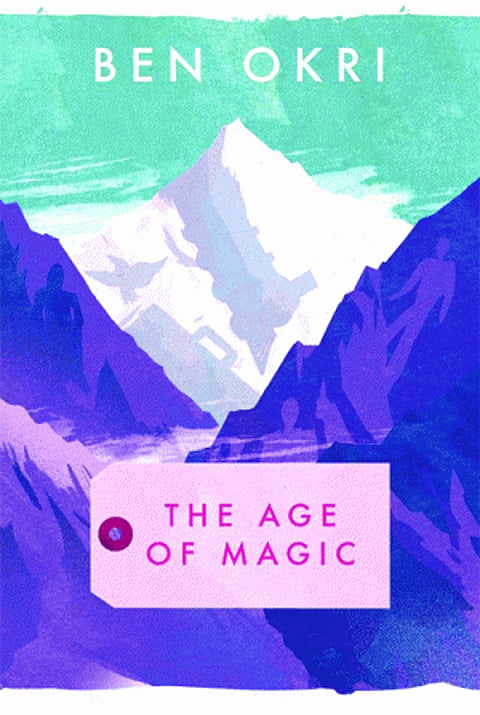

The Age of Magic
Author: Ben Okri
Publisher: Penguin, Rs399
This book may not be engaging enough to do justice to Booker winner Ben Okri’s merits, but the strength of the novel is still its poetic imagination and Okri’s lyrical finesse, writes ANANYA BORGOHAIN
As in his 2012 novel In Arcadia, Ben Okri’s The Age of Magic revolves around the same group of eight filmmakers who are on their way to Arcadia, Greece, from Paris, their last stop as in In Arcadia. The Age of Magic, could thus be considered his sequel to InArcadia. Although the troupe sets out with the motive to shoot a documentary film about Arcadia, Arcadia serves more as a pursuit, an image of a happy place for the soul to rest. It’s a state of ecstasy that facilitates soul searching for the characters and eventually, each undergoes a personal metamorphosis.
As they shoot in Basel, they stay in a hotel by the lakeside, a place which also hosts some spirits who help the characters evolve out of the inner turmoils that they struggle with (“For the first time in his life, inspired by an Arcadia growing in him, lao played with no sense of limitation. He played with an enchanted freedom. It was as though he had left behind all his complicated baggage. It was curious that the new bud of tranquility in him had found something so ordinary as a game of pool to reveal its powers”).
Coming to the spirits, there is a Quylph (“a nature spirit, a guardian of treasures”), whom only lao can see, but is friendly and compassionate. Malasso, on the other hand, appears to all of them but is a hateful fiend. Worse, Malasso’s voice finds its way into the characters’ heads. Interestingly, in spite of his evil qualities, the group cannot help but unanimously agree that Malasso’s pressure brings them together, and that he is their collective creation, representing their unchanneled creative aspirations.
The novel is distributed into seven books, each divided into chapters, and although at the beginning it is about a very practical objective and a story seems to be building its base, the pace of the first few pages is soon brought down as the narrative is overpowered by metaphorical and emotional attributes. As mentioned at the beginning of the concluding chapter, “Beautiful days are all too short — pure music between the hammer beats of life”.
The world of magic and spirit blurs the line between the real and imaginary. In fact, through the encounters that the characters have with the other world, it begins to be implied that notions of good and evil, pain and power, magic and beauty, are all manufactured by us. To fabricate magic in our lives, in our success and failures alike, is our personal craft (“Before long Jim found himself occupied by a mood alien to him, an eviling mood. But it couldn’t have been so alien or it wouldn’t have found a place in him. The mood had much to feast on in his soul. It fed on his life-long timidity, his failures and resentments and envy. It fed on that bile that formed out of having lived most of his life below his potential. It fed on the success of others, on his secret cowardice”).
The strength of the novel is its strong metaphors and Okri’s poetic finesse. His philosophical interrogation is lyrical and his eloquent words are thought provoking. His persuasion, at the same time, draws inspiration from Goethe’s Faust, which finds frequent mention in the novel.
What also needs to be noted is that this novel does not do justice to the merits of the Man Booker-winning Okri. The Age of Magic, in spite of the fascinating landscape it weaves, fails to be an engaging read.
The characters seem to be underplayed and although the book is laden with vivid imagination in sketching the inner conflicts of the characters, nothing significant happens in the outside world. Sure, it is literary, but it is also accompanied by a lethargic vibe. No wonder then that Okri also won the Bad Sex in Fiction Award from the literary Review for this book. Nevertheless, Okri succeeds in establishing his point, that dreams do ‘infect reality with their truth’.