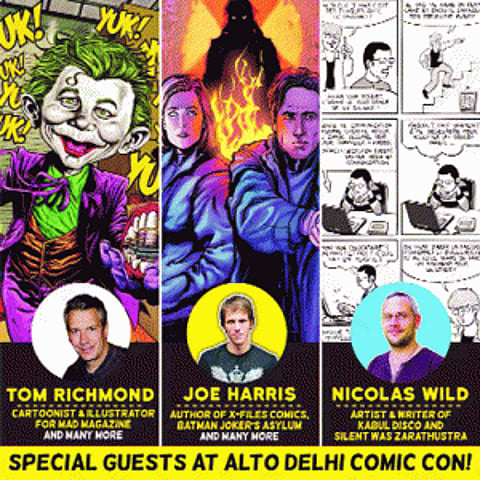

Meet and greet some of the great minds behind MAD comics, X-Files Season 11 and critically acclaimed comic book Kabul Disco at the ongoing Comic Con Delhi where these international artistes will be conducting workshops and sharing their experiences. Sangeeta Yadav chats with them about some of their great works
Comic Con, in the last couple of years, has garnered a lot of attention not just among children but also adults who get to relive their childhood fantasies through their favourite superhero comics. For some, it is to find out what their favourite superhero is up to, for some it is the story-telling and the content and for others it is to pick up a comic and read it for fun. What makes these comics a hit are the artistes who tell a story though their art.
Many such artists and their work is on display at the ongoing Comic Con Delhi taking place at the NSIC Grounds, Okhla. One can meet and interact with the likes of Tom Richmond, caricaturist, cartoonist and humorous illustrator who has created artworks for MAD film and comics, or Joe Harris, a comic, graphic novelist and screenplay writer, who has worked on The X-Files: Season 11. Then there’s French writer and illustrator Nicolas Wild, the author of critically acclaimed Kabul Disco: How I Wasn’t Kidnapped in Afghanistan. These international artistes are here to not only talk about their work but also follow Indian art work.
“I will come dressed like a medieval troubadour, juggle with axes and breathe fire. I will organise a giant hide-and-seek at the Red Fort. Or maybe, I give a lecture about my work, meet fans and sign books and posters,” Nicolas Wild says.
Since Comic Con began in 2011, the comic scene in India has changed by leaps and bounds. But Indian comics are yet to find an outlet at the international level and there is still a long way to go.
“India has developed in the comic scene with interesting tales to narrate. The three traditional families of comics are the Manga School (Japan, South Korea and China), the American School and the Franco-Belgian School. In France, the graphic novel scene is big, there are no less that 5,000 comics published every year (3,500 Franco-Belgian Comics and 1,500 foreign translation, mainly from Manga and American Comics). There are three comic festivals a week and we call comics the Ninth Art. A trend that I’m surfing on in France is comic reportage. A magazine called la revue dessinée has 100 per cent comic content. It’s a beautiful tool to explore and explain the crazy world in which we are living in,” Wild tells you.
For Tom Richmond, it was his love for Batman that led to the making of this caricaturist, cartoonist and humorous illustrator. “I’ve been a fan of Batman since I was a child. In fact, my love of that character is what got me interested in drawing. He was just a fascinating hero. As a child, I loved the work of Neal Adams, Carmine Infantino, Barry Winsor Smith and not the humorous side of Carl Barks and the Harvey books like Casper and Richie Rich. later, I would discover the classic MAD artists like Jack Davis, Wally Wood, Mort Drucker, Will Elder, Al Jaffee, etc,” Richmond says.
Out of all his works, the one which is close to his heart is his artwork on the MAD film. “I was very happy to get to do the artwork on the MAD film parodies of all three Christopher Nolan Batman films and the recent Batman v Superman. I’ve been working steadily with them for 16 years, and that has led to many other projects and jobs from other clients. I’ve been lucky to have been able to earn a living as an illustrator for over 30 years now. Being a freelancer is always difficult because you do not have a regular source of income. But I have been fortunate to have kept busy between comic work, magazine illustration, advertising and drawing caricatures,” Richmond says, who is finishing his second MAD children’s book spoof that follows up Goodnight Batcave and also a super-sized comic book titled Z People which is a humorous look at the zombie apocalypse.
Joe Harris will be seen promoting his new series Rockstars for Image Comics which is close to his heart. “It’s about rock ‘n’ roll, which is very dear to me. This project represents me best,” Harris says who is, at present, writing The X-Files comics series for IDW Publishing, a new series of Rockstars for Image Comics and co-writing the live action series Ninjak vs The Valiant Universe.
For Harris, to come up with something like The X-Files: Season 11 for IDW, Spider-Man spinoff, Slingers and the Bishop: The last X-Man series, all it takes is good reputation. “The publisher has to think you might be a good fit for the assignment so it takes a good reputation. It also requires a high degree of curiosity (I’m always following the news, current events, politics, etc) and a sometimes overactive imagination.
His turning point was when he got his first break. “My first big break as a writer came after I’d graduated from film school and a friend brought some editors he knew from Marvel Comics to a screening of my student film in New York City. We started talking about things and they ended up hiring me to write comics for Marvel. I’ve had the amazing experience of seeing my name projected on a screen in theatres full of people on a few occasions and that’s a lot of fun. I grew up loving horror movies and it meant a lot to my family to see films I’d created, co-written, produced and released,” Harris says.
Wild got inspired and relates himself to his favourite cartoon character Gaston lagaffe. “When I was a kid, I really like Gaston lagaffe, a Belgian anti-hero who used to spend most of his life goofing around Spirou Magazine office. Somehow, he’s who I was. When I was a teenager, I followed the adventures of Thorgal Aegirsson, a Viking who was a strong fighter with a pure heart. Somehow, he’s who I wanted to be. Now, I do biographic novels, so I am my own superhero,” Wild says.
Wild’s critically acclaimed graphic novel Kabul Disco: How I Wasn’t Kidnapped in Afghanistan captures his real life experience. “It’s a biographic and I get the story from my life which is an infinite source of inspiration. I didn’t get kidnapped in Afghanistan. Kabul Disco is the chronicles of this non-event. I lived two years in Afghanistan and worked in a communication agency. Whilst I was there, I blogged life on the chronicles of this agency. Once I went back home, I used the notes as material to do the two first books of Kabul Disco. Writing life through the blog gives the freshness to the style of narration. But you might also lack,” Wild says.
He is now finishing the third and last issue of Kabul Disco. “A darkest book that also takes place in West Pakistan and England. I also went to Cambodia in November and did researches about urbanism in Phnom Penh. I will explore this new topic and create a reportage out of it,” he tells you.
To tell stories through comic books and caricatures requires a lot of skill and new ways of storytelling. “Comic storytelling is an art that one must constantly strive to improve at. There are always new ways to discover to tell a story. Aspiring artists need to first find command over their drawing skills, and study the basics of comic storytelling so their craft has a solid foundation upon which to build,” Richmond says.
Wild tells you that one should constantly put their imagination on the paper and have a balanced lifestyle. “Be true to yourself. Fill sketchbook with drawings made from life. It’s a great exercise even, especially if you usually draw from your imagination. Also have a healthy life, practice yoga and meditation, make friends and travel worldwide,” he says.
Talking about what’s trending, Harris says: “It seems that rebooting the line of titles has become norm among Marvel and DC Comics in order to reach out to new readers and trying to keep things fresh. Another trend is successful titles featuring properties licensed (royalties) from entertainment companies like old TV shows, video games, etc.”
The biggest challenge for every artist is to create something new everytime. “As a writer, I’ve to always remember to think visually because this is a visual medium. lovely prose and snappy dialogue is wonderful, but telling a clear story and developing characters people will care about is a universal challenge,” Harris says.
Another challenge is to keep yourself motivated. “For me, the big challenge is to find enough motivation to draw all the pages. It’s a monk work, You spend lots of time on your desk inking paper. I need roughly three days to finish a page. So a 200 pages graphic novel would take two or three years. I should find a way to work faster or hire other cartoonists for,” Wild says.