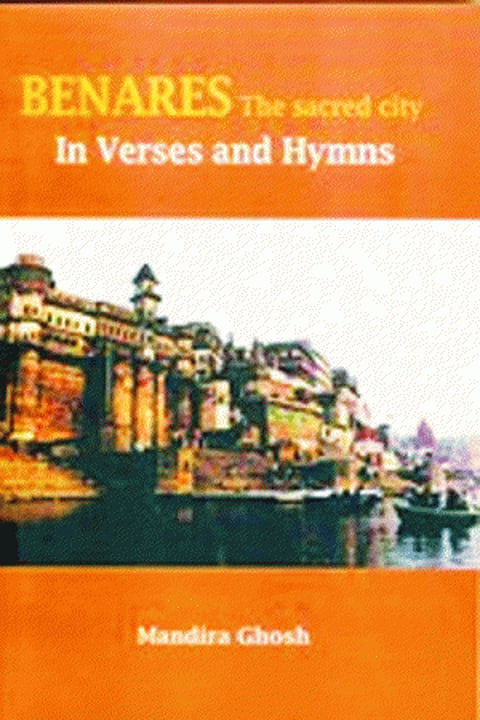

Benares
Author- Mandira Ghosh
Publisher- Shubhi, Rs395
This book is a personal take on the city of Benares and juxtaposes the traditional with the grim reality of the present, writes Rachna Joshi
Mandira Ghosh’s Benares The Sacred City In Verses and Hymns creates images of Kashi, the oldest and holiest city of the Hindus. Numerous books have been written about Benares but Ghosh’s book projects her personal take on this ancient city; a city which is an important part of the historic and religious subconscious of all Indians. She juxtaposes the traditional with the grim reality of the present. But at the end transcends all as she combines the earthly with spirituality, death with dignity, and every other thing that she observes is translated into images and verses.
Her love for lord Shiva and the city is profound. It is illustrated in poems like Shiva linga, Durga in the Cosmos andShiva, but she is also acutely aware of human failings and unhesitatingly describes the filth and suffering she observes. The book is fascinating as it covers many hues of the city. As she steps out from the airport, she looks for the cornfields but instead comes across constructions. In the midst of a modern and a traditional city she looks forparikrama and writes Cosmic Walk.
Readers familiar with her earlier works will understand how deep-rooted Shaivism is in her psyche. Standing on the river bank and contemplating on the creative, preservative and destructive aspects of lord Shiva and Shaivism, her mind gets filled with profound metaphysical thoughts. Hindus want to have moksha or liberation from suffering and from the material world and they believe that by going to Benares, they will get it. In the poem Steps, she says: ‘Once a transparent body/Now maligned by sin/Of sinners, who refuse to learn/But take comfortable dips/To wash dirt of all previous births.’ Also, in another poem, she says: ‘The City of Shiva turns into a conflict zone/When luminous linga loses light/When he turns into stone/Not only a piece of stone.’
The river plays a dominant role in the book. So do women. Women according to the poet, “are instruments of creation, water is the elixir of life, that flows into the rivers, fire burns all and again water extinguishes fire. Women at the ghats watch both processes of creation and destruction as the dual faces/forces of energy.” But she also sometimes gets critical as she observes that the river and ghats reveal filth and grime: ‘Half-burnt bodies on the pyre/Speak of inhuman torture and/Smell of ordinary incense along with odour/Wash the body of the river once crystal clear.’
But then there are poems such as River of Sorrow and That of Joy. Images of the city proliferate: ‘An immortal city/Never dies/The streets are revered/As the river/lanes and by lanes/Supposed to be divine/Half-burnt bodies, pathetic sight/Death came in plastic sheets/Quacks had earlier tried/To save his life.’
Ghosh talks about the women she observes. Widows come to Kashi to seek deliverance and their silent suffering is portrayed in the poem Still. The poet is extremely sensitive to condition of women, especially the widows; she says: ‘Still tears/Of widowed women/Her reflective grey hair/Shaken by wind and attitude/Broken by sand/Still their voices are still.’
In Death at the Ghats, she says: ‘Why calm wind suddenly decides to lash/On a candid afternoon, going slow/Death was distant/Demure appearance of a/Dying widow/Deep breath stopped in death/leaves sway/Discuss death.’
However,the book is not entirely sorrowful. There are subtle nuances that highlight the vibrant life of the city. Referring to the syncretic culture of Benares, she says in Thatheri Bazaar: Muslim weavers weave zari/As the Hindu brides smile. Or, in Gyan Bapi: Near the Kashi Viswanath temple/Near present sanctum sanctorum/Shiva’s ride Nandi facing the Masjid/Is it possibleIJ’
Shiva reigns supreme in Benares. But in a lighter vein, she writes about the Benares Hindu University in BHU: ‘Girls cycle giggling through campus/On the coffee table fumes froze/Boys and girls discuss Ritusambhara’
This book is a rare combination of spiritual and scientific thoughts, material and metaphysical, ancient and contemporary, religion and sometimes denial of it. The poet’s language is modern and full of allusions. There are references to Shiva, the Kashi Visvanath temple, Dashashwamedh Ghat, Manmandir Ghat and the observatory on the sameghat, the Sankat Mochan Hanuman temple and other well-known landmarks of Benares. To bring together facts and imagination is a daunting task and Mandira Ghosh has successfully and ably done a very complicated task.
Poetic insights and nuances are brought out very well: ‘Windows are today closed/Roads and alleys wait for monsoon/Mud mingled in the water azure/Angry Ganges may submerge her banks
Production of the book is delightful with pictures of various sites in Benares, the river and the ghats. The author has a wide range of interests — history, archaeology and science and these enter in her poems (Excavations at Akatha, Civilisation, Manmandir Ghat) too.
Ghosh, a post-graduate in English literature is presently the treasurer of the Poetry Society (India). Her work has reached a point where science meets philosophy, literature and all arts. A multi-dimensional personality and an extremely disciplined writer, she is also a novelist, researcher, critic, thinker and philosopher.
The reviewer is a Senior Assistant Editor at the India International Centre