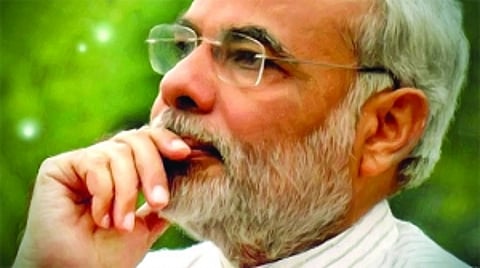

India and the world are waiting for Narendra Modi to demonstrate his reformist zeal, and the Budget will undoubtedly do so. The stagnation and status quo will be jettisoned; the Government will not carry forward many of UPA’s policies, says GAUTAM MUKHERJEE
It isn’t ours: we accelerate slow things.
An opening hand is already action
— Rainer Maria Rilke
Narendra Modi, at the head of the first majority Government in 30 years, has sworn to transform India over the next decade. This will entail massive financial investment and decisive, unprecedented, good governance. The upcoming Budget Session of Parliament will enunciate and delineate the economic thrust areas of this new vision. The nation, agog with anticipation, can hardly wait.
Modi as well as some of his ministers have been keeping their noses close to the grindstone for gruelling 12-hour work days. But the Prime Minister did take time out to blog on the completion of his first 30 days in the Government, wryly stating that his honeymoon in office did not care to last more than 100 hours, let alone 100 days. This can, of course, only change when the jaundice-eyed courtiers and opinion-makers of the Ancien Regime are unceremoniously turfed out and replaced.
Still, the Modi administration has not let the grass grow. There is a long list of initiatives, far more than any other previous Indian Government has taken in such short order, with a lot of them stretching into matters well beyond the exigencies of the annual Budget. But overall, the impression is of a Government eager to get the country — its economy in particular — moving again, and fast.
And while all attention is currently on the Budget, it is by no means going to be the end of the economic initiatives this Government will take this year. A number of the ‘bitter pills’ NaMo has spoken of might well be calibrated and spread out. A general theme of this Government will be to reduce and eliminate subsidies, re-engineer doles, and go in for more productive investment.
The boldest move made so far is the hike in the Railway fares and freight rates, fearfully avoided by the predecessors. The railway network, vital as it is, is over 150 years old, much neglected and uses outdated technology more than 50 years behind times. The tracks and signalling equipment are worn out from overload, poor maintenance, obsolescence, lack of replacement, and pose a safety hazard too. Through it all, the Indian Railways is a gargantuan employer, with over a million people on its rolls. The challenge will be to actually add to this number, as creation of additional jobs is a national priority, but vastly increase the scope of works, the skill sets, the commitment to profitability and efficiency.
But as such, it has grown less than 20 per cent in length since 1951, wrote Samar Halarnkar in The Hindustan Times, while passenger traffic has ballooned by 400 per cent. Freight loads have grown 600 per cent, and yet more freight has spilled onto National Highways and the swanky Golden Quadrilateral. Road haulage is much more expensive, but what do you do when you can’t book a rakeIJ
Now that the daily haemorrhaging has been stemmed to an extent, the Railway Budget is widely expected to concentrate on massive modernisation and improving the dismal safety record, inclusive of the Railways’ ability to protect itself from Maoist attacks. But, in a shift of strategy, it will be made to generate additional resources on its own and commit to run itself profitably. Keeping prices unrealistically low and depending on increasing the Central Government handouts is unviable. Much can indeed be done to raise resources by unbundling some of its extensive real estate. The quaint bygone era station network, now filthy, inadequate and dilapidated, also needs comprehensive upgrading, incorporating smart commercial exploitation to raise additional resources.
Modi has grand legacy plans for a ‘Diamond Quadrilateral’, which will link the country with a series of modern high-speed trains. This will naturally be expensive and will have to be largely foreign-funded, possibly by railway technology aces China and/or Japan, and with Railway Bonds and the like domestically.
In terms of the ‘Super Budget’ itself, one of the most pressing needs is to be seen to be providing money for business and industry, and many other starved-for-funds productive sectors. Everything needs to start expanding, growing and modernising again. The previous regime’s tight monetary policies, high interest rates, negative growth of industry, plummeting GDP, and hardly any money to lend with the banks, is a complete tale of woe.
Now, with continued high inflation, a poor monsoon and turmoil in Iraq to boot, the RBI may by itself lack the elbow-room to promote growth. And so, it is vitally important to turn to the supply-side of the economy, and crucially, other sources of funds.
The FIIs — which have spontaneously pumped in $25 billion into the Indian stock market — have eased the situation to a great extent, strengthened the rupee, added to hard currency reserves, and vastly improved market sentiment. But much more needs to be done to attract more FII and FDI monies by way of liberal reform and market-friendly procedures.
The self-help part of this, which will have a salutary knock-on effect, is important. One idea is to allow a proportion, about 30 per cent, of Indian pension funds to invest in the equity markets. This will let them seek returns higher than 8 per cent, quite inadequate in such inflationary times. It, along with hopefully continued large FII inflows, will provide funds for companies to raise money for development and growth. Plans are already on in over 100 companies to seek over Rs 1.5 lakh crore through 2014-15 from the stock market. The Government is also readying many PSUs for outright sale and others for diluting 25 per cent of their equity in favour of the general public.
The advent of pension funds in the stock market will also provide a stable flow of domestic monies, which won’t be volatile as FII money can sometimes be. In what is being called as a multi-year Indian bull market just begun, this should do well for the returns of pension funds. The market regulator SEBI also thinks this is a good thing. CII-Ernst Young estimates the Indian pension sector corpus will top $1 trillion by 2025. Even at present, pension funds add up to Rs 6.50 lakh crore, but none of it is coming into the bourses.
Another source of very cheap funds right now could be from low interest economies abroad, awash in liquidity. Such External Commercial Borrowings (ECB) are likely to be encouraged by the Government, given the fairly strong hard currency reserves position.
This Budget will surely give tax concessions to industry. The continued excise concessions to the automobile industry till December is indicative. But many other incentives, liberalisations, reforms and concessions for industrial development are expected.
Of course, infrastructure in general — inclusive of the needs of industry, urban and rural India — will be strongly boosted. It is acknowledged as a classic driver of growth in GDP, and indeed, jobs. To finance some of it, new tax-free infrastructure bonds may be introduced, while the Government will need to stand guarantee for foreign lenders. The infrastructure sector, on its needs base, could easily suck in over a $1 trillion and boost the economy dramatically. Outside the Budget, our outdated labour laws too are likely to be tweaked to encourage foreign investment.
Foreign investors, such as Japan, have been requesting tax concessions for manufacture and this will most likely be granted to remove an irritating roadblock. In addition, the Government has already indicated that it will get rid of retrospective corporate taxation. To compensate itself, however, it may withdraw some exemptions at the same time. The world, including the US and Europe, is waiting for Modi to demonstrate his reformist zeal, and this first Budget will undoubtedly do so. The stagnation and status-quoist policies will be jettisoned, and this Government will not carry forward many of the UPA’s policies.
India is targetting FDI investment from Japan and China in particular. The Chinese Government is well disposed commercially, even as it has persistent territorial issues on the borders. As yet it has only invested a meagre $900 million in India, with most of it going to Gujarat. But this can ramp up exponentially as China does have billions to invest. Japan, already committed to developing the Delhi-Mumbai Industrial Corridor among other initiatives, needs its problems addressed. The Budget will send out positive signals to both.
On the consumer side, there is a strong possibility of the income tax slabs being tweaked, in effect putting more spending money in the hands of people. Revenues lost to direct taxation, it is reckoned, will come back to the Government via indirect taxation of goods and services.
There is also the usual clamour to reduce or do away with all sorts of other imposts, including the transaction tax on the bourses, the service tax on many activities, the surcharges, and so on. But it is unlikely that the Government will oblige because of its poor financial situation. However, processes, including financial disbursement procedures, are likely to be simplified, and laws, such as the over intrusive new Company law, will be modified.
Various sectors will be opened up to 100 per cent FDI and others will have their limits enhanced. In defence procurement, 60 per cent of items, albeit not the critical path ones, have been taken off the list for mandatory Government licensing for manufacture in India. India is today the largest arms purchaser in the world, with an urgent shopping list that tops $300 billion. But for critical items that cannot wait, the Defence Budget will have to be enhanced. But as the domestic manufacturing of state-of-the-art weaponry takes off, it will contribute significantly to our financial health and create a new export stream as well.
The rural areas will receive massive infrastructural attention to create what Modi has called ‘rurban’ facilities inclusive of 100 new cities. The Budget is likely to dwell on allocations and stratagems to bring about this transformation to benefit over 600 million people.
A number of other items, such as the contentious gas prices, expensive electricity due to dependence on imported coal, inefficient generation and inadequate transmission systems, insufficient water and so on, will most likely be addressed in terms of both infrastructure development and better governance. Chennai, for example, long suffering water problems has probably taken care of it now with desalination plants under execution. The Modi Government is also very keen on solar power.
Projects stuck due to ‘land and forest clearances’ and ‘bureaucratic delays’ are in the process to be sanctioned briskly. These too, though outside the purview of the Budget, will contribute towards getting the economy going again.
Most of all, this Super Budget will exude confidence in the future and give people solid assurance that the country is on the move and they can look forward to better times.