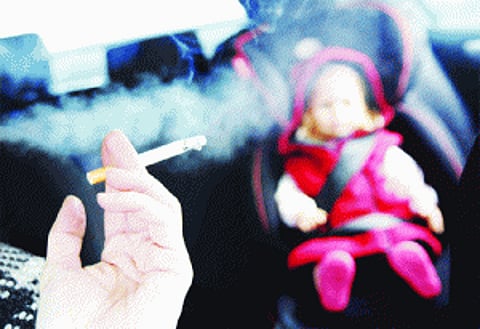

RANU JOARDAR speculates if the expansion of display area of health warnings on tobacco packets to 65 per cent or even 80 per cent can curb the consumption
Bigger warnings can probably save some innocent lives like mine. You have started to take people along in Mann Ki Baat (the Prime Minister’s series on All India Radio) where you recently talked about de-addiction. I hope you will also take up the cause of tobacco.” These were the last words of Sunita Tomar to Prime Minister Narendra Modi. She was the woman with a scarred mouth who appeared in advertisements during the breaks of television serials and spoke how tobacco ruined her domestic life. She died in Gwalior on April 1 at 4 am.
There may be many other people suffering from cancer owing to their lifelong addiction of chewing tobacco. But just a handful of them take up the task of not letting others go through the same. Bella Thorne (an American actress, singer and dancer) had once said, “Everyone suffers some injustice in life, and what better motivation than to help others not suffer in the same way”. Which is why people like Sunita Tomar and the emaciated Mukesh Harane (whose face was replaced by Sunita after his death in the battle against tobacco) are worthy enough of a round of applause. Both of them, instead of following others, chose a different path. They became the anti-tobacco campaigners of the Government. They wanted to stop other people from venturing into the path of pain; and both of them held the easy availability of gutka as the culprit.
In the year 2012, the Delhi Government had banned the manufacture, sale, display, transportation, and storage of gutka and other related products. But this rule did not deter some vendors to hesitate to continue their sale of gutka packets. While some pleaded innocence by claiming to have no knowledge of any such rule, others sold under the counter. Dr Monika Arora, Director of Health Promotion Division, Public Health Foundation of India, mentions that though after the 2012 ban mixing of gutka into pan masala by big companies have stopped, gutka packets are available separately and now the customers do the mixing themselves.
Tobacco has been used in India for centuries. Early forms of tobacco were limited to chewing tobacco leaves or smoking tobacco. Today, several products which contain tobacco are available in the market. Though smoked tobacco is indeed seen much more, yet smokeless tobacco is still very common in India too. Tobacco or tobacco-containing products are chewed, sucked as a quid, applied to gums, or inhaled.
Generally, it is assumed that that these chewable tobacco packets are only consumed by illiterate people as they are not aware of the painful death that awaits them, but that is a fallacy. According to Dr Sanjeela Maini, a doctor in Sir Ganga Ram Hospital, author of The last Puff and head of Tobacco Cessation, it is a pure myth that tobacco is a habit of the lower socio-economic strata of society. The hard reality is that the habit of tobacco chewing exists in all strata of society. Consumers classify it in two categories — premium brands and non-premium brands. Premium brands are expensive and the upper and middle socio-economic strata buy these brands. It is just like smoked tobacco. While some strata opt for less priced cigarettes, higher classes go for more priced ones, depending on their addiction.
The topic of gutka in the year 2015 came up because of Sunita and with it brought some rules and many controversies. last month the Central Government had again issued a rule — banning the sale of products containing gutka, pan masala, flavoured/scented tobacco and kharra in Delhi. Yet some MPs like Dilip Gandhi refuted the long time knowledge — Tobacco causes cancer. He said that a check needed to be done in India on whether tobacco here causes cancer as till date the survey and researches done have been by doctors of other countries (as if the tobacco of India is any different). Another MP Ram Prasad Sarmah has gone to the length of saying that there is no clear proof of linking cigarette puffing and cancer; in fact, he even wonders if tobacco contains “herbal medicine”.
Another MP Shyama Charan Gupta, a member of the Parliamentary panel looking into the size of pictorial warnings on tobacco packets and a bidi baron has also put this question. He asks, “Why do chain smokers not get cancerIJ” Founded in 1973, Shyam Bidi Works — an integral part of Gupta’s Rs350-crore Shyam Group of Industries — is one of the largest bidi manufacturers in the country. However, he denied a conflict of interest by serving on a committee that has given the tobacco industry a big breather and said that bidis are less harmful than cigarettes. However, Dr Harsh Vardhan, an MlA and a doctor by profession, has answered all these questions by stating that tobacco produces nothing less than death.
These controversies had not only shocked the researchers but also Sunita. In response to these comments she, three days before death finally relieved her from pain, had written a letter to Narendra Modi, saying “Recently Dilip Gandhi, chairman of a Parliamentary panel, wrote to the health ministry asking for the notification on bigger tobacco pack warnings to be kept in abeyance. I was shocked that people in such high posts can be so irresponsible.” As a part of the ‘lives Bachao Size Badhao’ public awareness campaign, she collected 38,740 signatures through an online and offline petition for implementing larger and stronger pictorial warnings on tobacco packages. It was submitted to Union Health minister JP Nadda in March.
To calm down the tense air, Modi immediately took steps to expand the image size of the warning on the packets of smokeless tobacco. He has suggested for pictorial warnings to cover 60-65 per cent, up from the existing 40 per cent but below the proposed 85 per cent, of the principal display area of tobacco products — cigarette, bidi and chewable tobacco. And to quieten the protests raised against those three MPs, some reports appeared saying that he has asked for the list of MPs of Parliamentary committees with conflict of interest. Apparently, he wants such disgraceful MPs to stay out of Parliamentary panel.
So here a question arises — is the expansion of display area of the health warning on tobacco packets to 65 per cent or even 80 per cent enough to put a red light on tobacco consumptionIJ About this some doctors like Dr Monika Arora feel that instead of these expansions, the Government should display the advertisement (a photograph of mouth cancer) on both sides of the packet. As per the WHO report, while 61.1 per cent tobacco users noticed health warning on packages, only 31.5 per cent thought of quitting tobacco because of it. It is also reported that India has one of the world’s weakest tobacco warning regimes.
Dr Arora believes that children of 13-15 years of age are most likely to indulge themselves in chewing tobacco as they imitate their elders and perceive chewing tobacco as a style statement. The companies even use flavouring agents and scents which act as icing on a vanilla cake. The Global Adult Survey 2010 says that about a 15 per cent of children are into this activity. A solution that she suggests is to have the picture of mouth cancer on both sides of the packet as this will tarnish the packet’s attractive appearance.
At present India is ranked 136th among 198 countries listed according to the size of their health warnings. It is predicted that by 2030 the unchecked, tobacco-related deaths from cancers, heart and ailments, lung disease, and stroke, among others, is expected to increase to over 8 million annually, with 1.5 million of them in India.
The doctors working to help people quit tobacco say that the position of India is going to remain unchanged if the expansion of advertisement is raised from 40 per cent to 65 per cent or even 80 per cent. Though they support the move of the Government to start education on tobacco awareness from the school level, Dr Sanjeela Maini believes that this rule of expansion of the display is also going to sniff dust like many other rules. It is because the last survey — Global Adult Survey — was conducted by the Union Health Ministry in the year 2010 and no other survey has been conducted since then. What happened to the ban on sale and manufacture of tobacco in 2012, no one has any clue. She says due to this lack of surveys now researchers are finding it difficult to dwell into any further research.