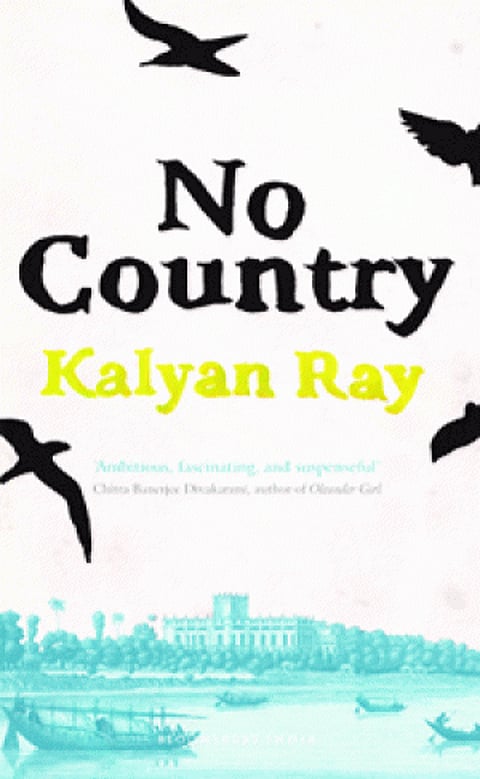

No Country
Author: Kalyan Ray
Publisher: Bloomsbury, Rs599
Kalyan Ray takes his readers through the Ireland of 1840s, India of 1910s and New York of 1980s. He shares with ANANYA BORGOHAIN his ideas of identity, politics, history, and sentiments
Kalyan Ray is the author of the novel Eastwords and has translated several books of contemporary Indian poetry into English, including City of Memories which has a preface by Allen Ginsberg. Owing to natural disasters, political unrest, and poverty, his family was uprooted from the Ganges Delta (now Bangladesh). He grew up in Calcutta, was educated in India and the US, where he is now a professor of English literature. He spends his time between India and America, and is the husband of renowned Indian filmmaker Aparna Sen. In his new novel, No Country, he intertwines private histories and political events. It is the story of two friends — Padraig and Brendan — “and a chain of unforeseeable, irrevocable events that will propel one to North America and the other to Bengal”. It begins in 1989 when “an Indian couple are discovered murdered in a small town in upstate New York. They lie together as though just disengaged from a long embrace. Yet their murder has been two centuries in the making”. In an interview, the author speaks about how he lived the past while writing the novel and how he would like his readers to live those phases and hear those voices too.
Identity, borders, nationality and so on are the crucial themes of your book. What does statehood mean to youIJ
I find most of the borders to be elusive. If you think about it, you will realise that you can have borders, but they will get redrawn in the next economic onrush. Very often, borders mean so little, because in the old days entire countries were controlled by companies. Think about how Gabriel Garcia Marquez writes about the United Fruit Company, and what borders mean to him. likewise, borders have been redrawn in the last 150 years; they have been reduced to matters of convenience.
Your book has passages of Yeats’s Sailing to Byzantium. Is Yeats an influence upon youIJ
Yes, I realised when I was writing the book that so many aspects of it could be summed up in this one poem. All of the epigraphs and the title come from it. The idea of crossing over, of change and changelessness both, the notion of an inexorable passage of time “set upon a golden to bough to sing to the lords of Byzantium” inspired me to find a name for my story from that poem. ‘No Country’ is the title because no country is permanent. We are talking about impermanence. Do you remember that place on the famine ship where Brendan, Maeve are sailingIJ Brendan is a man of belief but he’s lying there, thinking, about how almost every one of God’s most remarkable miracles was about food, be it The last Supper, Sea of Galilee, or loaves and Fishes. He then says to God, “Are we not your children tooIJ Do we not deserve sustenanceIJ” It’s a cry from the soul. Think about the Partition, or the creation of Bangladesh. Yeats comes with these ideas of identity. There are few poets who had such an amazing idea of history.
Was it a conscious ploy to narrate the accounts in the first person narrativeIJ Does that reinforce the idea of ‘identity’ in the bookIJ
Yes, nothing establishes identity as the voice itself; the first person singular ‘I’. The examination of ‘Who am IIJ’ is constant. In the letter that Robert (a British era policeman in colonial Calcutta) writes, he asks, “Where do we come fromIJ” And he wonders about names. How the name Aryana changes to Iran or how the Gypsies are called ‘Manush’ in French. Have you ever wondered what is the real persona of an otherwise familiar acquaintanceIJ It’s the ultimate familiar unknowability. Right now, we are talking but we don’t really know each other. Or think about the dying Maire Aherne. There is a substantial contrast between the fiery woman who lived and the miserable Maire who has nobody by her side in her last moments. Madgy too is someone who doesn’t have a voice, but is sorted.
Was there a conscious attack upon iconoclasmIJ Both Captain Connolly and Father Conlon are not inspiring figures for a clergyman and captain respectivelyIJ
There is indeed a sense of disillusionment, of course. Maire Aherne, for instance, rushes in because she can’t bear the sight of her neighbour’s hut being demolished. But there is no sentimentality when she lies dying. In fact, even in that crisis, she is robbed. You don’t associate tears with her but in her last moments, she is in tears.
What is the relevance of political historyIJ
All histories are political. Also, consider how we tell a story. The moment we start thinking, that moment has gone to the past. All stories are about the past. You think on a canvas, that canvas is time.
How did you research for this novelIJ
I did research a lot but I made much effort to hide the effort I was putting in. I wanted to tell a story which was a page turner. I wanted people to go through it as if they were living through those lives, voices and phases, and then wonder “Oh my God, how much politics has gone into it! Everything is about politics.” I took a sabbatical and read Irish accounts from 1835 to 1847. I went through Irish political works, newspapers, folk songs and so on of that period. In my head, I was living in that age. Even the description of Dublin in 1843, when Padraig is walking through the street, they all had existed. I looked at their pictures with magnifying glasses. I tried recreating the past just like that, not a pretty one, but just right.
You are a professor of literature, how do you solve the problems in literary historiographyIJ More so, because your book is about the Ireland of 1840s, India of 1910s and New York of 1980s. Can ‘literary History’ be definedIJ
You know, I could talk on and on about theory but one might still not come out with a jot of understanding literature without a complete, immersive reading of the text itself. In the last 35 or so years, we have had a lot of sheer jargons and superficial isms in the name of literature; I am tired of it and tried to tell a story with voices that are clear enough and not dependent on deconstructive and reader-response theories. They are clear voices of life. They are more real. What Yeats called ‘the rag and bone shop of the heart’: “I made my song a coat, covered with embroideries out of old mythologies from heel to throat; But the fools caught it, wore it in the world’s eyes as though they’d wrought it. Song, let them take it, for there’s more enterprise in walking naked.”
How do you look at the East-West dichotomyIJ
If you look at a globe, can you say which is the East and which is the WestIJ Even the International Date line is an artificial construct. So many civilisations, like the Greek, have passed through the “East”. Spanish architecture is actually Moorish architecture. Think about the Islamic middle ages, they are the reason why renaissance or the ideas of Aristotle or modern maths flourished. Not that they are superior. Ideas will flow. The name Saraswati (goddess of knowledge) means ‘flowing water’. If it remains stagnant it wouldn’t be knowledge.