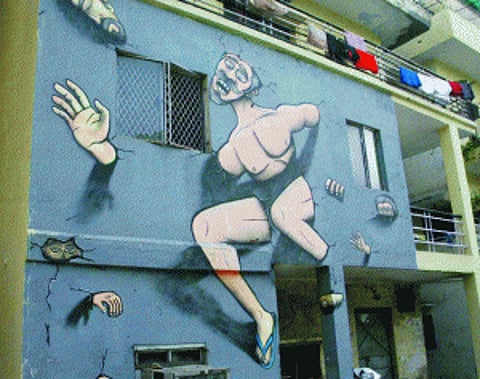

Street art in Delhi is steadily but surely enhancing its boundaries, serving as a cathartic channel, particularly for the youth. ANANYA BORGOHAIN explores these spectacular locales and talks to the artists who have made it possible
One of the first graffiti works to be seen on the streets of Delhi is said to be the work of a pseudonymous artist who calls himself Daku. His works are an eclectic merger of typography, art, and protest. They came under the limelight in 2011 when he tagged nine walls in Mumbai with the word ‘f***’ overnight in the Devanagari script, against Vasant Dhoble, the Assistant Commissioner of Police, Mumbai, infamous for his raids on the city’s pubs and bars.
Daku’s rise to both popularity and notoriety bears significance as it offers an agency to subvert dominance that is otherwise unconquerable for the common man. He’s also famous in Delhi for redoing the Public Works Department’s ‘Stop’ signs at Khel Gaon Marg in South Delhi by adding words right under the word Stop: Bribing, raping, honking, criticising, and so on.
Other than that, another appalling work of his was a hand with a voter mark on the middle finger captioned ‘matt do’ last year in Connaught Place, referring to the General Elections. But in recent times, his art — although officially considered vandalism and liable to both imprisonment and fine — has been hardly making appearances. Daku says, “Of late, I have become slightly less active. The cops started to identify me and that could be troublesome.”
But isn’t Delhi a late bloomer when compared to, say, Kolkata, where, if not street art, at least graffiti art has always been present in an almost cultural way as a form of protestIJ He disagrees, “Delhi is actually more international and more supportive of street art. Mumbai has always been Bollywood-centric, for example, it has always had the colourful Bollywood poster designs, but Delhi is more cosmopolitan. In Kolkata, graffiti has been used for protesting. In fact, graffiti is illegal under the West Bengal Act, which comes from Kolkata, but the prospects are wider in Delhi. It has a bigger canvas to explore and it is picking up quickly.”
Considered to be one of the firsts, he is today joined by other pseudonymous artists such as Yantr, UFO, PCO, and so on. Yantr says, “Daku and I were one of the first artists who started painting the walls of Delhi, and now many other young artists have forayed into the pursuit. I use art as a medium for activism.”
The graffiti culture in Delhi is steadily but surely enhancing its boundaries, serving as cathartic agency particularly for the young lot. These artists are now also joined by international artists who bring their own signature styles and expertise to Delhi.
In the contemporary scene, graffiti art has established itself as a form of public art that strives to emancipate one from the constricting realities of life or acts as a catalyst in the achievement of a goal. Prominent examples of such galvanised revolutionary fervour in today’s society would be Banksy. Not much is known about him but he comes from the Bristol underground scene and is considered to be one of the most notorious and popular street artists. Banksy’s art is known for its radical attributes, be it the anti-war stencil art in Bristol or the satirical images of life around the controversial West Bank in Israel. And last week, he was back in news for designing a dystopia-themed grotesque art project in England called Dismaland, a riff on Disneyland.
During the movement of the mid-20th century, in the 1970s in the US and UK, graffiti art became the agency of the educated unemployed who were bearing the brunt of a disputable, hierarchical structure. Graffiti art became a medium to voice the innermost feelings of the disoriented youths. The term graffiti has been derived from the Italian word ‘graffiato’ which means ‘scratch’, and is applied in art history to refer to works of art produced by scratching a design into a surface.
However, graffiti is not a product of the post-modern era; its traces can be located in the ancient Greek and Roman ages. Michelangelo, Raphael, Ghirlandaio and other Renaissance artists had carved their names in their works and so did the French soldiers (on monuments) during the Napoleonic campaign of Egypt in the 1790s. The first documented evidence of graffiti in New York City was reportedly ‘Julio 204’ by someone who tagged himself on walls.
Starting from New York in the modern age, graffiti art has thus been a medium of recognition for the artists and has today filtered into popular culture. It effectively transgresses the boundaries of proprieties set according to the dominant classes and is proceeding towards forming a parallel set individual and creative freedom.
The general strikes and students’ protests of 1968 in Paris witnessed revolutionary slogans as l’ennui est contre-revolutionnaire (Boredom is counterrevolutionary) expressed in painted graffiti, expressing anarchy. likewise, in the US, another read: “Dick Nixon before he dicks you” (President Richard Nixon), which underlined the hostility of the youth towards the head of the state.
Such works ignite the burning debate between vandalism and art, but also attempt to resolve it by locating a channel with humanist concerns, particularly for urban youths who are disenfranchised and constantly fighting the odds to make ends meet. It is their declaration of the rejection of the working-class environment that forbids them to establish individuality in the workplace.
Carving their name enables them to showcase their consciousness to the world. They leave a lasting impression by merging humour with repulsion towards monopolised authority, and also generates an array of resistance techniques. And while it is still not a mainstream, popular pursuit, the emergence of this form of art in the country, more prominently in Delhi, reflects a significant paradigm shift.
But not just graffiti, street art in Delhi too is emerging with greater resonance. A walk around Shahpur Jat, Malviya Nagar, Khirki Extension, Shankar Market etc will familiarise one very well with the soaring popularity of street art in Delhi. Colourful artworks, murals, stencil art, typography etc today adorn the walls of the city, giving it a vivid, charming and youthful appeal.
They beautify the city and also draw significant attention to issues — be it the Gandhi mural at the Delhi Police Headquarters (ITO), which is the tallest mural in the country done by German artist Heindrik ‘ECB’ Beikirch and Indian artist Anpu Varkey, or the Rain Basera project at Sarai Kale Khan by Olek, a popular artist worldwide who emphasised women’s issues by wrapping huts at Seelampur Village with knitted crochets.
It does not come as a surprise that street art in Delhi is perpetuated by a team of five young enthusiasts. St+art India is an organisation that “aims to make our streets more interactive through the medium of urban art festivals across India”. The team, founded by Akshat Nauriyal, Arjun Bahl, Giulia Ambrogi, Hanif Kureshi and Thanish Thomas, has an office in Hauz Khas Village and brought the first edition of Delhi’s street art festival last year.
Giulia, a curator, studied History of Art, History of Contemporary Art, after which she worked for some years at Italy’s biggest contemporary art museum, MAXXI, and was associated with street art in Italy since 2006. In 2012, there was a street art festival at Khirki Extension organised by not-for-profit Foundation for Indian Contemporary Art (FICA); Hanif was running it and Giulia was in the country for the India Art Fair and offered to join them.
She says, “We are introducing something very new to the culture here, so we have to do that gradually, educate people visually. For a project, we look at which artist can really understand the context and blend in. This is a site-specific work, so you can’t repeat what you do in the US or Europe, for instance.” About responses from people in Delhi, she says, “In general, people in India are curious. If something new happens on the streets, everyone gathers around to find out what has happened. I think street life in India is the most vibrant, more than in any other country. likewise, people in Delhi are a lot responsive to street art as well.
For instance, when we were painting private residences, initially there was scepticism, but gradually many came up to us asking us to paint their walls as well. Now for the festival, we have hundreds of applications from people who want to collaborate with us and they all belong to very different backgrounds.” last year, on the boundary wall of Tihar Jail, they also made the longest mural in the country, a 968 metres long painting of verses of a poem— ‘Chardiwari’ from Tinka Tinka Tihar — an anthology of poems written by the women inmates.
This year’s edition again saw both national and international artists participated to create murals and installations as well as organised talks, workshops, exhibitions and curated walks. Government bodies like MCD, PWD, NDMC, Department of Women and Child Development etc have started collaborating with them and the artists have worked on themes such as recycling, pollution control, Swachh Bharat, women issues, and so on.
The festival saw the participation of international artists such as lady Aiko from Japan (who has worked with Banksy and has also been the personal assistant of Haruki Murakami), Okuda from Spain, Olek from Poland, Clemens Behr from Germany, Paulo Ito from Brazil, Rukkit from Bangkok, and Samina from Portugal etc along with their Indian counterparts. In India they are also financially supported by various embassies like the Norwegian and Polish embassies, Max Mueller Bhavan, Goethe-Institut to name a few.
Giulia adds, “We distribute the departments among ourselves. For instance, I look after the aesthetic aspects, Arjun manages the budget, Hanif does both, Akshat looks after documentation, Thanish is the production manager, and so on. Also, for finances, Asian Paints have been a huge support. For instance, while painting a building in Mumbai, we used 800 litres of paint just for the coat. Overall, we would need 1,000-1,500 litres of paint and thousands of cans, so their funding is of immense help.” About the type of paints they use, she says that they use Cosmos Corner whereas international artists prefer Montana which has much more shades.
Hanif pursued Fine Arts in MS University, Baroda, and came to Delhi in 2003 and did a couple of other jobs for a while. He says, “I like typography and sign painting. I commission sign painters to design the font and then we digitise it. And then we put it online for the public. Our objective is to convert the urban Indian landscape into an interactive art gallery. Most cities in the country are grey, so to say. We want to add colour to them. We also want to make art approachable, emancipate it from galleries. Most people do not visit galleries. Art need not be seen as something exclusive and elitist; then the objective is lost. We want to bring it to the streets. One may pass by a work of art and yet there could be something striking about it.”
About how they choose their locations, he says, “Subjectively, we pitch in our ideas. But if it is a sanctioned project, say MCD has commissioned it, then we go to the locations. Other than that, we are frequent travellers and when you travel, you also look around for appropriate sites, good walls to paint on.”
Arjun says, “We all have our own private ventures but we don’t work on anything other than the festival for six months in a year. So we don’t have any regular salary for that time. Which is why when people open up to our ideas, express interest and acceptance, it instills a lot of confidence in us. When we were at the Delhi Police Headquarters, we were just marvelling at the tall wall and wondering how fantastic it would be to paint it and we put in our permission letter in their office. In 10 days we got their approval and we couldn’t believe it. It also coincided with Gandhi’s 66th death anniversary.” But attaining consent is not always so easy.
He adds, “The police have fortunately been always supportive. But sometimes we may have problems in attaining consent from bodies such as, say, the CPWD. Delhi residents too are otherwise open to ideas. When we were painting Shahpur Jat, initially they were unsure, but once they understood that we don’t have any vested interests, that we are not promoting any brand, nor are we making any money out of it, they were really appreciative. For the festival too, the artists can set their own themes but from our end we suggest upbeat, harmonious ideas as the themes.”
For a regular visitor to the area, it would be a visual treat to see how the dull, fatigued and blemished walls of Shankar Market have been remodelled into multiple colourful murals and paintings on music and culture. The foundation responsible for it is the Delhi Street Art (DSA), led by Yogesh Saini.
Known as the ‘fabric market’ for women, Shankar Market is one of the city’s oldest shopping zones and the NDMC joined hands with Saini’s team to refurbish it. Shankar Market is situated opposite the M block of Connaught Place’s outer circle. The NDMC has reportedly also hired an architect to remodel Gole Market.
Saini’s foundation too brought art out to the heart of the city, to its people and their humdrum milieu. He grew up in Delhi and moved overseas for some time and then returned to Delhi. DSA started in 2013. He recalls, “It started as a social initiative and is only two years old. We had first painted garbage cans at lodhi Garden. Gradually, through word of mouth, friends and social media, more people started joining us. I also put up posters around areas like lodhi Garden announcing upcoming events and endeavours. For the Shankar Market project, we had about 50 artists.”
About the nature of DSA’s working, he says, “We have both new people as well as established artists. We make plans and design themes in accordance with aspects such as whether it’s a social engagement or an aesthetic indulgence. Or, say, if we have safety concerns like the artist has to climb a very tall wall for a mural, we generally prefer experienced artists for that. For graffiti, too, we tend to focus on established artists.”
The 1960s and 1970s in the US were an exciting and intriguing time. Along with graffiti art and other movements, several sub-cultures were born during this period — the hippy culture that rejected conservatism and celebrated hallucinogenic drugs, the punk culture with all its anarchy and national flag-burning antics, as well as the emergence of jazz from the African-American community, as a manifestation of cultural diversity. last month, street artists painted a whole town of Mexico. Closer home, graffiti art has paved the way for a broader exploration of street art and looks like it is here to stay. Social transformations are emanating from diverse demonstrations of arts; they could be rooted in personal or indigenous frustrations, or an urge to beautify the world, but either way they are broadening the periphery of the mind with the introduction of a nascent worldview.
ananyapioneer@gmail.com
Image courtesy- AlWIN SINGH