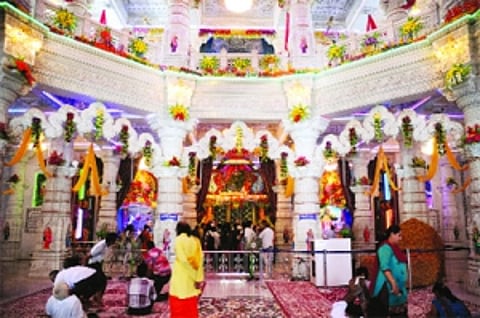

like the spells cast by Krishna, his homeland Vrindavan, conjures up different images for different people, says ERAM AGHA
The greeting Radhey Radhey works like magic in Vrindavan. You could be stuck in a jam or be mean to someone but a mere mention of Krishna’s lady love is sure to bail you out. The guard at the door of my lodging too welcomed me the Vrindavan way. His Radhey Radhey greeting held great promise of hospitality in the days to come by.
I was instantly at home in Krishna’s bhoomi. I took the Delhi-Agra expressway to reach Vrindavan. And I wouldn’t be lying if I said that my journey was an absolute delight. Finally here’s a highway that shows off India’s potential to make available high-tech road network to its citizens and guests.
Temple talk
On my way to the oldest surviving temple, the Govinda Dev Mandir, our guide Raj Kumar gave me the first tip for the trip: “Mind the monkeys. Hide your glares, hold on to your wallets and don’t carry eatables inside. You wouldn’t even realise that they are there till you are robbed of your belongings. Any resistance is met with aggression.” I made a note of this. My must-carry list turned into a must-leave behind list.
Travel is the only way to learn how rules change from one destination to another. What he did not warn me, however, was that the same rule applies to wearing gajra (hair wreath) that I bought from the vendor outside the temple. No sooner did I walk out of the temple than a monkey jumped out from nowhere and robbed me of hair accessory. “Nothing will happen now, just don’t run or react. Plus, I am carrying my lathi,” said my guide by way of reassuring me.
Only, I did not feel that way. The Madan Mohan temple was built by Raja Man Singh. Mughal emperor Akbar, too, is said to have donated money and red sandstone towards the construction of this shrine.
The Mughal influence in the architecture is apparent, at times reminding me of the buildings in Fatehpur Sikri. “Where Akbar encouraged the construction of temples, Aurangzeb destroyed even the existing ones,” the guide went on to say. “It is said that Krishna had appeared in the dream of a priest and directed him to shift his idol to another temple because Aurangzeb had planned to demolish it.” The statue was thereafter shifted to Jaipur.
As I moved on and deeper into a lane, I saw the gateway leading to Shahji Temple. It bears a striking resemblance to the Rumi Darwaza of lucknow. This gateway was built by a wealthy jeweller, Shah Kundan lal of Awadh, in 1876, and, therefore, the name. The stories of Aurangzeb’s temple intolerance and Akbar’s contribution punctuated my entire tour. The disturbing thoughts were drowned only by the chants of Hare Rama, Hare Krishna, sung by the sadhus on iktara and manjeera. It was difficult not to get transported to another world, one of spiritual peace far above human conflict.
Modern versus traditional
There was a time when this road was rarely used. But that was before a new temple called Prem Mandir came into existence. “And now it is choked with traffic,” said the guide. The mandir took more than a decade to complete. In fact, the work is still in progress. In the evenings, families gather here for jhaki (gatherings) and look forward to the water and light show. The prasad, peda and meva laddu are prepared in pure ghee at the ashram.
The ISKCON temple is very popular, making the temple topography of Vrindavan a blend of temples from yesterday and today. Those who attended the morning aarti came out renewed. The early morning wake up call at 3:30 am was too ambitious for most of us present. Temples, as in the past, continue to be a gathering point that encourage community interaction.
Whether the contemporary ones designed with modern technology or the older constructs made in times of aesthetic richness, they tend to draw heavy crowds. “It is difficult to imagine how the most artistic temples were made in the time of non-availability of architectural schools that give formal education without any technological advancement,” he pointed out. My next halt, Banke Bihari Temple, was quite crowded. Some of the beleaguered devotees came back cribbing about money demands made by the priests inside the temple and those who waited outside took long to recover from the unending line of widows who came along asking for alms and favours.
legend comes alive
“Hurry up please,” said the guide. His only concern was to drive us to Nidhivan before sunset as the Van shuts down for the raas leela to begin. It is believed the tulsi trees turn into gopis. The priest at the Radha temple was heard telling other visitors, “This is the only temple where Radha’s statue is seen with the flute. It enshrines the principle of man and woman are equals, and if you want to stay here, you need to seek Radha’s permission. The Van is the Supreme Court where Radha is the chief.”
This is where Swami Haridas, guru of Tansen and devotee of Krishna, found the image of Banke Bihari Temple. He spent his time rehearsing amidst these trees. later, at night I ordered a special thali to get the first feel of the local cuisine. “There is nothing like authentic Vrindavan cuisine. It is pure vegetarian made without onions and garlic,” said the guide. Pedas are a must-carry-back and are unique Vrindavani delicacies.
What more do you expect from the land that feasted Kanha on milk and the delicacies made by its produceIJ Pure divine love.
Copyright: Exotica, the wellness and lifestyle magazine from The Pioneer Group, available in all rooms of select five-star hotel chains