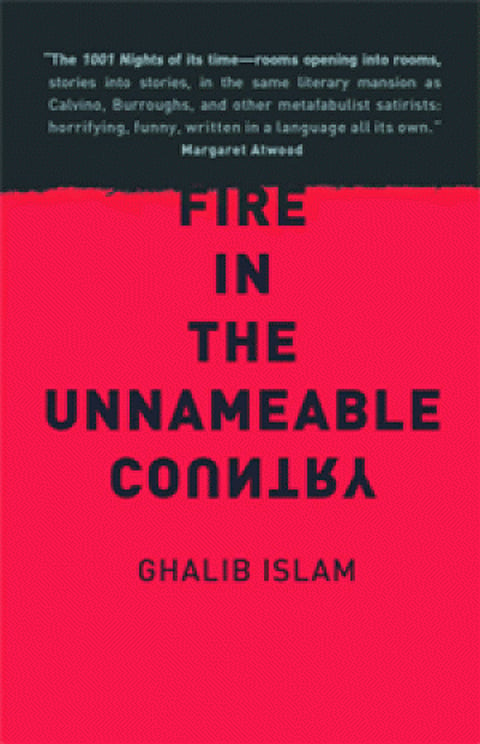

Fire In the Unnameable Country
Author: Ghalib Islam
Publisher: HarperCollins, Rs699
It’s the kind of book that authors dream about: full of sound and fury signifying something special. Hope it doesn’t take another decade for Ali to be out with his second Ghalibnama, says KHAlID MOHAMED
Turn to any page of this pleasantly plump novel, and you’ll discover unexpected visual imagery, twists in the phrase, and prose richer in calories than whipped cream. Take the opening para of page 153, for instance: “He sang as does a picaresque troubador, of his own story, what else: I vaulted here on a miscreant wind, he sang. I turned into a reed in the fleshy arms of a baker woman whose dogs bit me, he exaggerated, a woman who never sang but turned on her toes so lovely.”
Ghalib Islam’s debut-making Fire in the Unnameable Country is as much of a brain-banger as it is a sheer display of the writer’s enchantment of the mind. The 32-year-old Bangladeshi-Canadian spent 10 years to complete the tome after 100 drafts (it would be quite a learning experience to sample the first few drafts) almost perished in a road accident but continued to beaver away at this blockbuster which packs in practically every element of global paranoia post the 9/11 attacks.
The mythical country here is open to terrorist attacks anywhere, any time, any day. To compound the dread, there’s constant surveillance, viral epidemics and thought control to the extent that no one can dare to think critically about the powers-that-govern. Here Facebook posts and tweets aren’t under censure. That’s piffling. The almost-faceless dictatorship has become the monitor of the mind, leagues ahead of Ray Bradbury’s Fahrenheit 451, in which books were sought to be shredded for enticing thoughts which verged on the iconoclastic. Gratifyingly, Ghalib Islam doesn’t deal out his own religion’s card overtly. In fact his yodelling yarn could be applicable to the subjugated across the world, explaining the ‘unnameable’ in the title.
Call it dystopia or a nightmare, the premise for Fire in the Unnameable Country isn’t exactly mint fresh. Current Hollywood cinema, in particular the 3-D special effects fantasies, as well as end-of-the-world dystopian novels are commonplace, to put it mildly. The eponymous fire, too, is a far too familiar metaphor for mass tumult and an approaching apocalypse. Then what makes this book so magesterialIJ Broadly, it’s because the writing is stylish, inventive and like a jazz riff wanders, flirts around and returns to its base with a whooping crescendo.
It’s not an easy read. It’s a rewarding one, cruising along with its protagonist Hedyat — an alter ego for the author — who was born on a magic carpet. Through his irreverent eyes, you encounter a panorama of characters who range from the insane to insaner. No one’s normal, least of all our little big hero. And as you’re made privy to the Magic Carpet boy’s family tree, you tend to loll on its branches.
A delightfully quirky ensemble, parents, uncles and aunts, grannies and great grannies, appear in vignettes recurrently, frequently making it a chore to detect who’s who and why the hell. Yes, characters abound as they would in a vintage Russian saga. The names slip and stay, often compelling you to re-read entire chapters. Incredibly enough, the chapters improve on re-reading.
Underplotted, the story’s slippery. Simplistic cause-and-effect dramaturgy doesn’t interest Ghalib Ali, a feat that’s tough to pull off in this millennium which likes to be spoon-fed. Offering a banquet for thought saucily, the author has been likened to a wide range of writers from William Burroughs and Jorge luis Borges to Salman Rushdie. That can be seen either as high praise or as a downer for the author who has a chutzpah which can be described only as ‘individualistic’. He’s self-indulgent and abstruse, too, when he harps on ‘glossolalia’ or ‘speaking in tongues’. Never mind such reservations. After all, writers who can carry off their singularity are rarer than blue moons.
A graduate from the University of Toronto in creative writing, under the mentorship of Margaret Atwood, it is possible that her poems and short prose pieces may have cast a shadow on Ghalib Islam. However, there is none of Atwood’s proseltysing zeal on environmental issues. Her student’s mindscape is relentlessly grey and gaseous, spiked by bursts of flaming colour and tints of the exotic Orient. The sensibility is that of a young brown man whose vision is kaleidoscopic — annoyingly pointless at times — the reality show could be straight out of the Hunger Games series — but in sum, adds up to a dazzler.
Turn to any random page again. On Page 173, a rhythmic line goes, “Cirrus clouds cover the cemetery grounds where my mother and father first met. A girl is collecting, basketing the clouds, which are everywhere on grave mounds, thicker between skeletal branches of the cemetery flora…” A beautiful imagery — one’s parents’ love story being traced, of all places, to a cemetery.
Is there a danger of overpraising Fire in the Unnameable CountryIJ Not at all. It’s the kind of book authors dream about: full of sound and fury signifying something special. Here’s hoping it doesn’t take another decade for Ali to be out with his second Ghalibnama.
The reviewer is a senior journalist, film critic and screenwriter