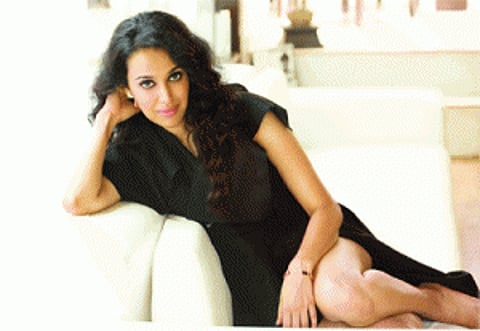

Swara Bhaskar’s roles have been substantially distanced from conventional overtones. ANANYA BORGOHAIN explores what has shaped her vision and discusses her professional evolution and personal moments of epiphany
Swara Bhaskar is assertive with clarity, contemplative with experience and analytical with methodical dedication towards the performative arts. Originally from Delhi and now based in Mumbai, she comes from a scholarly background, with both of her parents being academics. A postgraduate from Jawaharlal Nehru University in Delhi herself, Swara is a self-confessed film buff since her childhood, though she is not formally trained in the field. She came to notice as Payal in Tanu Weds Manu (2011) and was seen as the feisty Bindiya in last year’s Raanjhanaa, for which she recently won the Screen and Zee Cine awards in the Best Supporting Actress category. Excerpts:
What is your earliest memoryIJ
I hail from an upper middle class, academic family. My father is a retired naval officer and my mother is a professor of cinema studies in Jawaharlal Nehru University (JNU), Delhi. I perceive myself as the complete, typical Delhi girl. like the girl next-door in Delhi, I too have hopped on and off DTC buses and have hung out with friends in popular zones like Khan market. I was always privileged in my education and went to Sardar Patel Vidyalaya and later completed my graduation in English literature from the University of Delhi after which, I joined JNU for my post-graduation. I have always been a film buff and nurtured a hidden aspiration to be on the big screen. I was trained in Bharatnatyam by leela Samson and though I have never studied acting formally, I was actively involved in theatre and plays during my time in JNU. I have worked with the Indian People’s Theatre Association’s (IPTA), JNU chapter, and also in NK Sharma’s group theatre. The dream to be a film actress which I cultivated propelled me to budge towards Mumbai.
How has the culture shock in Mumbai been for youIJ
It was tremendous. The toughest challenge was learning how to wear heels. Everyone in Mumbai was good looking and I was a big jhalla from JNU. In the academia in Delhi, a kurta and a jhola is quite the ‘in thing’, which is in stark contrast to the ambience in Mumbai. I remember when I had gone for my audition, I was asked why I was wearing a bed-cover! My struggle was primarily on the grooming I had to undergo to assimilate myself in Mumbai’s social milieu. Given my background, it was a strange kind of an unlearning process. I did not change myself completely but was willing to accommodate and the transition gradually happened.
let’s talk about your experience at the relief camp in Gujarat in 2002 right after the Godhra violence.
I was still in school when the post-Godhra Gujarat violence took place. Though I was a child, I was old enough to understand and be horrified by how sinister we could be. Unlike natural disasters, it was a man-made catastrophe that shook the nation’s conscience. For instance, when you look at the photo of a petrified man with folded hands and tears in his eyes (the photograph of Qutbuddin Ansari, which later became the face of the Gujarat violence), the feeling of dreadfulness is inescapable. I was very moved by what was happening back then and spent three weeks of my summer holidays there at the Qutab-e-Alam dargah, Ahmedabad, participating in the Aman Ekta Manch. In whatever way we could, we counselled the women and children, and taught a little Hindi to them. It was a huge learning experience, to be able to reach out to so many people in need and contribute to their efforts to hold themselves up.
Did that memory help you shape the actor in youIJ
In a magnificent way. It has created a reservoir of experience and emotional depth within me. I access the emotions and convert them into a performance. It certainly invokes a strong conscience in me. I don’t believe in being neutral. Art is a powerful medium and a lot of productivity could be channelised through it, which is why I have learned that taking a stand and making efforts are very crucial.
How do you prepare for your rolesIJ
My biggest insecurity was that I was not trained in acting formally. Which is why I leave no stone unturned whenever I can attain more knowledge and push it further. I would call myself a workshop junkie and have taken acting lessons lessons whenever I could. Since I am also from a literature background, every time I am handed over a script, I make copious notes, read between the lines and textually analyse its potential.
So the controversy surrounding how Raanjhanaa allegedly propagated misogyny and the real-life incident of a spurned lover attacking his classmate in JNU, soon after the film’s release, transferred you to a moment of self-doubtIJ
The JNU incident had left me completely shaken. It was my alma mater that they were talking about, and not to forget, the university was an integral part of the film too. I had taken classes in that very room, and I was familiar with all corners of it. When we learned what had happened, both Himanshu Sharma, the writer of Raanjhanaa, and Aanand Rai, the director, were extremely worried, apprehending if this was a parallel consequence of the film. We were all saddened and shocked by the incident. It was the worst form of misogyny wherein the woman does not have the right to differ and refuse. It was as bad as rape. But one should realise that in the film, Zoya is never threatened and scared of Kundan. Kundan is not viscious, one has to understand the complexity, context and the ground-reality here.
Is Mumbai culturally advanced and more secure for a girlIJ
Contrary to popular opinion, Mumbai, I feel, is as unsafe as Delhi is. In fact, I have been teased in Mumbai more than I have been bothered in Delhi. Women are vulnerable everywhere, it’s symptomatic of the world we live in today. Though it’s difficult, I think women should legally keep reporting crimes committed against them and never take attacks lying down. This should, in fact, be collectively experienced as a society.
Was it a conscious decision to play the role of a rape survivor in your very first filmIJ
Not really. The film was titled Niyati and was directed by Pravesh Bharadwaj. It dealt with marital rape and the role was not only tough but also full of clarity. Unfortunately, the film never saw the light of day.
What message do you have for the Indian woman todayIJ
I don’t know if I am qualified to advise Indian women but I just believe and lament that they are not genetically wired to raise their voices against injustice. Virtue and guilt are too inculcated in them and their deep- rooted emotional strength somehow helps them suffer silently, which is a drawback. They need to be strong and break free from rigid norms.