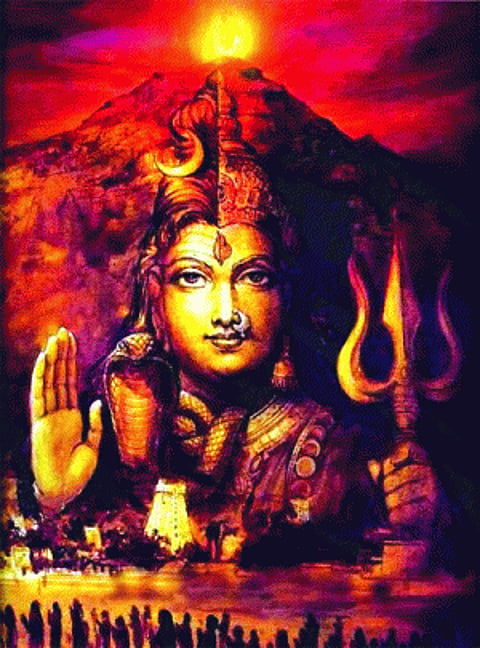

On Mahashivratri, nature pushes us towards our spiritual peak, writes Ridhi Bahl
Mahashivratri, dedicated to lord Shiva, is celebrated on the moonless night of the month of Phalgun, which is the 14th day in the Krishnapaksh or dark half. Owing to a special planetary conjunction, spiritual practices done on this day are considered especially auspicious and beneficial. On this night, the northern hemisphere of the planet is positioned in such a way that there is a natural upsurge of energy in a human being. This is a day when nature is pushing one towards one’s spiritual peak. In our tradition, we establish a certain festival which is night-long. One of the fundamentals of this night-long festival is to allow this natural upsurge of energies to find their way — you remain with your spine vertical, you stay awake.
Mahashivratri is significant for people who are on the spiritual path as it is for those in family situations, and the ambitious ones in the world. People who live in family situations observe Mahashivratri as Shiva’s wedding anniversary. Those with worldly ambitions see it as the day Shiva conquered all his enemies. But for ascetics, it is the day Shiva became one with Mount Kailash; he became like a mountain — absolutely still. In the yogic tradition, Shiva is not worshipped as a God but considered the Adi Guru, the first guru from whom knowledge originated. After many millennia in meditation, one day he became absolutely still. That day is Mahashivratri. All movement in him stopped and he became utterly still, so ascetics see Mahashivratri as the night of stillness.
Why this day and night are held in such importance in the yogic tradition is because of the possibilities it presents to a spiritual seeker. Shivratri is the darkest day of the month. Celebrating Shivratri on a monthly basis, and the particular day, Mahashivratri, almost seems like a celebration of darkness. Any logical mind would resist darkness and naturally opt for light. But the word ‘Shiva’ literally means ‘that which is not’; it also means if you open your eyes and look around, if your vision is for small things, you will see lots of creation. If your vision is really looking for big things, you will see the biggest presence in vast emptiness. A few spots which we call galaxies are generally much noticed, but the vast emptiness that holds them does not come to everybody’s notice. This vastness, this unbounded emptiness is what is referred to as ‘Shiva’. Today, modern science also proves that everything comes from nothing and goes back to nothing. It is in this context that Shiva, the vast emptiness or nothingness, is referred to as the great lord or Mahadev.
A popular story from thePuranas goes like this: There was once a poor hunter from Varanasi by the name of Suswara. He lived with his wife and child in a small hut. Theirs was a hand-to-mouth existence. Suswara would go to the forest and hunt whatever came his way and thus fed his family. One day, he caught many small animals and birds, which he put in a sack. Encouraged by the catch, he wandered deeper into the forest in search of more. Soon darkness set in and he turned to go home; he was worried as the forest was infested with dangerous animals. He did not like the idea of spending the night there. Soon it became very dark and unable to find his way back, Suswara climbed up a tree to be safe from wild animals. Attracted by his scent, animals came lurking under the tree. Hoping to scare them away, Suswara plucked some twigs from the tree and threw them at the animals but to no avail. Throughout the night, the animals kept prowling beneath the tree.
Suswara was unable to get a wink of sleep as he kept vigil throughout the night. He plucked leaves from the tree, which happened to be a Bilva tree and dropped them on the ground. Unknown to Suswara, there was a shivlingam at the foot of the tree and so, although he was unaware of it, by dropping the scared Bilva leaves, Suswara made a sacred offering to Shiva. That night happened to be Shivratri, so the hunter had kept a night-long vigil and worshipped lord Shiva.
According to Shiv Purana, Mahashivratri worship should incorporate six items — offering Bilva leaves to the deity after giving it ceremonial bath, which represents purification of the soul, applying vermilion paste on thelinga after bathing it which represents virtue, offering food which is conducive to longevity and the gratification of desires, lighting incense which yields wealth, lighting of oil lamp which signifies the attainment of knowledge, and offering betel leaves which marks satisfaction with worldly pleasures. These six items form an indispensable part of the Mahashivratri worship, be it a simple ceremony at home or grand temple worship.
The story above is an allegory. Just as the hunter sought to kill wild animals, the spiritual seeker tries to overcome lust, anger, greed, infatuation, jealously and hatred. The jungle is the mind where all these negativities roam about. A spiritual aspirant must kill these “animals” to be free. The name of the hunter was Suswara, which means “one of melodious voice”. This indicates purity of intent and speech, which in turn imply a level of mental purity.
Mahashivratri is an opportunity to experience the vast emptiness within every human being, which is the source of all creation and is thus complete in itself.
The writer is an astrologer and Vastu consultant