
- HOME
- INDIA
- WORLD
- BUSINESS
- STATES
- LAW & JUSTICE
- ENTERTAINMENT
- SPORTS
- VIEWPOINT
- LIFESTYLE
- TECH
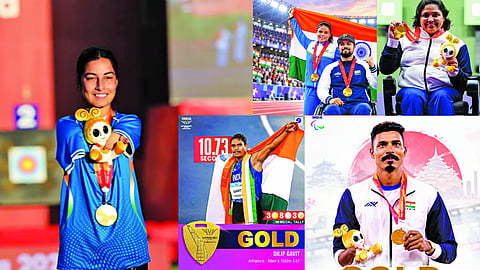
India’s performance at the 2026 Asian Para Games was not merely another successful sporting campaign. It was further evidence of how dramatically the landscape of para-sport in the country has changed over the past decade. India finished fourth in Aichi-Nagoya with its best-ever Asian Para Games performance, winning 114 medals, including 30 gold, 35 silver and 49 bronze. It bettered the tally of 108 medals and 27 golds from the previous edition in Hangzhou. What made the achievement even more remarkable was that India competed with only 168 athletes, compared with more than 300 at the previous edition.
Para-athletics remained backbone of India’s campaign, contributing 65 medals, including 22 golds. But there was encouraging depth elsewhere as well. Para-badminton contributed 16 medals, swimming 11, table tennis seven, archery six and shooting five. The improvement in swimming was particularly noteworthy, with India rising from just one medal in Hangzhou to 11 in Nagoya. The numbers, however, tell only part of the story. India’s rise in para-sport has been largely built around three interconnected factors: awareness, participation and support.
Para-sport is certainly not new to India. Murlikant Petkar won India’s first Paralympic gold medal in the 50m freestyle swimming event at Heidelberg in 1972, setting a world record in the process. It was the first time an Indian had won a gold medal in the Olympics or Paralympics. Petkar had been an accomplished boxer in the Army before suffering life-changing injuries during the 1965 India-Pakistan war. Swimming, initially taken up as part of his rehabilitation, eventually made him a Paralympic champion.
Yet Petkar’s success remained an isolated achievement for decades. India won four medals at the 1984 Paralympics but then endured a 20-year wait for its next Paralympic medal. This limited success unfortunately also affected the recognition that para-sport received in India.
The real transformation has taken place over approximately the last decade. At the Rio Paralympics in 2016, India sent only 19 athletes and won four medals. At Tokyo 2020, participation increased dramatically to 54 athletes and India won 19 medals. By Paris 2024, India was represented by 84 athletes and returned with a record 29 medals. In the space of just eight years, therefore, India’s Paralympic contingent grew more than fourfold while its medal tally increased more than sevenfold.
The Asian Para Games tell a similar story. India won only 14 medals at the inaugural edition in 2010 and 33 in 2014. The breakthrough came in Jakarta in 2018, when India won 72 medals, including 15 golds. Hangzhou represented another major jump before Nagoya established a new benchmark. What has changed is not simply the number of medals but the place para-athletes occupy within Indian sport. Government support, initiatives such as the Khelo India Para Games and private companies taking para-athletes into their support systems have created far greater opportunities than existed in previous generations. Sustained positive results, and the stories of the athletes behind them, have also kept para-sport in the public consciousness.
With the Paralympics and Asian Para Games following the Olympics and Asian Games at the same host destinations, para-sport is also increasingly becoming part of the larger sporting conversation rather than being viewed in isolation. There are, of course, important distinctions in the events and their classifications. A single discipline, for example, can have multiple events based on the nature and extent of an athlete’s disability.
Today, India’s leading para-athletes are increasingly recognised simply as some of the country’s finest sportspersons. Sumit Antil is one such example. Once a wrestler before becoming a para-athlete following the loss of a leg in an accident, he has become the dominant figure in his javelin classification and won Paralympic gold at both Tokyo and Paris. Sheetal Devi, meanwhile, has become a global sporting personality through the extraordinary technique with which she competes in archery without arms, along with the huge success she has enjoyed at the world and Asian levels.
There will inevitably be an inspirational dimension attached to para-sport because of the challenges many athletes have overcome merely to reach the competitive arena. But it would be unfair to view them simply through that prism. There is an enormous degree of sporting prowess required to win 114 medals at an Asian Para Games and to consistently produce gold medallists, world-record holders and international champions.
The next challenge is to ensure that this momentum continues. The transformation of Indian para-sport over the past decade has already been remarkable. The 114 medals in Nagoya suggest that what was once considered exceptional is gradually becoming an expectation.
The author is a sports management consultant with over a decade of experience in sports promotion and development. His work across both the private and Government sectors gives him a well-rounded view of India’s sports ecosystem; Views presented are personal.