
Sport is spiralling in unforeseen directions, with new powers, and new constellations. Why should hockey be differentIJ Hockey’s world order has seen a gradual shift to the West, over thirty years. As in international relations, so also in sport, the presiding deities are loathe to invite newcomers to join their exalted ranks.
Thus, Australia, the Netherlands and Germany are the holy trinity of world hockey, with Spain, Britain and New Zealand the other major icons. India is nowhere near the top. But whenever India fails to achieve a target, the knives are out, as if some outrage has been committed by the team. Maybe, this is the frustrated response of a proud nation that internalized a colonial sport with notable success.
In discourses on Indian hockey we tend to spin memory and nostalgia into uncontrollable emotion and expectation. A recent example is India’s failure to qualify for the World Cup at the Hockey World league semifinals at Rotterdam.
From hockey writers in India and from former players we heard familiar cries of ineptitude, with the stirring of old debates about Indian versus foreign coaches, lack of a bench strength and so on. But gallingly for India, its plight goes unnoticed among the hockey fraternity abroad, because there is nothing novel about India not doing well.
The surprise comes only when India performs beyond expectations. When India qualified for the semifinals of the Champions Trophy at Melbourne in 2012, the International Hockey Federation’s website ran an article with the headline: “India Continues Cinderella Champions Trophy Run.”
But dreams evaporate when your reserves desert you at crunch moments. India’s slump is a fall into a mental black hole. After the 1975 World Cup this has been a consistent script. India’s best Olympics finish after the 1988 Seoul Olympics has been seventh.
Since the 1998 World Cup at Utrecht, India has performed no better than eighth in a World Cup. India has only one medal from the Champions Trophy, a bronze at Amstelveen in 1982. The fourth place finish in the 2012 Champions Trophy has been the only recent exception to India’s otherwise mediocre performance in the three major tournaments.
Even at the continental level, India last won the Asia Cup in 2007, and has not been in the medal round after that. Why should we expect India to suddenly become a medal hoper at the majorsIJ
Seen in this context, the criticism of the team’s performance at the Hockey World league semifinals at Rotterdam is unfair. Actually, 11th- ranked India did not fare so badly at Rotterdam. It played creditable draws against 6th-ranked New Zealand and 9th-ranked Spain, and it took a penalty shoot out to get a decision in Spain’s favour. The bad game India had was against fifteenth-ranked Ireland, escaping with a 4- 4 draw with a late goal. In India’s 0- 2 loss to the Netherlands, it was the brilliant Dutch goalkeeper, Jaap Stockman, who made the difference. Australia’s play is currently decidedly superior to India’s, and the 5- 1 score in Australia’s favour was an accurate reflection of the gap between the two teams.
Given current capabilities, India’s losses to the Netherlands and Australia at Rotterdam were not out of character. India has not beaten the Netherlands in a major tournament for a decade or longer. Australia has won 67 of the last 99 games it has played against India. In the 2010 World Cup India lost 2- 5 to Australia, and 0- 3 in the 2012 Champions Trophy.
Similarly, India lost 2-5 to Spain in the 2010 World Cup, and 1-5 to New Zealand in the 2012 Sultan Azlan Shah Cup. So, it was always going to be tough to finish among the top three teams at Rotterdam. For India to ascend the ranks, the process has to be gradual.
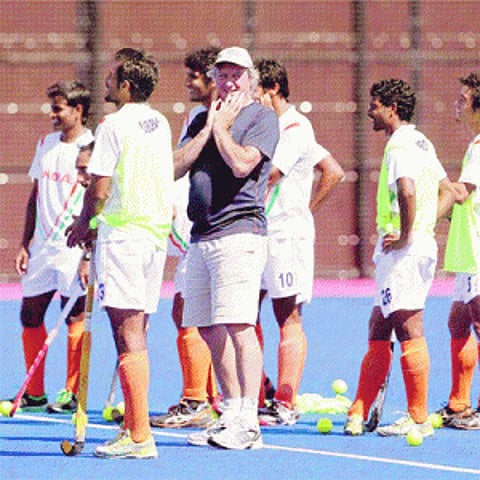
If India’s recent performances contain no surprises, there seems to be some improvement. Michael Nobbs, who has now been replaced as the head coach of the men’s team, had consistently maintained that it would take five years for him to produce a world- class team. Nobbs had had only two years in the job.
The steady ascension of the Europeans to the summit of the sport took years of hard work and planning. Certainly, if the fitness of the Indian team has improved over the last few years, tactics will too, in due course, by playing better teams.
like Nobbs did, Hockey India’s High Performance Director Roelant Oltmans has been repeatedly emphasizing the need to play the top teams more often. For India, being a major second-tier team may have instilled a hallucinatory self- belief, but the time to begin a real ascent has arrived.
The writer is an Indian Foreign Service officer. These are his
personal views, not those of the Government of India