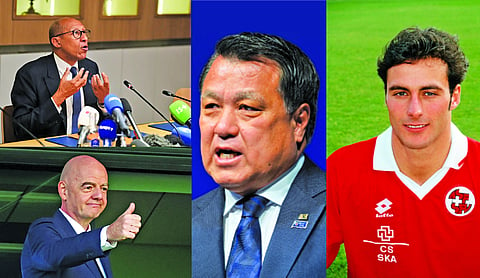

No sitting FIFA president has lost a re-election contest since 1974. Gianni Infantino has the weight of history on his side trying to extend his 11-year presidency of soccer’s governing body to 2031, with a deadline of midnight Wednesday in Zurich for challengers to enter the race.
Infantino was expected to run unopposed until a global backlash sparked in July by media reports of his secretive plan to sell stakes in the World Cup to private investors. The March 18 vote is now turning into a three-way contest between Infantino and challengers from France and Japan.
Who are the candidates? Gianni Infantino: The 56-year-old Swiss-Italian lawyer became FIFA’s president in 2016, replacing Sepp Blatter, who resigned after a corruption scandal. Under his leadership FIFA expanded the men’s World Cup from 32 to 48 teams, brought VAR video reviews to the tournament and increased development funding for member federations. He was cruising toward re-election for a third straight time until his now-scrapped FIFA Forward Enterprise Plan prompted dozens of national federations, mostly in Europe, to withdraw their support.
Kohzo Tashima: Turns 69 on Saturday, a former Japan international player who later coached youth national teams. At the Japan soccer federation he has been general secretary, president, now honorary president. Since 2015, Asian federations elected him as one of their representatives on FIFA’s ruling committee.
Philippe Diallo: The 63-year-old president of the French Football Federation since 2023. A veteran sports administrator, though recent arrival in international soccer politics. Elected in April 2023 to the executive committee of European soccer body UEFA. Until this crisis was seen as loyal to Infantino.
Ramon Vega: A 55-year-old former Switzerland and Tottenham player who has said he wants to be a candidate for the fourth straight FIFA election. Vega didn’t have the necessary endorsements to get on the ballot in his previous attempts, and it’s unclear whether he does this time. What’s at stake? At the core of the election is how FIFA governs the world of soccer at a time when commercial interests play an ever-growing role in the game. Infantino has been an increasingly executive boss pushing to create new, bigger and more lucrative FIFA competitions for national and club teams with little if any consultation. World Cups got bigger, more profitable - directing ever more money to FIFA voters - but a drive to play every two years instead of four failed.
Continental bodies like UEFA have seen Infantino’s expansionism as a threat to their events, like the Champions League and European Championship.
Soccer leaders in Asia, Europe and the North Americas were blindsided and furious by the FFE plan, which they called trust-breaking deception by Infantino. Under the plan, investors led by Joshua Kushner - the brother of President Donald Trump’s son-in-law Jared Kushner - would pay $4.2 billion for a 20%-plus stake in FFE. That would fund $20 million payments to each of the 211 members who effectively own FIFA.
The plan also reignited unease at Infantino breaching FIFA’s statutory political neutrality by unilaterally aligning with Trump: giving him FIFA’s Peace Prize, leasing an office in Trump Tower in Manhattan and not enforcing a mandatory red-card ban for U.S. forward Folarin Balogun in an unprecedented World Cup controversy. Infantino, who has apologized for how the FFE plan was presented, still has widespread support among federations outside Europe including Latin America and Africa who have benefited from more development money from FIFA. He has promised to use FIFA reserves to significantly increase the money national federations receive to $25 million between 2027-2030.
How does election process work? Candidates for FIFA presidency had to apply by midnight in Zurich on Wednesday with written support from at least five of 211 member federations.
They must also have had an “active role” in soccer - “as a player or an official within FIFA, a confederation or an association,” the FIFA Governance Regulations state - for two of the past five years.
Candidacies are put to a FIFA-appointed three-person election panel: Swiss accountant Bruno Chiomento, governance expert Chris Mihm of the U.S. and Jamaican sports official Molly Rhone.
The panel has until Feb. 18 to confirm which candidates passed eligibility and integrity checks to advance to a secret ballot on March 18 in Rabat, Morocco. The panel’s rulings can be appealed against at the Court of Arbitration for Sport in Lausanne, Switzerland.
The FIFA timetable could run alongside against expected attempts by newly empowered Democrats in the U.S. Congress to summon Infantino to a hearing.
Meanwhile, UEFA has asked U.S. courts to authorize evidence discovery for a possible criminal complaint against Infantino in Switzerland.
FIFA has accused UEFA of a “smear campaign.”
How many votes are needed to win? Infantino needs support from 106 of the 211 members to win re-election. An AP tally shows he currently has 105, based on announcements by member federations in recent months. More than 50 federations have not announced a position.
While 50 nations have declared opposition to Infantino, only a handful of have publicly endorsed one of the challengers, though that is likely to change in coming weeks.
In a three-candidate election, votes from two-thirds of the eligible members are needed to win in the first round.
In the second round, the candidate with the fewest votes is eliminated and then a simple majority will win.
It is set to be just the third time in the past 50 years an incumbent FIFA president had an opponent on the ballot paper.
In 2002 and 2015, Sepp Blatter won handily each time against a single opponent amid allegations of mismanagement fueling fury from much of Europe aimed at the Swiss head of a FIFA whose reputation was hit hard.